

Regulatory Compliance Reporting: A Practical Guide

It's Friday afternoon, and your security team has confirmed that customer data reached an unauthorized recipient. Legal wants to know which authorities must be notified, IT is still reconciling affected accounts, and the incident dashboard doesn't match the supplier's spreadsheet. You don't just need a report. You need figures that someone can defend.
That's the practical challenge of regulatory compliance reporting: proving that information is complete, accurate, and explainable, even when it comes from disconnected systems across jurisdictions. Faster submission helps only after your team can show where the information came from, how it changed, and who approved it.
Table of Contents
Which Reports Regulators Require and Why Data Must Be Structured - Match the obligation to the reporting entity - Structured data changes what reviewers can test
How to Build the Reporting Workflow Step by Step - Put accountability into the execution steps - Organize the quarterly cycle around decisions
Evidence Trails That Make Every Figure Traceable - Give events a common structure - Apply the reviewer's drill-down test
Setting Retention Periods and Avoiding Gaps - Build a defensible retention matrix - Size storage for actual evidence production
Using AI in Reporting Without Losing Control - Assign controls to the task - Test what can go wrong
A Worked Example and the Failures It Exposes - Follow the discrepancy through the records - Turn the failures into scheduled fixes
Metrics That Show Reporting Health - Translate pressure into operational measures - Give each metric a controlled definition
Confirm Your Reporting Readiness This Quarter - Use an evidence-based checklist - Decide what happens after a failure
Which Reports Regulators Require and Why Data Must Be Structured
The controller handling that breach must establish what happened, which reporting obligations apply, and when the relevant reporting clock began. Waiting for a perfectly complete investigation can be risky, but submitting an unsupported account creates a different problem. The response needs an accountable decision-maker, documented uncertainty, and a way to supplement information appropriately.
Compliance reporting is the recurring evidence an organization submits, maintains, or must be able to produce to demonstrate that it meets legal obligations. A filing is one output. Processing records, control assessments, incident decisions, and supporting evidence make that output defensible.
Match the obligation to the reporting entity
The following table is an orientation tool, not a substitute for checking the applicable rule. Scope, exemptions, filing status, and the facts of an incident can change the precise requirement.
Main reporting regimes, scope and timing
Regime | Who reports | What the report covers | Typical timing |
|---|---|---|---|
SOX Section 404 | US public companies | Management assessment of internal control over financial reporting | Annually with the 10-K |
SEC periodic filings | US public companies | Financial statements and risk disclosures, tagged in XBRL | Quarterly and annual |
GDPR Articles 30 and 33 | Controllers and processors in the EU and EEA, with different responsibilities | Records of processing activities; personal data breach notice to the supervisory authority | Controller breach notice within 72 hours of awareness, where notification is required |
Suspicious activity reports | Banks and regulated financial firms in the US | Details of suspicious transactions and the parties involved | Generally within 30 days of initial detection, subject to the applicable rule |
Don't treat controllers and processors as interchangeable. A processor's escalation to a controller and a controller's notification to a supervisory authority are distinct responsibilities. Likewise, an event can affect privacy reporting, financial disclosure, contractual notices, and sector-specific reporting without producing identical recipients or deadlines.
Build the inventory around legal entities and activities, not just countries. A group headquarters, local subsidiary, and regulated business unit may need different evidence from the same incident. A data classification framework helps identify which records contain customer information, financial data, or other regulated material before an incident forces the question.
Structured data changes what reviewers can test
The SEC established a voluntary financial-statement XBRL program in 2005, expanded it to mutual-fund risk-and-return summaries in 2007, and made covered XBRL reporting mandatory for operating companies and mutual funds in 2009, as described in its report on machine-readable corporate disclosure. The rules covered relevant information in registration statements, periodic reports, and current reports.
A paper ledger can be skimmed for plausibility. A structured database must reconcile row by row. Tagged information lets reviewers search, compare, and validate disclosures, so your team must manage definitions, tagging accuracy, and consistency with source systems.
Enforcement also illustrates why definitions matter: the CMS GDPR enforcement summary recorded 510 fines from March 2023 to March 2024, bringing the reported cumulative total since the regulation took effect in 2018 to 2,225, or 2,086 when counting only cases with complete information. The same summary reported approximately €4.5 billion in cumulative fines and an average near €2.1 million. Those are GDPR enforcement figures, not a tally of reporting failures alone.
Practical rule: Record the population, exclusions, and completeness criteria behind every total. A correct number with an unclear definition can still mislead.
For jurisdiction-specific notices, preserve the procedural context as well as the amount in dispute. Charter AI's Section 274 notice resource is a useful starting point for teams organizing an Indian income-tax penalty show-cause response, separate from their routine reporting calendar.
List every regime touching your business, then assign its owner, recipient, deadline rule, and supporting records.
How to Build the Reporting Workflow Step by Step
A reporting workflow should make responsibility visible before anyone starts drafting. It should also distinguish routine processing from decisions that require judgment, such as accepting an unexplained difference or correcting a previously submitted figure.
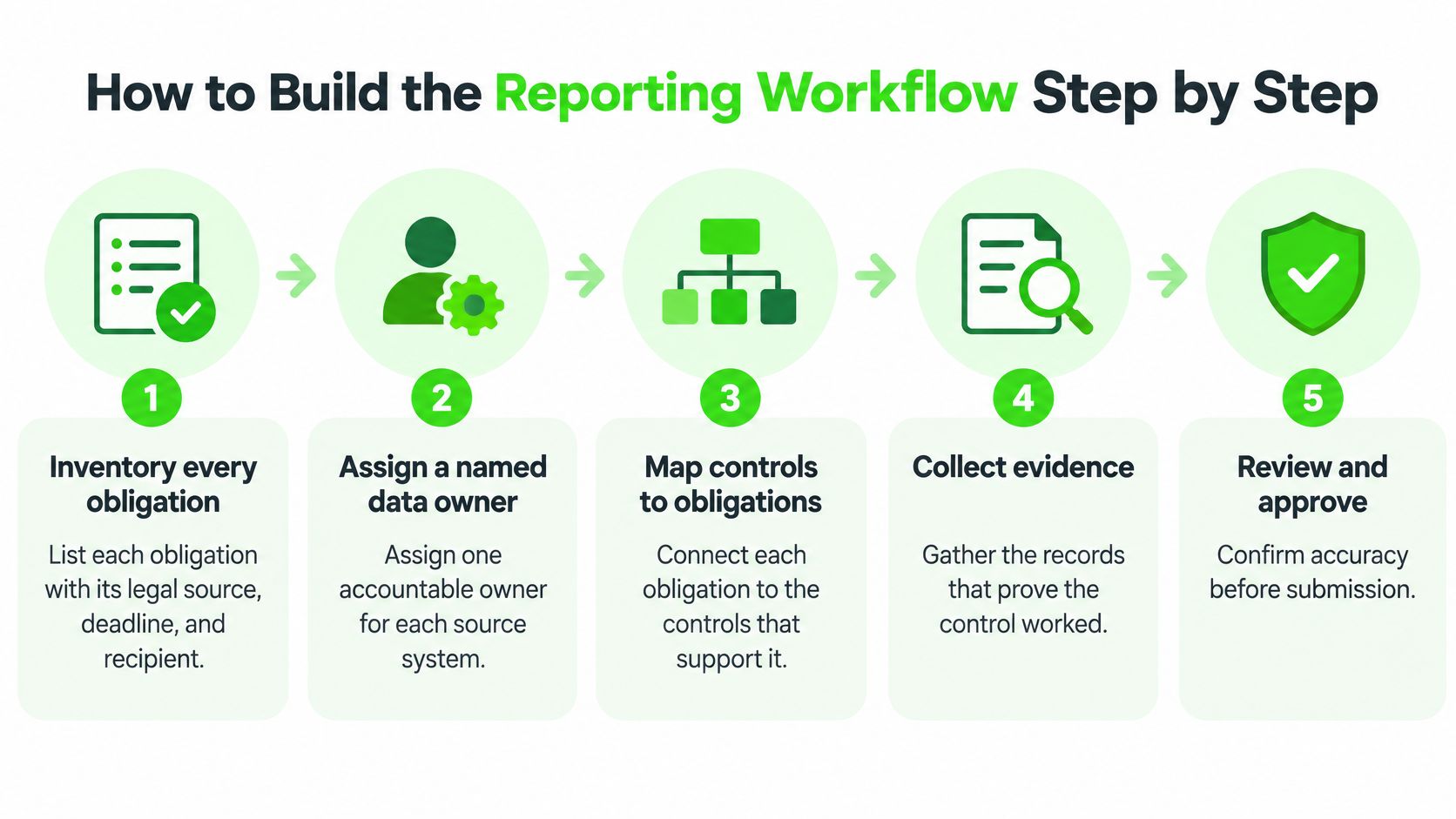
The process overview keeps the major responsibilities visible.
Put accountability into the execution steps
Inventory every obligation. Record the legal source, reporting entity, recipient, deadline rule, and accountable reporting owner. A list of laws without operational responsibilities won't tell anyone what to do when a deadline approaches.
Assign a named data owner for each source system. This person confirms the source's coverage, definitions, and known limitations. Don't substitute a department mailbox for someone who can resolve a disputed record.
Map obligations to supporting controls. Connect each required disclosure to the control that generates or checks its evidence, such as an access review or transaction reconciliation. The common mistake is mapping a policy document without verifying that anyone performs the control.
Collect source records and preserve the originals unchanged. Capture the extraction parameters, reporting period, source identifier, and collection status alongside the evidence. An exported spreadsheet without its selection criteria leaves reviewers unable to assess completeness.
Transform and reconcile the information. Log filtering, deduplication, currency conversion, aggregation, and other rules before comparing outputs with authoritative sources. Never fix a total by overwriting it without recording the original value and reason.
Record exceptions and late corrections. Give each issue an owner, impact assessment, disposition, and relationship to the affected report. A correction buried in an email thread can disappear when the preparer changes roles.
Obtain human sign-off from a named approver. The approver should see unresolved exceptions, material judgments, and evidence limitations, not just the finished narrative. Approval without access to those issues is an administrative gesture rather than a meaningful control.
Submit and archive the reporting package. Preserve the submitted version, source-query version, approval record, submission receipt, and relevant correspondence. Don't assume the current dashboard will reproduce what the organization filed.
Organize the quarterly cycle around decisions
At the start of a quarterly cycle, the compliance owner checks applicability and regulatory changes while system owners confirm extraction readiness. During the reporting period, teams collect evidence and address broken feeds rather than postponing those problems until close.
As the reporting cutoff approaches, analysts reconcile populations and escalate differences. Reviewers then assess exceptions, challenge judgments, and approve the reporting package before submission.
After submission, the reporting owner checks acceptance messages and records any required correction. Keep preparation, review, and correction effort separate in your time records so you can distinguish a slow approval process from poor upstream information.
For cross-border reporting, use a shared dictionary with explicit local mappings. If a subsidiary defines an incident differently from the group, retain both definitions and document the approved translation instead of forcing them into an apparently consistent total.
The workflow is complete only when another authorized person can repeat it without relying on the preparer's memory.
Evidence Trails That Make Every Figure Traceable
Keep raw evidence separate from derived metrics. Analysts need usable information, but usability shouldn't come at the cost of changing the records that establish what happened.
Evidence review is a joint task for compliance, engineering, and the business owner.

NIST SP 1318 describes audit-record controls supporting monitoring, investigation, reporting, and traceability to individual users, including report generation without altering original audit records. Use those principles to design an evidence pipeline appropriate to your organization's obligations.
Give events a common structure
Store original logs in a protected evidence layer. Create normalized copies for analytics, preserving a reference to the original object and documenting any parsing or enrichment.
A canonical schema makes it possible to connect identity-provider records, cloud-service activity, and infrastructure events. The example values below are illustrative, not production records.
Minimum fields in a canonical compliance event record
Field | Purpose | Example value |
|---|---|---|
Event time | Shows when a control acted, using synchronized time | Friday, close of business, UTC |
Asset identifier | Ties the event to a system, device, or service | customer-data-service |
Authenticated actor | Makes each action traceable to an identity | jdoe (SSO identity) |
Action | States what happened | role.granted |
Result | Shows success, failure, or denial | denied |
Source | Identifies the system that produced the log | identity provider |
Correlation ID | Links related events across systems | 8f3c-21a7 |
In production, event time should use a precise machine-readable timestamp with timezone information. Preserve both the source timestamp and ingestion timestamp when arrival delays could affect the interpretation.
Service accounts need explicit treatment too. An authenticated technical identity identifies the executing account, but you may also need the initiating user, approving person, or scheduled-job owner to establish accountability.
Apply the reviewer's drill-down test
Start with a dashboard assertion, such as completion of privileged-access reviews. Can the reviewer reach the included records, excluded records, query version, control mapping, and exception decision?
The denominator matters as much as the completed count. If a connector omitted a business unit, the dashboard might look healthy while describing an incomplete population.
Use this video as a discussion aid, then test the actual drill-down in your own reporting environment.
For a regulatory compliance audit, package transformation logic, execution timestamps, report versions, and exception approvals with the evidence references. Restrict access to sensitive records rather than distributing unrestricted log exports.
Writing support can improve readability, but it doesn't establish accuracy. Accounting teams considering editorial support for CPA firms from NewsletterAsAService should keep factual validation and approval with the responsible practitioner.
Every reported assertion should be reproducible from preserved evidence, not reconstructed from someone's recollection.
Setting Retention Periods and Avoiding Gaps
Retention is a control-design decision, not a storage toggle. A system can display an approved retention setting while failing to preserve the records your investigators need.
NIST SP 800-53 Revision 5 calls for audit-record retention over an organization-defined period consistent with policy and sufficient to support investigations and applicable retention requirements. It doesn't establish a universal period for every organization or record type.
Build a defensible retention matrix
Map each record class to its legal requirements, contractual obligations, investigation window, business purpose, and approved disposal method. Include the responsible owner and document how conflicts are resolved.
Start with these classes:
Authentication events: Preserve evidence of successful, failed, and suspicious access.
Administrator actions: Capture privileged changes and the identities responsible.
Configuration changes: Retain the settings and approvals needed to explain system behavior.
Vulnerability evidence: Keep assessment results, remediation decisions, and relevant verification.
Regulatory submissions: Preserve filed versions, supporting approvals, and acceptance records.
Set an explicit start event for each retention period. Creation, account closure, contract termination, and investigation completion aren't interchangeable triggers.
Legal and privacy teams should review conflicts between preservation duties, minimization requirements, and local restrictions. Don't assume that keeping everything indefinitely is safer, or that a group policy automatically overrides a local requirement.
Size storage for actual evidence production
Calculate capacity using event volume, average record size, replication factor, compression ratio, and retention duration. Include headroom for incident-driven logging and changes to application coverage.
Test the assumptions against actual ingestion. A logging system that stops accepting records when storage fills can create a gap even while archived records remain intact.
Protect archives with least-privilege access, secure transfer, tamper detection, and write-once or logically immutable storage where appropriate. Automated retention enforcement should respect approved preservation holds and produce evidence of disposal when the lifecycle ends.
A resource on meeting retention and e-discovery obligations from Vigil Security can help teams connect operational archiving decisions with retrieval and preservation needs. Keep those needs visible when selecting archive formats and access controls.
Run restoration tests against realistic requests. A retained file that can't be decrypted, parsed, or associated with its source won't provide useful evidence.
Report missing intervals, ingestion failures, retention exceptions, and deletion records, not merely the volume stored. A clean retention dashboard should mean that preservation was tested, not that nobody reported a problem.
Using AI in Reporting Without Losing Control
A report draws from a regional ledger, a cross-border feed, and a document repository. An AI tool may classify the documents correctly while missing a source, or draft a fluent explanation for figures no one has reconciled. Regulators expect the reported figures to be complete, accurate, and explainable. Automation can help with the work, but it cannot establish that the underlying evidence is complete or that an interpretation is correct.
The Grant Thornton survey release reports that 13% of organizations had broadly or fully deployed AI for regulatory compliance, while 40% used it for regulatory change monitoring. Respondents also cited siloed structures and data quality as barriers to integrated risk and compliance management, at 69% and 66%, respectively.
Assign controls to the task
Set controls according to what the AI does and the consequences of an error. Sensitive inputs, business impact, and access privileges can raise the risk of an otherwise routine task.
Risk tiers for AI tasks in regulatory reporting
AI task | Risk tier | Required control |
|---|---|---|
Document classification | Low | Sample-based human check; log the model version |
Retrieval of source regulations | Low | Reviewer confirms the cited text is current |
Reconciliation suggestions | Medium | Exception queue; an analyst approves each match |
Drafting narrative text for a filing | Medium to high | Subject-matter expert review and named sign-off |
Interpreting obligations or submitting automatically | High | Human decision, segregation of duties, no autonomous submission |
Human review should test whether sources are valid and decisions are justified, not merely whether the text reads well.

Keep prompts, approved source snapshots, model identifiers, outputs, and reviewer decisions under an appropriate access and retention policy. Limit prompts to the personal and confidential information needed for the task.
For workflow automation using AI, specify what happens when confidence is low, sources disagree, or evidence is missing. Send those cases to a named reviewer. A system should not fill gaps with a plausible-sounding answer.
Test what can go wrong
Compare citations with the source text and confirm that the cited requirement is in effect. Test cases involving superseded regulations, conflicting jurisdictional requirements, missing attachments, and invented citations.
If a model changes during an audit, preserve the details of the earlier execution and validate the replacement before using it. A report rerun with a different model is a new output, not the original evidence.
Automation can reduce manual handling, but its benefit depends on controls. Require provenance for source material, defined validation thresholds, and an audit trail that records each machine-assisted decision.
A Worked Example and the Failures It Exposes
Consider a hypothetical retailer whose supplier feed has double-counted returns for six weeks. The error affects a quarterly compliance figure used in a jurisdiction-specific submission.
An analyst notices that the reported returns total doesn't agree with the supplier's settlement statement. Instead of replacing the dashboard value, she freezes the affected output and records the discrepancy for review.
Follow the discrepancy through the records
The dashboard's calculation points to a normalized transaction table. The analyst isolates repeated return events and follows their evidence references to the original ingestion records.
Those records show that a duplicate ingestion job processed the same supplier batch. Matching source transaction identifiers and payloads establish the duplication; the shared correlation identifier helps connect the related processing activity but isn't sufficient proof by itself.
The technical team disables the duplicate job and creates a controlled replay in a staging environment. The reporting analyst recalculates the affected population while preserving both the incorrect output and the corrected result.
Legal and compliance then assess the consequences for the submitted report. They determine whether a correction or other communication is required under the applicable regime and document that decision, including any remaining uncertainty.
Correction discipline: Preserve what was reported, what changed, why it changed, and who authorized the response.
Turn the failures into scheduled fixes
Use the following as an illustrative remediation schedule, not a universal delivery commitment.
Missing feed owner, workflow step 2: Assign an accountable supplier-feed owner within a week, with authority to resolve source discrepancies.
Unlogged reconciliation, workflow step 5: Add a reconciliation-log entry requirement in the next reporting cycle, including original values, adjusted values, rationale, and approver.
Unrecorded late correction, workflow step 6: Approve an exception template before the next filing and attach it to any correction decision.
Assigning an owner and publishing a template are quick administrative fixes. Demonstrating that those changes work requires operating evidence: whether staff escalate discrepancies, reviewers challenge adjustments, and owners close issues.
For this scenario, plan a full quarter of observation before concluding that the reconciliation control is effective. That period lets the team examine repeated processing, period-end activity, and the next review rather than treating configuration changes as proof.
The cross-border complication appears when the group report and local submission use different return definitions. The analyst should calculate the effect under each approved mapping, not copy the corrected group figure into every local filing.
The useful outcome isn't just a repaired total. It's a documented decision about each affected report, supported by a repeatable correction process.
Metrics That Show Reporting Health
Submission status tells you whether a report went out. It doesn't tell you whether the team trusted the inputs, relied on undocumented adjustments, or learned about regulatory changes too late.
Use survey findings to understand reporting pressure, then measure your own process. The surveyed populations aren't performance targets for your organization.
Industry statistics on reporting pressure
Measure | Survey finding | Source |
|---|---|---|
Improving data quality | 71.6% of respondents rated it a high priority | |
Time spent on compliance among UK businesses | 8.0 days per month in 2024, up from 6.6 in 2022 | |
Keeping up with regulatory change | 44.1% of surveyed compliance professionals named it a major challenge |
Translate pressure into operational measures
Track the share of reported figures that pass reconciliation without manual adjustment. Define what counts as an adjustment so preparers can't improve the measure by reclassifying corrections as routine processing.
Measure staff days per filing cycle, separating collection, reconciliation, review, submission, and remediation. Include contributions from IT and legal, not just the reporting team.
For regulatory change, record elapsed time from an identified applicable change to an approved control mapping. Preserve the publication date, effective date, applicability decision, and implementation status so readers can distinguish monitoring delays from planned implementation.
Add an evidence measure: late corrections and exceptions per cycle, each with a logged reason. Review causes and severity alongside the count, because improved detection can initially increase recorded exceptions.
Give each metric a controlled definition
Use a standard metric record containing:
Definition: State the numerator, denominator, inclusions, and exclusions.
Owner: Name the person accountable for interpretation and follow-up.
Source query: Preserve the query identifier, version, and reporting cutoff.
Review date: Record when the owner validated the result and any limitations.
Set your baseline during the first complete cycle. Compare like-for-like reporting populations, and annotate changes in systems, reporting scope, or measurement methods.
A falling preparation time is useful only if accuracy and evidence coverage remain acceptable. Review the measures together rather than rewarding speed in isolation.
Confirm Your Reporting Readiness This Quarter
Run a readiness review against an actual reporting package, not a policy presentation. Record pass or fail, the evidence inspected, the reviewer, and the date for each check.
A pass means the team demonstrated the control. An assurance that someone could retrieve the evidence later isn't enough.
Use an evidence-based checklist
Confirm reporting coverage. Review SOX Section 404, SEC filings, GDPR, and suspicious activity reporting for applicability, then include other relevant local and sector requirements. Document why a regime is out of scope instead of omitting it.
Check source ownership. Verify that each contributing system has a named owner who understands its coverage and can resolve discrepancies. Test this by sending an actual data-quality question.
Trace a reported figure end to end. Select a dashboard value and inspect the raw records, query version, control mapping, and relevant exception decision. Record any point where the trail becomes ambiguous.
Inspect retention execution. Check the approved matrix against storage capacity, archive retrieval, preservation holds, and documented disposal. Ask for operational evidence rather than relying on configuration screenshots alone.
Review AI accountability. Confirm that each AI-assisted task has a risk tier, retained execution details, and a named human approver. Verify that the configured permissions match the approved task.
Decide what happens after a failure
If any item fails, prioritize the highest-risk obligation and log the remediation as an exception. The shortest deadline often deserves immediate attention, but potential harm, filing significance, and the ability to recover evidence also matter.
Give the fix an accountable owner and a completion condition that can be tested. Repeating a procedure or purchasing a tool isn't a completion condition unless the team can demonstrate the intended result.
Use the reporting-health metrics to establish the next cycle's baseline. Keep the readiness result with the reporting package so future reviewers can distinguish accepted limitations from unnoticed gaps.
Internal and external reviewers should apply the same evidence standard. Credentials can help you assess relevant expertise: our Shea R. has a BA and a CPA and served as a Senior Manager at PricewaterhouseCoopers in audit and assurance services. The review itself must still stand on documented findings.
Start the one-figure trace test this week. Choose a consequential figure, ask someone other than its preparer to reproduce it, and record the first point where that person needs an undocumented explanation.
Freeform Company offers compliance assessments, governance support, and bespoke AI integration services to help organizations connect reporting obligations with evidence and accountable controls. Visit Freeform Company to explore practical compliance and AI guidance, then use your one-figure trace findings to identify the reporting gaps your team needs to address.