

Why Is Data Privacy Important: Risks, Rights and Trust

The global average cost of a data breach fell 9% in 2025, according to IBM's Cost of a Data Breach executive summary. That sounds reassuring until you examine what organizations still pay, how much exposure comes from suppliers, and whether customers are willing to keep sharing their information. Privacy isn't a legal expense. It's a financial control over what an organization collects and a commercial signal about whether people should trust it.
For enterprise leaders asking why is data privacy important, the practical answer begins with decisions made before an incident: which information to collect, who may use it, and when to delete it. Those decisions determine both the value an organization can create and the harm it can cause.
Table of Contents
The Four Reasons Data Privacy Matters - Privacy and security answer different questions - The decision belongs before collection
How Privacy Failures Harm Individuals - Some information can't meaningfully be replaced - Loss of control is itself a problem
Privacy Laws Now Cover Most of the World - Rights require an operating model - Cross-border processing needs a purpose-by-purpose assessment
What Breaches Cost and How Sprawl Multiplies Them - Why unnecessary copies increase the work - Suppliers and people sit inside the risk boundary - Automation creates a control trade-off - Put the controls in an implementable order
Why Consent Alone Does Not Make Collection Fair - Permission isn't the same as meaningful choice - Design for limited permission
How Privacy Failures Show Up in Customer Revenue - Measure distrust where customers make decisions - Don't mistake correlation for attribution
Your Privacy Audit Starts With These Questions - Match expertise to the audit
The Four Reasons Data Privacy Matters
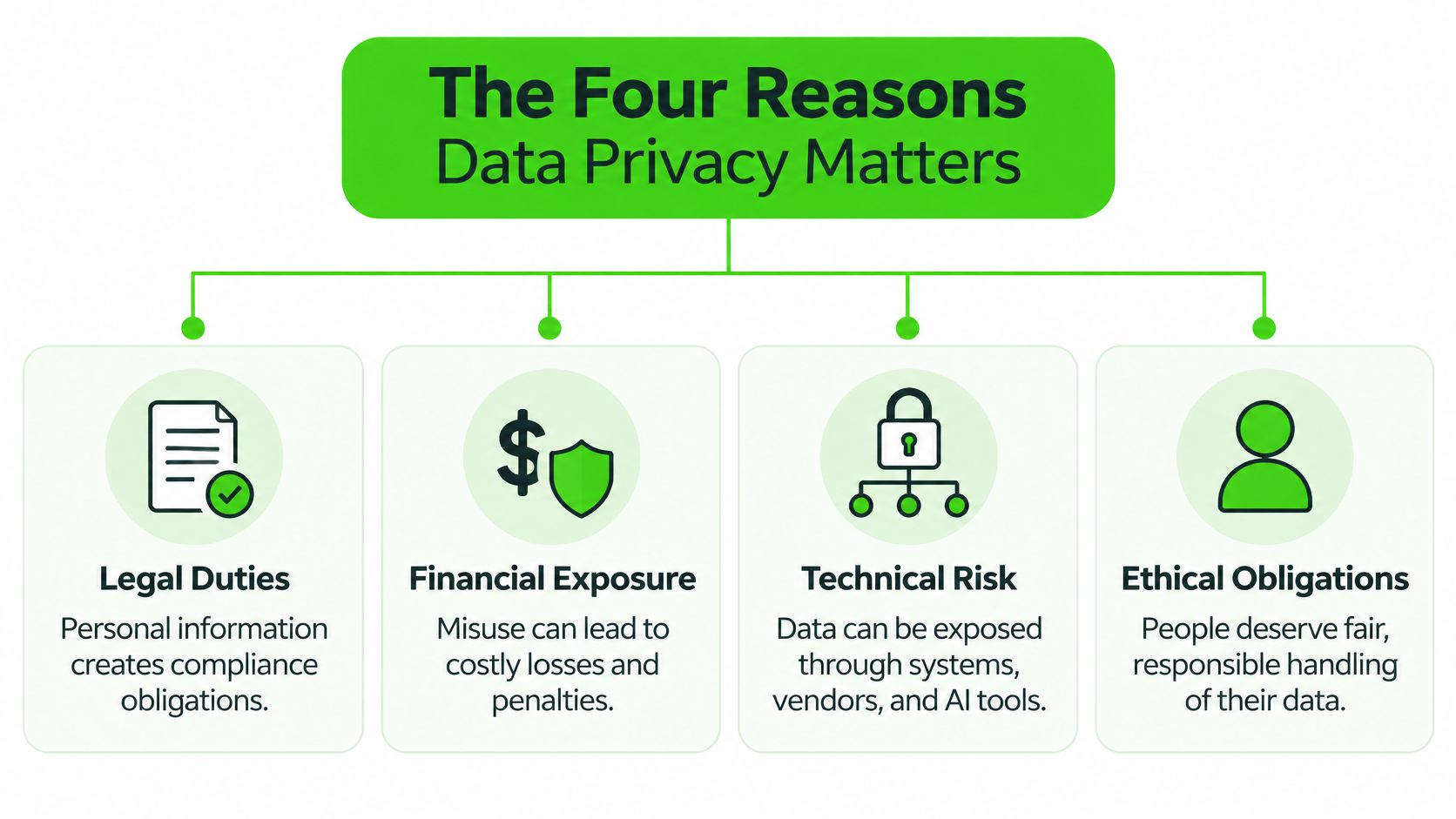
Data privacy matters because personal information carries legal duties, financial exposure, technical risk, and ethical obligations to the people it describes. Treating any one of these as the entire problem leaves the others unresolved.
A compliance team can approve a notice without checking whether engineers retain unnecessary copies. A security team can encrypt a database without questioning whether the organization should use its contents for a new purpose. Neither action, by itself, establishes responsible handling.
The four reasons data privacy matters
Reason | Who It Protects | What Goes Wrong Without It |
|---|---|---|
Legal | Regulators and data subjects | Enforceable rights breached and penalties imposed |
Financial | The organization and its shareholders | Breach costs, notification and remediation expenses |
Technical | Systems and the data they hold | Excessive collection and weak access widen exposure |
Ethical | Customers, employees and citizens | People lose control over how their information is used |
Privacy and security answer different questions
Security asks whether someone can access or alter information without authorization. Privacy also asks whether an authorized person should collect, combine, disclose, or retain it in the first place.
Consider a customer-support platform. Restricting access to authenticated employees addresses security. Preventing those employees from repurposing sensitive support conversations for unrelated profiling addresses privacy. You need both controls, but they solve different problems.
The diagram brings these responsibilities together.
The decision belongs before collection
The trade-off isn't privacy versus useful information. It's justified information versus speculative accumulation. A team may need transaction details to resolve disputes without needing unrestricted access to every customer's communications.
Assign an owner to that distinction. Legal counsel should assess the justification, engineers should enforce the boundary, and business leaders should accept responsibility for the processing purpose.
Decision test: If a dataset leaked tomorrow, could every affected person and regulator see a clear, lawful reason it existed?
An organization that can't answer that question has more than a documentation problem. It hasn't established why it should carry the exposure.
How Privacy Failures Harm Individuals
Say a retailer accidentally exposes a customer record containing a name, email address, and recent purchase. A criminal could use those details to send a convincing delivery message referring to the actual product. The customer doesn't need to lose a password in the original incident to face a credible attempt at impersonation or account theft.
The important distinction is between exposure and harm. Exposure makes information available. Harm depends on what someone can infer, combine, or do with it, including actions the original collector never intended.
Some information can't meaningfully be replaced
A customer can change a compromised password. They can't change their date of birth, and changing a phone number can disrupt work, healthcare communications, and account recovery.
Sensitive information also reveals more when combined. In a hypothetical fitness-app incident, route histories might identify where someone sleeps and works even if the exposed file contains no home-address field. Removing an obvious identifier doesn't necessarily remove the ability to identify a person.
For risk assessments, examine the consequences rather than merely counting fields:
Impersonation: Could someone use the record to make a believable request to a customer, employee, or help desk?
Sensitive inference: Could ordinary activity records reveal health concerns, financial distress, or a person's location?
Consequential decisions: Could inaccurate or improperly obtained information influence an offer, eligibility assessment, or employment decision?
Unwanted profiling: Could someone use the record to sort people into different prices or opportunities without their understanding?
Loss of control is itself a problem
Not every privacy failure begins with an attacker. An organization can harm people by using information outside the purpose they understood, even when its systems work exactly as designed.
Say an employee provides personal information to arrange a workplace accommodation. Reusing that information to evaluate promotion prospects would raise a very different issue from securing the original form.
Assess the person's ability to contest the use, not just the organization's ability to defend the database.
Practical remedies require operational capabilities. A correction request is ineffective if the organization changes the customer profile but leaves the inaccurate value in downstream systems. A withdrawal mechanism offers little control if nobody knows which vendors received the information.
Picture the person behind the account number. Their risk may continue long after an organization closes its incident ticket.
Privacy Laws Now Cover Most of the World
In 2020, the United Nations Conference on Trade and Development reported that 66% of countries had enacted data-protection and privacy legislation, an 11-percentage-point increase from 2015, while another 10% were preparing draft legislation. Its regional breakdown below shows why a global organization couldn't assume uniform adoption or uniform requirements.
Share of countries with privacy legislation, 2020
Region | Share of Countries With Privacy Laws |
|---|---|
Europe | 96% |
Americas | 69% |
Asia and Pacific | 57% |
Africa | 50% |
Global average | 66% |
Countries preparing draft legislation | 10% |
These are historical adoption figures, not a current inventory of every jurisdiction. They establish the broader point: privacy had already become a global governance responsibility, rather than an issue confined to a particular technology team or region.
Rights require an operating model
Privacy laws establish accountability for how organizations collect, use, store, share, and delete personal information. Depending on the applicable framework, organizations must operationalize rights such as access, correction, and deletion, while accounting for relevant conditions and exceptions.
That means connecting legal obligations to systems. A rights-request workflow needs identity verification, a reliable search across repositories, an accountable reviewer, and a method for recording completion. A policy page alone can't perform those tasks.
For teams managing a UK footprint, F1Group's resource on understanding GDPR compliance for UK businesses offers jurisdiction-specific context. A broader review of regulatory compliance requirements can help frame the organizational responsibilities that sit around individual legal rules.
Cross-border processing needs a purpose-by-purpose assessment
Consider a retailer planning a loyalty program for customers in Germany, Brazil, and Kenya. Before launch, its team should map applicable consent, international-transfer, retention, and deletion requirements rather than copying a notice from another market.
The difficulty isn't maintaining different documents. A shared customer platform may perform the same technical action for people whose information is subject to different obligations.
Identify the markets: Record where people are located and where the organization operates.
Trace the processing: Include hosting locations, support access, analytics providers, and onward transfers.
Resolve differences: Establish a common baseline where practical, then document jurisdiction-specific rules and exceptions.
A universal interface can conceal a fragmented legal situation. Standardize controls where possible, but don't assume that standardization makes every use lawful. Start by listing every market where you hold personal information and confirming which rules apply to each processing purpose.
What Breaches Cost and How Sprawl Multiplies Them
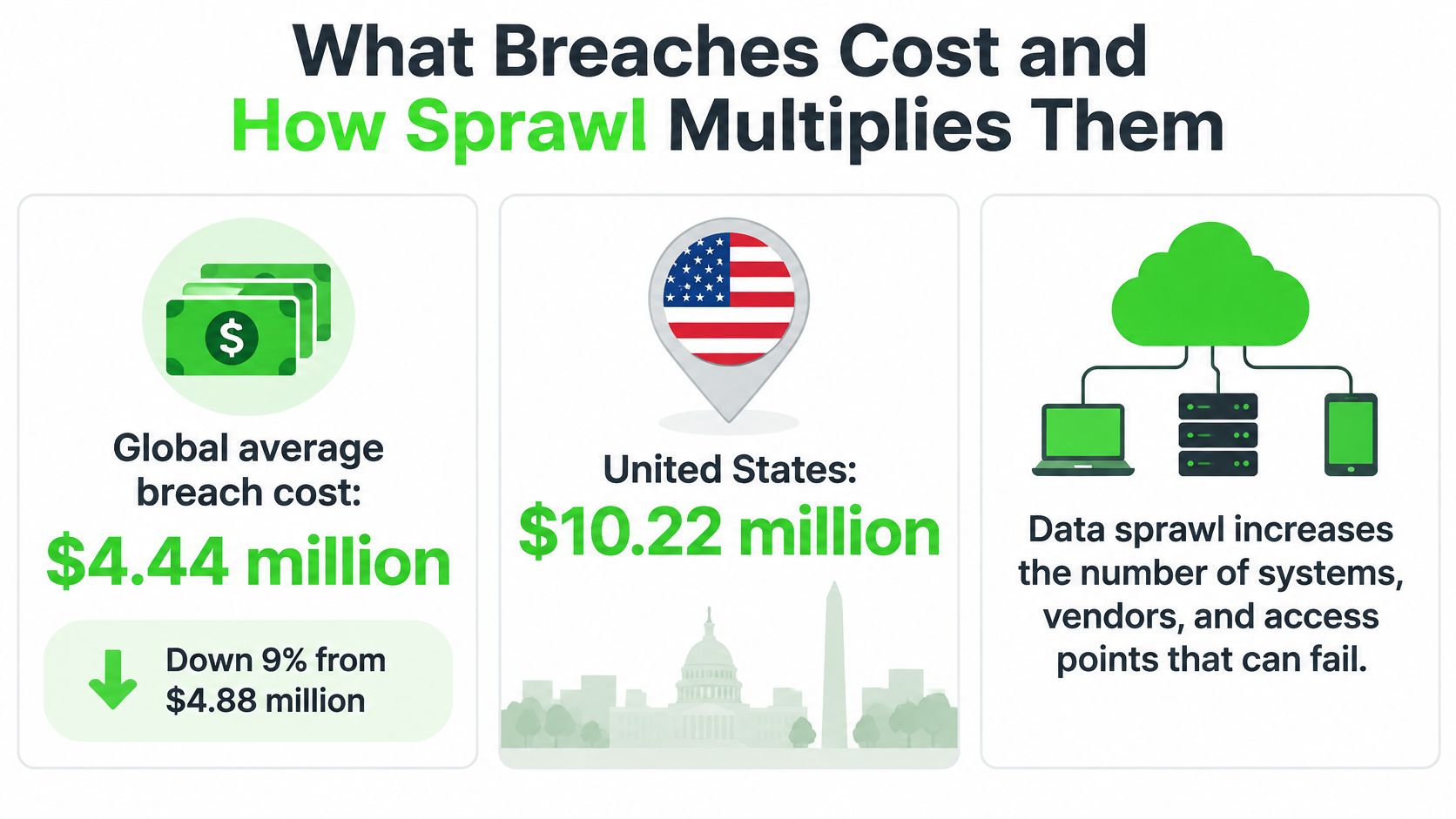
Breach costs are large enough to warrant financial-control discipline. IBM's 2025 Cost of a Data Breach study, covering 600 organizations breached between March 2024 and February 2025, reported a USD 4.44 million global average and a record USD 10.22 million U.S. average. The following comparison brings together its cost findings and the related IBM findings on containment, incident types, and shadow AI.
Breach cost drivers and averages
Factor | Average Cost |
|---|---|
Global average breach | USD 4.44 million |
United States average breach | USD 10.22 million |
Breach identified and contained in under 200 days | USD 3.87 million |
Breach taking over 200 days to contain | USD 5.01 million |
Third-party or supply-chain compromise | USD 4.91 million |
Malicious insider incident | USD 4.92 million |
Shadow AI involvement (added cost) | USD 200,321 |
These are observed averages, not a quotation for your next incident or proof that a particular control guarantees savings. The shadow AI figure is an additional cost, not a total breach cost. Likewise, containment-time comparisons describe the organizations studied, not an acceptable incident-response deadline.
The cost comparison illustrates why privacy decisions belong in operational risk reviews.
Why unnecessary copies increase the work
A breach investigation must establish what happened, which information was accessible, who was affected, and what remediation is necessary. Uncontrolled copies make each question harder to answer.
Suppose a customer export exists in a production database, a marketing workspace, a shared drive, and a developer's test environment. Investigators must examine the relevant locations and access paths rather than treating the production database as the complete record of exposure.
The resulting work can include forensic analysis, legal assessment, notifications, access resets, restoration, and regulatory engagement. More records don't automatically produce proportionately higher costs, but more locations and uncertain ownership expand investigative scope.
Retention therefore deserves the same attention as access control. Ciphar's discussion of how to limit data retention to reduce breach risks is useful when translating deletion policies into operational safeguards. Define a retention trigger, name the system owner, and test whether deletion reaches exports, replicas, and downstream services.
Keep necessary legal holds separate from routine retention. Otherwise, a legitimate exception can become an indefinite excuse to keep everything.
Suppliers and people sit inside the risk boundary
Verizon's 2025 Data Breach Investigations Report, analyzing more than 22,000 incidents and 12,000 breaches globally, found that third-party involvement doubled from 15% to 30%, while the human element remained involved in roughly 60% of breaches. Those findings undermine a perimeter-only approach.
A supplier may possess valid credentials. An employee may be authorized to export a file. Neither situation guarantees that the resulting use is appropriate or safe.
Vendor oversight should therefore examine actual access, not merely whether a supplier has signed a contract. Ask which data fields the vendor receives, which subprocessors participate, whether support staff can view raw records, and what happens when the relationship ends.
Specific restrictions are easier to enforce than broad assurances. At Freeform Company, we don't share mobile information with third parties or affiliates for marketing or promotional purposes. An operational review of that kind of restriction should check audience exports, integration settings, and affiliate workflows, not just published wording.
Automation creates a control trade-off
IBM also associated extensive AI and automation use with shorter identification and containment times and lower breach costs. That supports using automation for detection and triage, but it doesn't justify unrestricted AI access to enterprise information.
Approved security automation and unsanctioned AI tools perform different roles. A detection system can help analysts locate suspicious activity. An employee pasting a customer export into an unapproved assistant creates another processing destination that the organization may struggle to investigate.
The control objective is governed automation, not maximum automation. Restrict inputs, verify supplier terms, and make the resulting activity auditable.
Put the controls in an implementable order
Use the following sequence to turn customer data protection into enforceable boundaries:
Map every data flow and processor. Start with collection points, then trace application databases, warehouses, exports, support tools, and AI services. Record the purpose and owner of each transfer.
Write purpose and deletion limits into vendor contracts. Address permitted processing, subprocessors, incident cooperation, and termination. Confirm that the technical configuration matches the agreement.
Enforce least-privilege and conditional access. Separate administrative privileges from ordinary work. Review service accounts alongside human users, and remove access when roles change.
Encrypt data in transit and at rest. Protect encryption keys separately and restrict decryption privileges. Encryption can't compensate for an account that is legitimately allowed to retrieve excessive information.
Tokenize or pseudonymize model inputs. Replace direct identifiers where they aren't needed. Keep reidentification mappings separate, and don't describe pseudonymized records as anonymous.
Route AI use through approved gateways. Apply input restrictions, approved-model policies, and data-loss prevention checks before requests leave the environment.
Keep linked audit trails. Connect users, prompts, datasets, destinations, and outputs without unnecessarily duplicating sensitive content in logs. Restrict access to the audit records themselves.
The payoff is investigative clarity. Responders should be able to establish what was processed, by whom, for which purpose, and where it went without reconstructing the organization's architecture during an emergency.
Why Consent Alone Does Not Make Collection Fair
In a 2026 survey of 11,000 consumers across the United States, United Kingdom, Germany, Spain, Italy, the Netherlands, and Sweden, 52% trusted AI less than humans with personal data, while only 7% were fully comfortable granting access without conditions, according to the Usercentrics State of Digital Trust Report. The report also found that 16% granted AI access despite feeling uncomfortable. A recorded acceptance therefore isn't evidence that someone welcomed the underlying use.
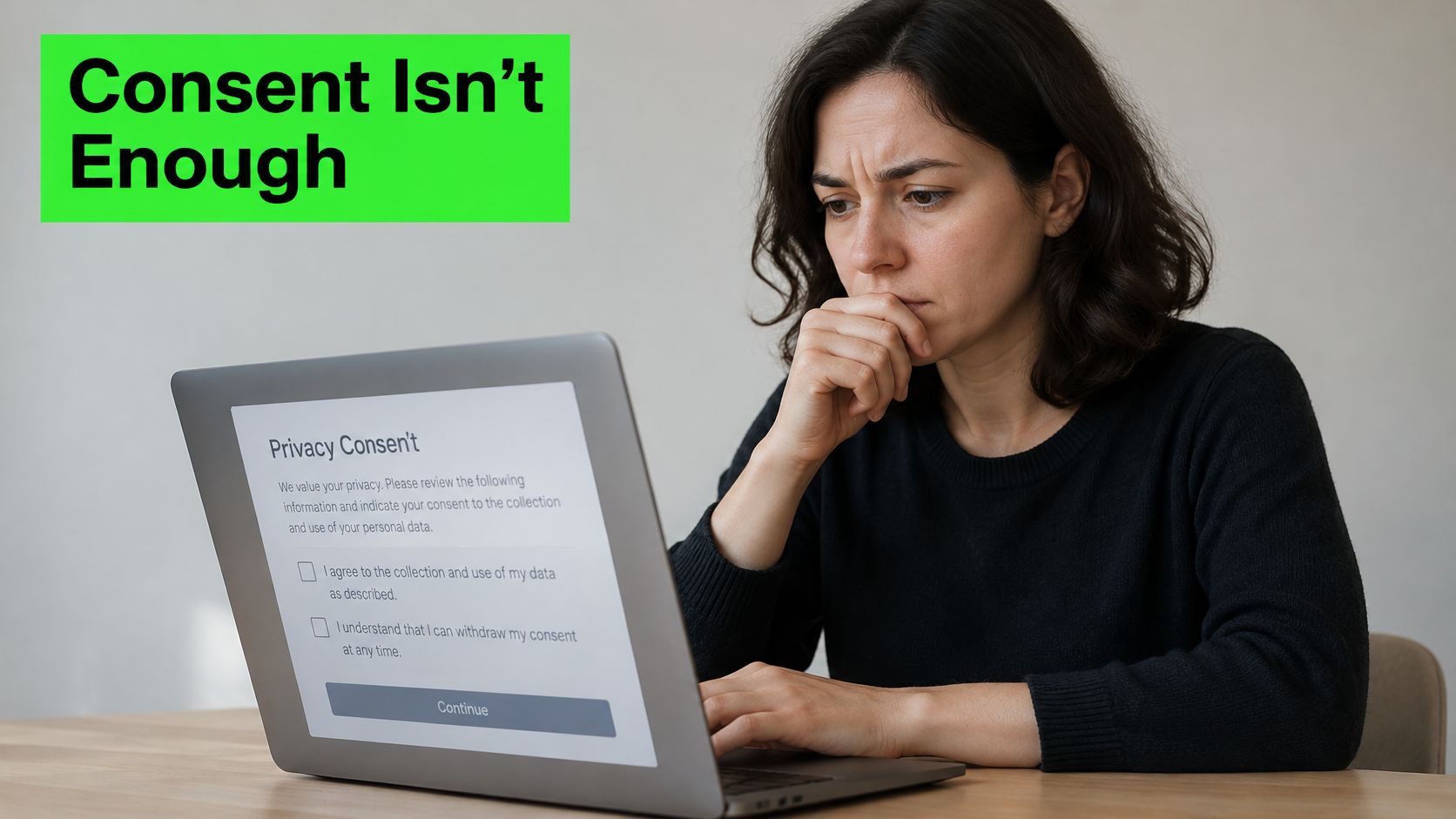
Consent interfaces put that distinction into everyday product decisions.
Permission isn't the same as meaningful choice
Say a productivity app requires access to an entire mailbox and calendar before any feature works. A person who needs the app may accept the request despite wanting only a narrow scheduling function.
That acceptance raises questions about necessity and fairness. It doesn't establish, by itself, whether consent meets the applicable legal standard. Legal validity requires a jurisdiction-specific assessment, while ethical design also requires examining the pressure built into the experience.
Test the interface against practical questions:
Understanding: Can the person explain what information will be used and why?
Refusal: Can they decline optional processing without losing unrelated functionality?
Withdrawal: Can they reverse the decision through an obvious control, with a clear explanation of what happens afterward?
A consent log records an action. It doesn't establish that the person understood the consequences or had a reasonable alternative.
Design for limited permission
Use plain-language explanations at the moment a feature requests access. Separate necessary processing from optional personalization, and request narrower permissions when the task permits them.
A scheduling feature should explain whether it needs availability, event details, or ongoing calendar access. Those aren't interchangeable permissions, and users shouldn't have to infer the difference from a lengthy policy.
The embedded video provides an additional format for considering privacy and consent.
Visible revocation matters as much as initial permission. Show users which connections remain active, make withdrawal easy to find, and explain any necessary limits on deletion or continued processing.
Better consent design may produce fewer permissions. That's not necessarily a failure. It can reveal which uses people value rather than which requests they tolerate to get through the interface.
How Privacy Failures Show Up in Customer Revenue
Privacy distrust can change purchasing behavior before a regulator takes action. In the 2026 seven-market Usercentrics survey, 47% of consumers said they had taken an action with a direct revenue consequence during the previous six months because of concerns about AI use of their data, including 24% who canceled a subscription, 20% who switched to a competitor, and 20% who reduced spending, according to the State of Digital Trust findings.
Those categories shouldn't be added together as separate populations. The findings describe consumer-reported behavior, not an audited estimate of revenue lost across all enterprises.
Measure distrust where customers make decisions
The commercial implication is narrower, and more useful, than claiming privacy always increases revenue. Customers may reject a feature when its perceived information cost exceeds its value. A relevant recommendation can be welcome; unexplained access to unrelated communications can make the same recommendation feel intrusive.
Treat privacy as a market-quality signal. Clear boundaries let customers judge the exchange, while opaque collection makes it harder to distinguish a useful service from an exploitative one.
Build a measurement plan around observable behavior:
Indicator | What to examine |
|---|---|
Consent withdrawal | Which permission or product change preceded withdrawal? |
Opt-outs | Are customers rejecting optional processing or abandoning the service entirely? |
Support complaints | Do customers understand the explanation of data use? |
Churn after disclosure changes | Did cancellations rise among customers who saw the change? |
Feature adoption | Do clearer, narrower permission requests affect activation and continued use? |
Don't mistake correlation for attribution
A customer can cancel for price, reliability, or privacy concerns simultaneously. Pair behavioral measures with cancellation reasons and support records, and compare similar customer groups before drawing conclusions.
Where practical, test clearer explanations and narrower collection rather than deliberately making another experience opaque. Track whether customers understand the purpose, not just whether they click accept.
The central trade-off is more information versus continued participation. A team may improve a model by collecting additional fields while discouraging people from using the product that supplies them.
That is a false efficiency if the organization counts data volume as progress but ignores lost adoption. Put customer retention and permission-related friction beside model-performance measures so leaders can evaluate the whole exchange.
Your Privacy Audit Starts With These Questions
A warehouse export, an AI-tool destination, and a vendor contract can describe three different versions of the same customer record. Until those versions match, the organization cannot show which personal data it holds or who may use it. Make the audit produce decisions, owners, and evidence this quarter. A completed questionnaire is not enough if nobody can demonstrate that the controls work.
Which personal data do we hold, and where? Reconcile your inventory against warehouse schemas, cloud storage, integration settings, and exports.
Which fields do we need? Require the business owner to identify the function each field supports.
Which vendors and AI tools receive it, under which terms? Compare contracts with configured destinations and actual usage.
Can customers see, change, and withdraw permissions easily? Test the journey with someone who didn't design it.
How quickly could we identify and contain an exposure? Run a tabletop exercise using a realistic supplier or AI-tool incident.
Who signs off on each new processing purpose? Name the approver and retain the decision.
Use this visual checklist to extend the review to internal access, retention, and disposal.
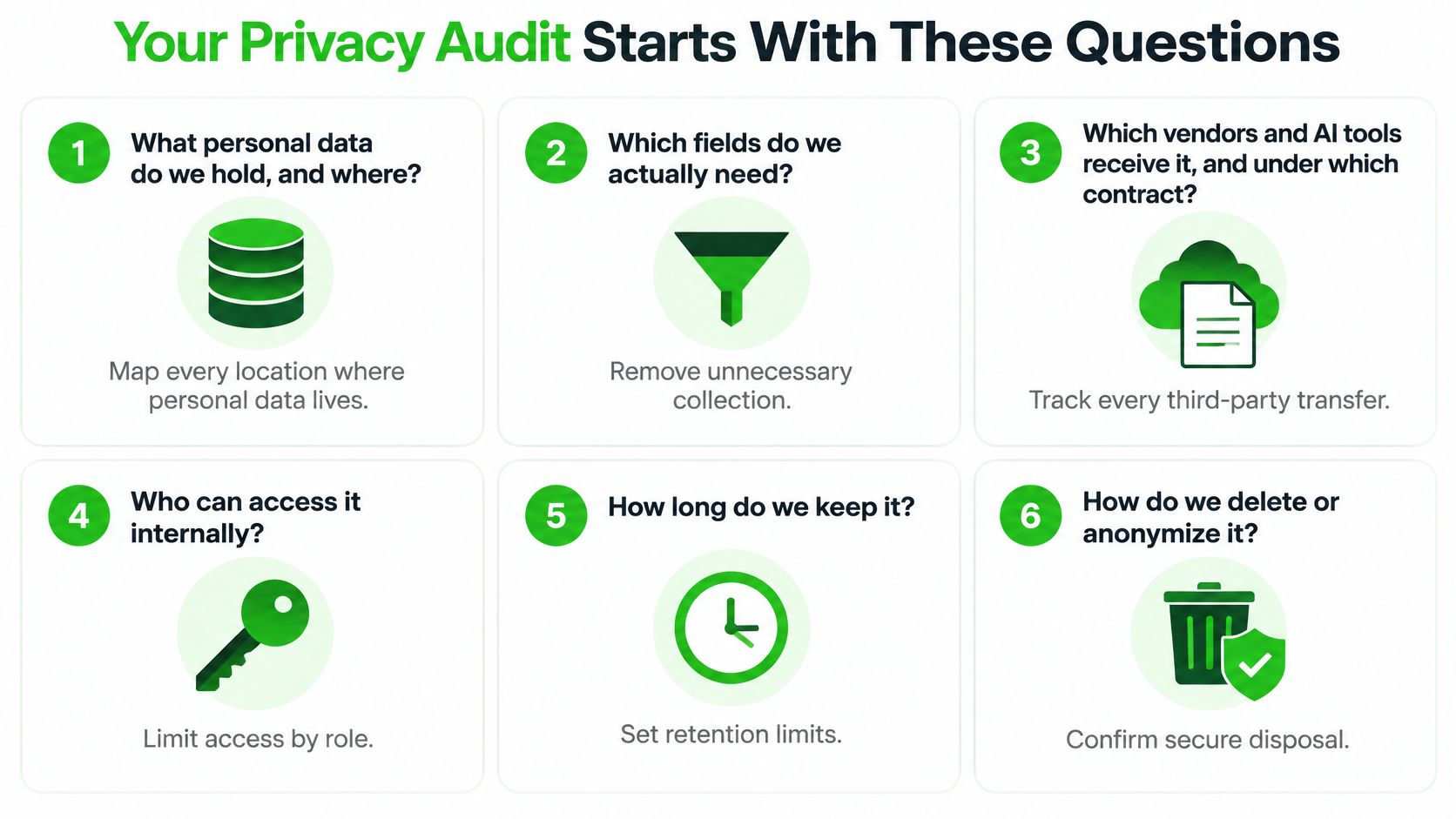
Treat access, retention, and disposal as part of the same control, not a later cleanup. A field with no named business function is a deletion candidate, not material for another integration. The trade-off is clear: a new AI workflow can ship faster if purpose, retention, and an approver wait until after launch, but that speed leaves an exposure window with no owner. Record the sign-off before the destination is switched on.
Time the containment question. In the tabletop, note who first sees the supplier or AI-tool incident, which systems must be searched, and what "contained" means in practice (stopped sharing, revoked access, or completed deletion). A vague "we would investigate" answer is not a control.
Match expertise to the audit
Freeform's data warehouse specialist Mounica R. has 10+ years of experience architecting and building data warehouses and is an AWS and Google Certified Professional Data. Credentials provide relevant context for schema and pipeline questions, but they do not replace evidence about a particular environment.
Use data privacy compliance tools to support inventories, consent records, and rights workflows. Require demonstrable outputs: a completed deletion test, a reviewed access report, and a documented processing decision. Owning the tool is not proof that those outputs exist.
Freeform Company offers compliance assessments and bespoke AI integration services to help organizations connect technology decisions with data-handling responsibilities. Visit Freeform Company to explore its privacy and governance resources, then bring your data-flow inventory and highest-risk processing questions to a discussion about your next assessment.