

Data Privacy Compliance Tools: 10 Platforms Compared

A consent banner clears marketing's next campaign, but access requests still go to whoever answers first. Customer records may also sit in databases the team has not inventoried. The result is a compliant-looking website and a request process that cannot reach all the data.
This roundup groups ten data privacy compliance tools by their role in the privacy stack: website consent, enterprise discovery, engineering-led request automation, or lightweight policy tools. Each entry covers what the product handles and where rollout can stall, so teams can match a tool to their data footprint before comparing prices.
GDPR enforcement underscores the cost of weak processes. The European Commission's account of GDPR enforcement says the regulation began applying across the European Economic Area on 25 May 2018. It describes enforcement and examples of penalties, but does not substantiate the specific fine counts and amounts often repeated alongside it. Those figures are not a sound basis for comparing tools. The practical takeaway is that organizations need workflows suited to their processing, transparency, marketing, and data-protection obligations.
Identity checks can also complicate request workflows. Before choosing a verification provider, confirm what evidence it collects, how it handles that information, and whether its process fits your organization's legal obligations. Avoid treating a vendor blog about data residency as regulator guidance. The list spans broad enterprise platforms through website-first products.
Table of Contents
1. OneTrust Privacy Automation
OneTrust is the platform you open when privacy operations, consent, assessments, and incidents have to sit in one system across many business units. It is built for large enterprises, not a two-person desk that only needs a banner.
The product surface is wide enough that buyers often underestimate the operating model.
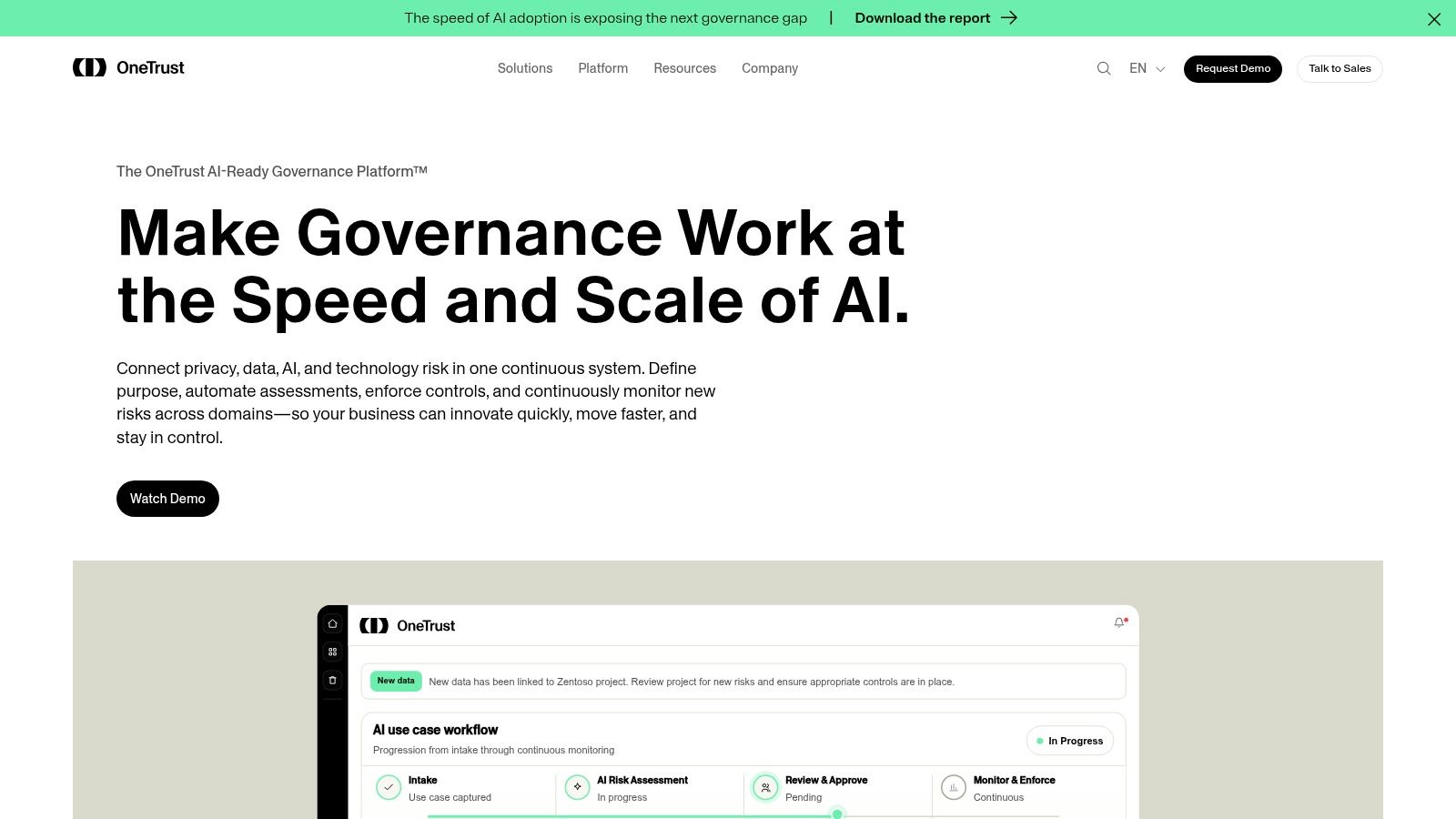
OneTrust pairs privacy workflows with separate AI-governance and broader risk-management capabilities. Public documentation covers APIs and request automation, which helps if tickets and identity already live elsewhere. A data protection management system still fails if nobody owns the inventory after the integrator leaves.
Data mapping: Processing-activity records instead of a stale spreadsheet.
Assessments: Privacy impact assessments and vendor privacy risk workflows.
Requests: Intake, verification, discovery, deletion, and redaction.
Notices and incidents: Consent management, privacy notices, and incident workflows.
Practical rule: Breadth isn't a rollout plan. Name the administrators and the privacy-asset inventory with sales before you treat custom pricing as a quote.
That scope can swamp a smaller team. Budget ongoing program owners, not only licenses.
2. TrustArc Privacy Management Platform
TrustArc fits mature teams that want software workflows and privacy-specific research in the same relationship, with optional assurance services when internal counsel is thin. It isn't a lightweight cookie add-on.
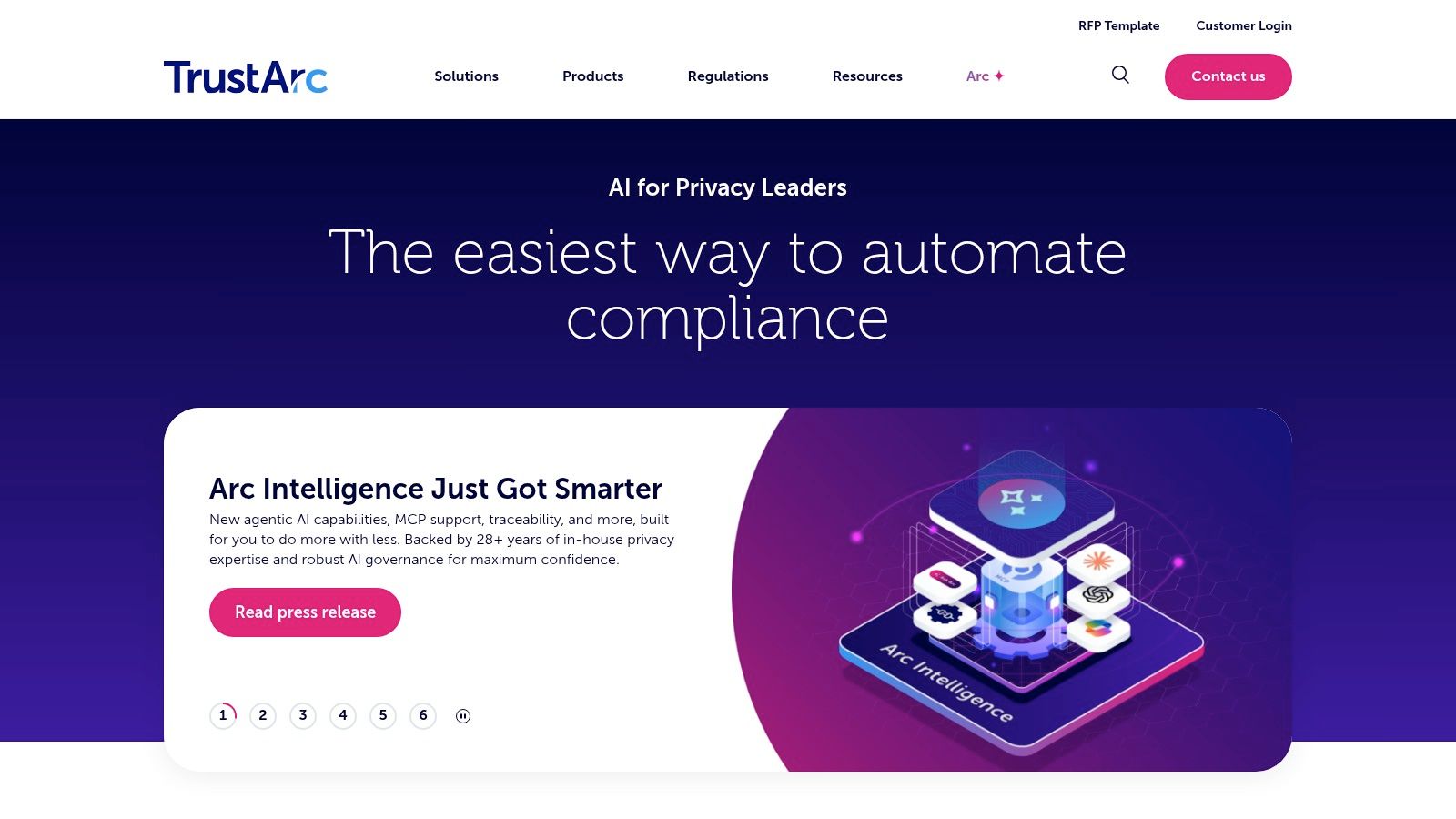
The TrustArc platform covers data mapping, compliance management, consent, assessments, and privacy-rights workflows. Its Data Mapping & Risk Manager is meant to hold a personal-data inventory and support processing records, risk scoring, and audit reporting. Automated and AI-assisted mapping feeds PrivacyCentral controls, evidence, tasks, and reporting. Regulatory research sits beside the software, which is useful when you operate in several jurisdictions and don't want a separate research retainer for every law change.
G2's TrustArc profile showed 4.2/5 from 345 reviews when checked. That volume is a signal of real use, not proof that every module in a proposal is turned on.
Pricing isn't public. Confirm which products, evidence exports, and integrations are included in the order. A services-heavy package can look complete in a demo and still leave your team maintaining the inventory by hand.
3. BigID Privacy Suite
If you can't say where sensitive data sits, a questionnaire-only privacy tool will flatter you. BigID starts from discovery and classification across cloud, SaaS, hybrid, and on-premises stores, then ties that picture to rights requests, assessments, and mapping.
BigID sells modular privacy bundles for data rights, preferences, and mapping, and it can link privacy work to data security, governance, and AI controls. That overlap is the point for teams that already argue about whether privacy or security owns classification. A clear data classification framework still has to be agreed before connectors start labeling production data.
G2's seller profile displayed a 4.8/5 aggregate rating, though individual product pages have smaller review samples. Don't treat the headline score as a verdict on every bundle.
Pricing and implementation depend on data sources, connectors, deployment, and services. Evaluation takes longer than with a single-purpose privacy tool because you're scoping a data platform, not a form. Pilot the hardest source first, usually unstructured stores or a legacy database with weak owners.
4. Securiti DataAI Command Platform
A rights request stalls when a team cannot find the person's data across cloud, SaaS, and hybrid systems. Securiti connects privacy workflows to sensitive-data discovery, security, governance, and AI oversight, making it a fit for organizations with a broad data footprint.
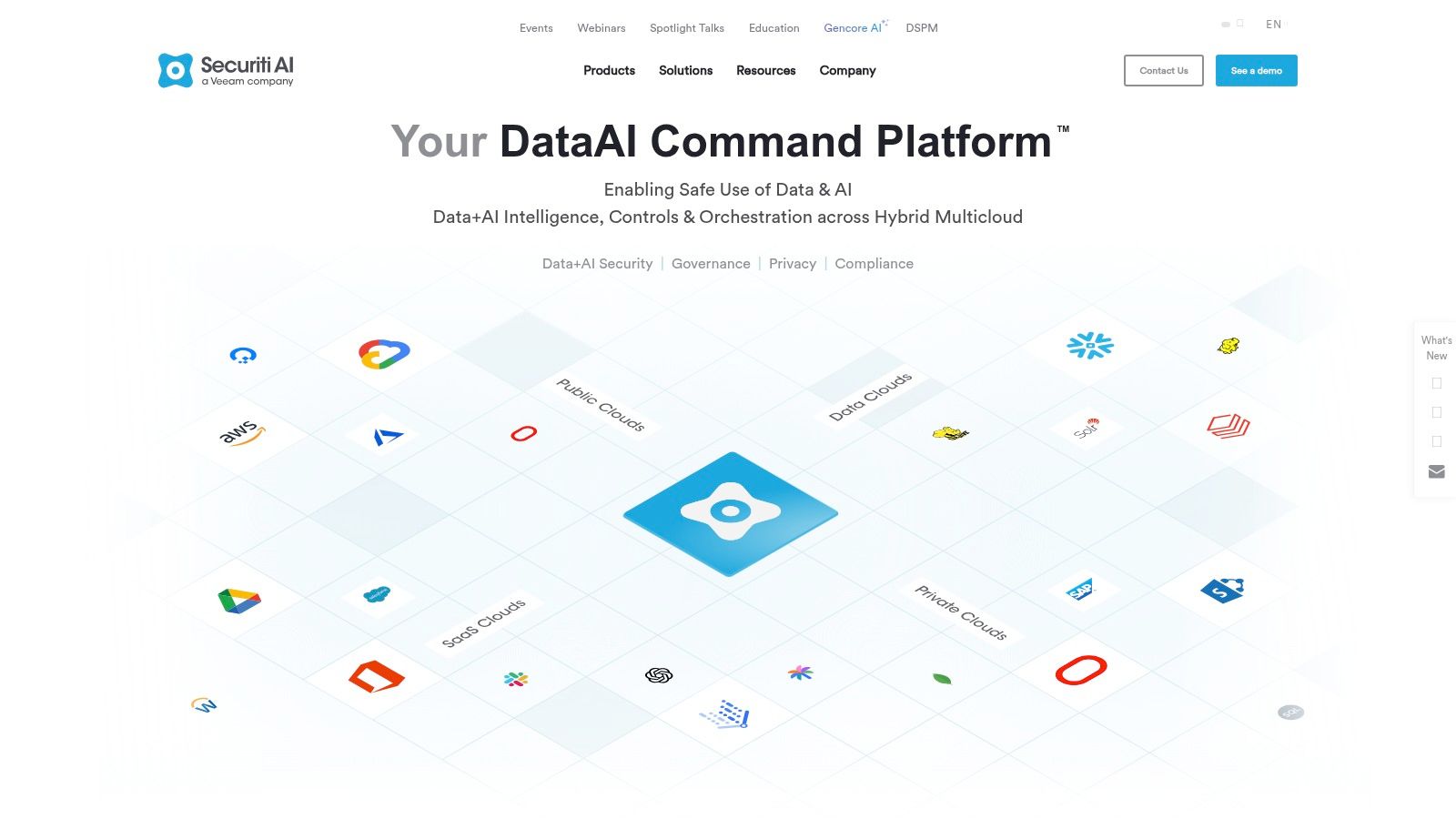
With Securiti, teams can intake rights requests, verify identities, route work through automated workflows, and keep audit records. That gives privacy leads a way to track requests from submission through fulfillment, while assessments, processing records, consent, and data-flow governance share the platform with security and AI-governance features. The vendor describes integrations across cloud and SaaS environments.
What stalls after the demo
The trade-off is operational breadth: teams need privacy, data, and security owners to configure workflows and maintain connections to their systems. Without that ownership, the platform's wide scope can leave staff unsure which inventory or process to trust. Before contracting, test a request against the systems that are hardest to search, and confirm who will maintain integrations and handle support. That pilot will show whether the platform fits your footprint better than a narrower privacy tool.
5. Osano Privacy Platform
Osano is the integrated option for teams that want consent, subject rights, mapping, assessments, and vendor risk from one vendor, including U.S. state privacy duties alongside broader global laws. It positions itself as approachable. Check whether that approach matches enterprise workflow depth.
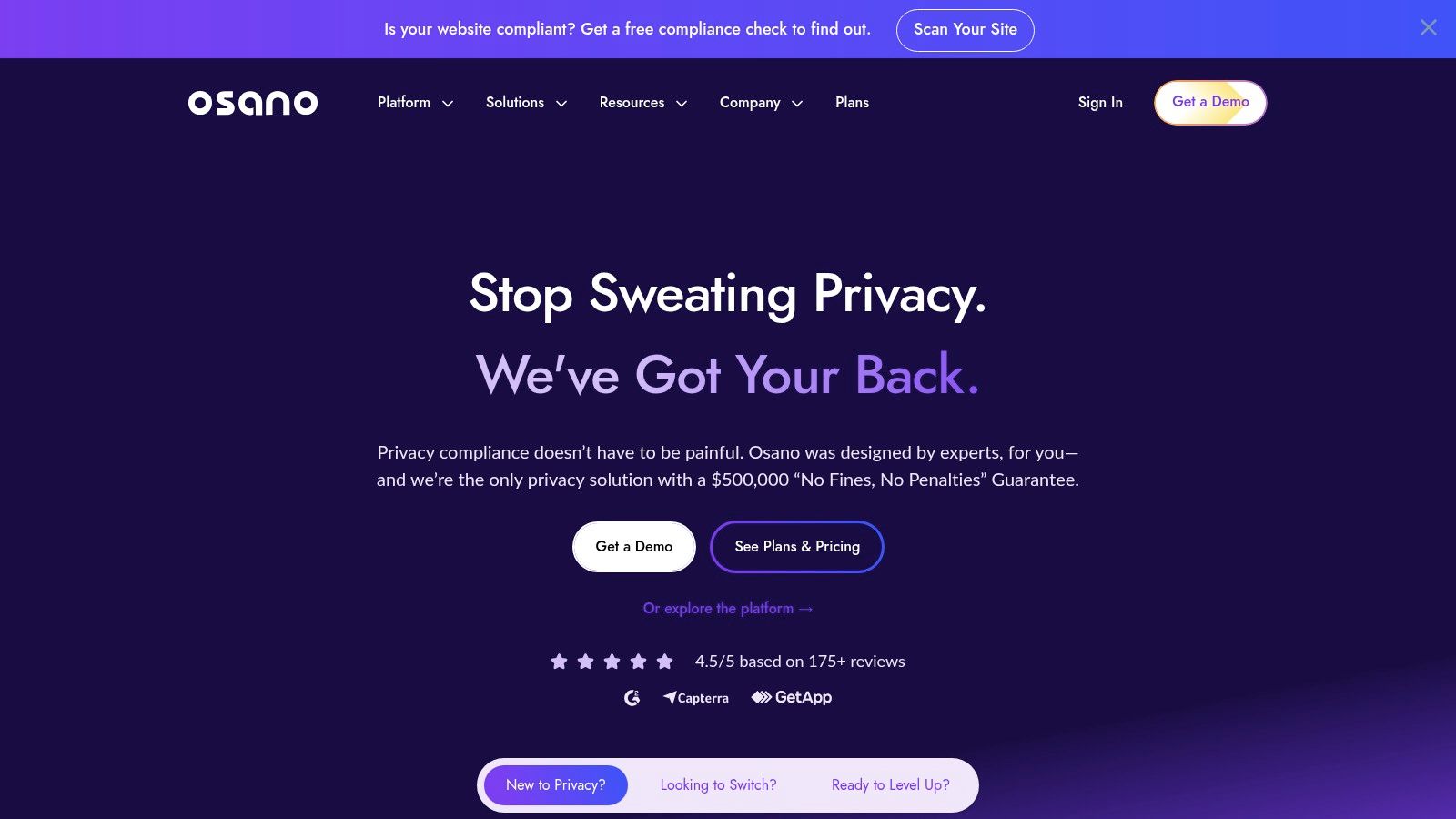
Osano includes cookie and consent management, request intake, data mapping, processing records, privacy and vendor assessments, and templates across jurisdictions. Some products are self-serve. Broader needs go through a demo. If your exposure is mostly domestic, map the workflows against data privacy laws in the US before you assume one global template covers state opt-outs.
G2's data privacy category listing showed 4.5/5 from 171 reviews when checked. Pricing varies by product and usage, so a full-program cost usually needs a sales conversation. If you also need wider GRC, ethics, or non-privacy compliance, you'll add another platform. That's a feature boundary, not a failure.
6. DataGrail Privacy Platform
DataGrail is for teams whose pain is the request queue and a system list that changes every month. The Live Data Map is designed to flag new systems and support processing records. Request workflows sit on a large integration network.
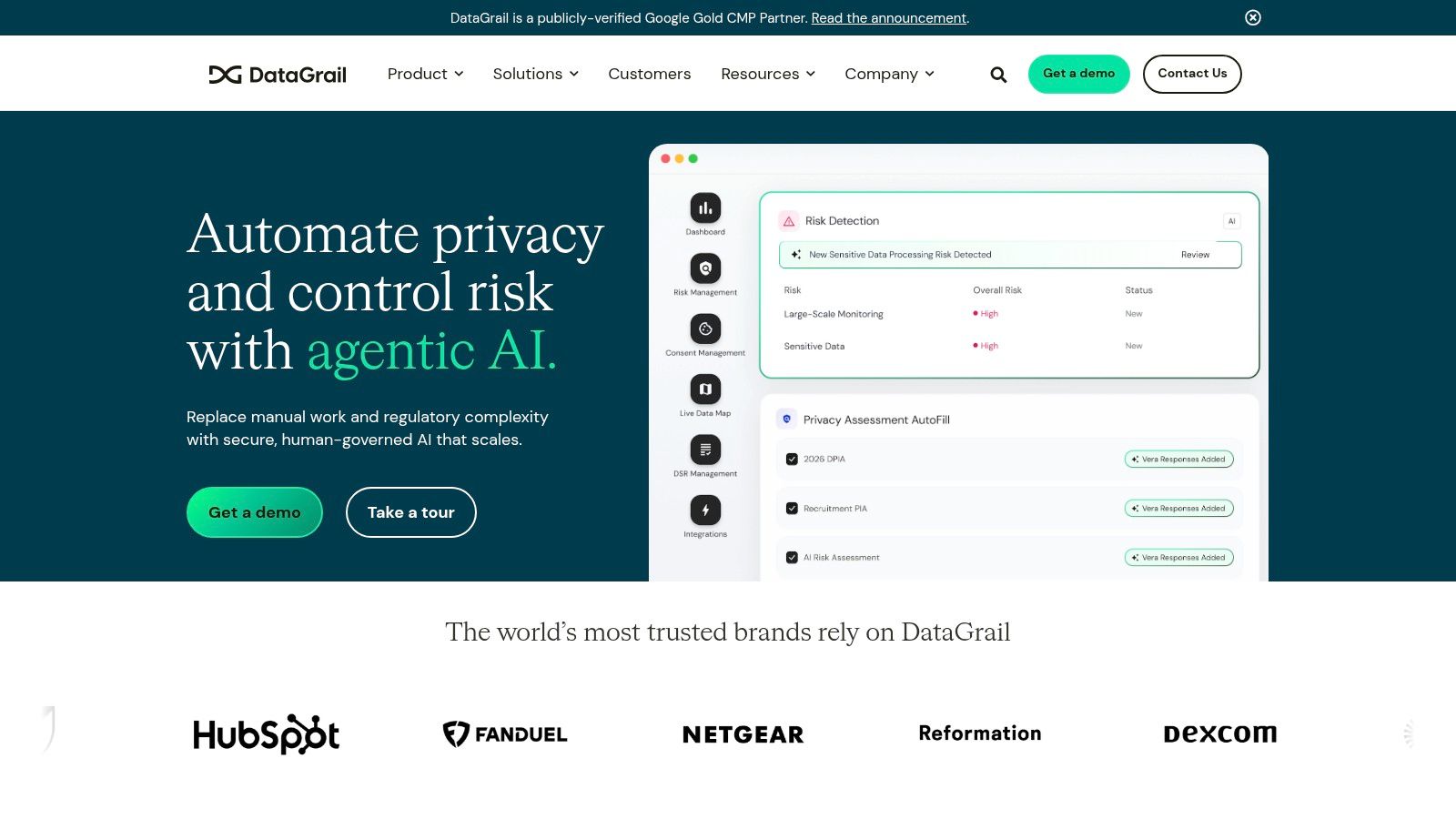
DataGrail handles intake, identity verification, and fulfillment, plus consent and tracker management, privacy impact assessments, and vendor risk. AI-assisted workflow features connect to internal and third-party systems. Documentation describes API-based integrations and manual actions where automation isn't available. G2 showed 4.7/5 from 207 reviews when checked, with reviewers noting usability and implementation support.
An integration that "supports deletion" can still stop at a ticket for a human. Verify the exact access and delete action on your top ten systems before you forecast cycle time.
Enterprise pricing isn't published. Implementation effort tracks the systems you connect, not the size of the connector catalog.
7. Transcend Privacy Platform
Transcend is the engineering-led choice. It connects inventory, consent, a privacy center, assessments, and request automation so you can locate, export, delete, or modify data in connected systems. Policy docs aren't the product. The connectors are.
Transcend offers data discovery and a live inventory, automated access, deletion, and opt-out workflows, and a configurable privacy center for requests and preferences. Connectors cover databases, SaaS tools, and unstructured stores. Vendor comparison materials praise automation and ease of use. Developers usually like that. Privacy counsel still has to define what "delete" means in each system.
Pricing isn't listed publicly. Reviews summarized by the vendor note that integration work can take longer than expected. Plan engineering time as a project, with owners for API changes and a fallback when a connector breaks. If engineering won't staff it, pick a tool that tolerates more manual fulfillment.
8. Ketch
Ketch gives teams a public entry point for website consent, with a route to broader privacy operations. Free and paid consent tiers are visible without a sales call. Data-rights automation and data mapping are separate modules, so consent pricing alone does not show the cost of a wider stack.
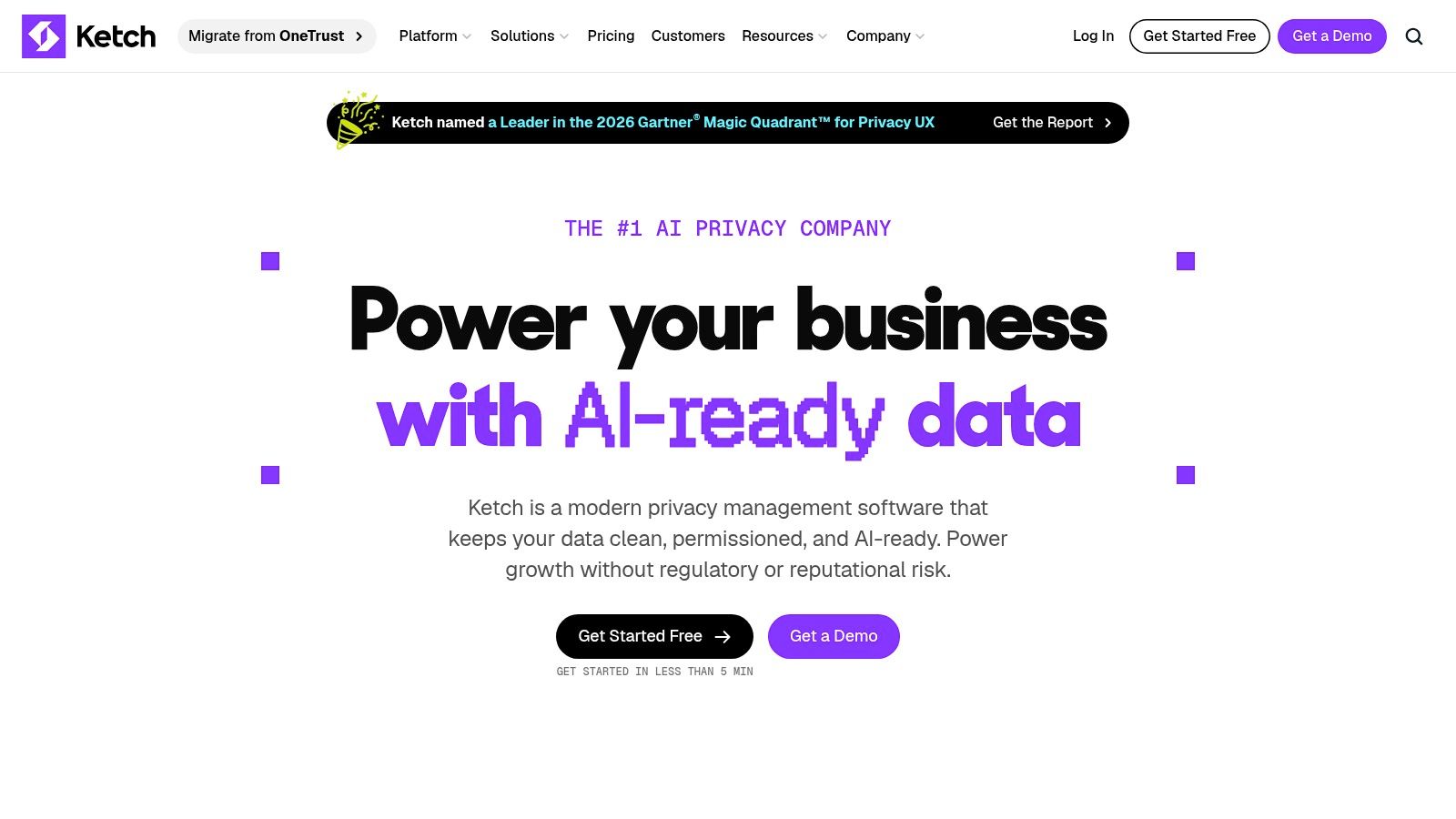
Ketch offers customizable consent experiences, a preference center, website tracker scanning, tag orchestration, privacy-law templates, and consent records. Plans are measured by monthly unique users, while other modules use system or contact counts. That model suits teams starting with consent, but traffic growth can push them into a higher tier.
Check the cost of rights automation and mapping before treating the free tier as privacy coverage. Ketch's published entry pricing applies to consent; broader operations require a separate budget discussion.
9. Usercentrics CMP
Usercentrics is a consent management platform for many websites, apps, or digital properties. It collects and documents consent through configurable banners and integrations. It isn't a stand-in for enterprise mapping or request fulfillment unless those live somewhere else.
That narrow focus matches how most programs buy. The IAPP Privacy Governance Report 2024 found nearly nine in ten surveyed organizations using a third-party provider for cookie-consent management, and about eight in ten using external providers for third-party risk management, regulatory tracking, and data mapping.
Usercentrics offers banners, preference controls, consent records, reporting, web and app setups, and marketing and analytics integrations, with separate products and plans. G2's combined vendor profile showed 4.3/5 from 433 reviews, and recent reviewers praised customization and setup. There's a 14-day CMP trial. Pricing depends on product, usage, and plan, so confirm current U.S. prices and limits. A consent record won't answer a regulator who asks where the warehouse copy lives.
10. Termly
Termly is the website tool for smaller businesses that need notices and cookie-consent basics at a price you can see. It won't replace enterprise discovery or a high-volume request operation, and it doesn't pretend to.
Termly combines privacy-policy and other legal-policy generators with cookie scanning, a consent banner, script blocking, and data-subject request form options. Eligible plans host embeddable policies and push automated updates. An agency plan covers multiple sites. A free plan and published monthly pricing make a trial cheap. Termly's comparison page reported 4.3/5 on G2 from 38 reviews, with users citing time savings and helpful support.
Free and lower tiers limit policies, scans, views, and features. Use it when the footprint is the website. Don't use it when vendor risk, cross-cloud mapping, or engineering deletion is the main gap. Those jobs need a different layer in the stack, not a bigger banner.
How the Ten Data Privacy Compliance Tools Differ by Focus, Pricing Visibility, and Entry Options
Item | Primary Focus | Pricing Visibility | Free or Entry Option |
|---|---|---|---|
OneTrust Privacy Automation | Enterprise privacy and governance workflows | Custom pricing through sales | No free option specified |
TrustArc Privacy Management Platform | Privacy operations, regulatory intelligence, and services | Not publicly listed | No free option specified |
BigID Privacy Suite | Sensitive-data discovery and enterprise privacy workflows | Depends on scope and implementation | No free option specified |
Securiti DataAI Command Platform | Privacy, data security, governance, and AI oversight | Not specified; confirm with vendor | No free option specified |
Osano Privacy Platform | Consent, privacy requests, mapping, and assessments | Varies by product and usage | Self-service options for some products |
DataGrail Privacy Platform | Privacy requests and live data mapping | Enterprise pricing not published | No free option specified |
Transcend Privacy Platform | Engineering-connected privacy workflows and request automation | Not publicly listed | No free option specified |
Ketch | Consent management and broader privacy workflows | Published consent-tier pricing | Free consent tier |
Usercentrics CMP | Website and app consent management | Varies by product, usage, and plan | 14-day CMP trial |
Termly | Website privacy policies and cookie consent | Published monthly pricing | Free plan |
Choosing the Right Stack Before You Sign
Start with the systems you need to cover. A consent platform handles website choices. A discovery-led suite maps sensitive data across cloud services and SaaS. Engineering-connected tools manage access and deletion in operational systems. Lightweight policy tools help smaller teams prepare website notices. Many organizations need more than one layer, so choose tools by their role in the stack, not by a single overall ranking.
Shortlist two or three products for the layer you lack. Test them against a difficult request, such as one involving a legacy database and a vendor you do not fully control. Ask vendors to document integrations, hosting region, evidence exports, connector work, and administrative effort. A license price alone does not show the cost of implementation or ongoing operations.
Regulatory exposure can reach companies outside Europe if they offer goods or services to people in the EU or monitor their behavior. A cross-country DLA Piper survey reported cumulative GDPR fines of €5.88 billion from 25 May 2018 through 10 January 2025. Ireland accounted for €3.5 billion, including a €1.2 billion penalty on Meta Platforms Ireland in 2023. Treat those figures as a reminder to map processing, monitor it, and retain evidence of what happens to personal data.
Dashboards do not establish an audit trail on their own. A 2026 Kiteworks survey found 67% of organizations lacked tamper-evident audit trails, 50% could not produce a complete AI data-access record within one business day, and 40% used a consistent evidence approach across required frameworks. Check whether the system preserves time-stamped records connecting data use, consent decisions, policy versions, vendor actions, and remediation. Test it with a simulated regulator request. Can your team produce a reproducible evidence package within hours?
The tool still needs an owner. The 2026 ISACA survey of more than 1,800 privacy professionals reported a median privacy team size of five, down from eight the year before. Technical privacy expertise was the leading skills gap at 54%, and 47% reported understaffed technical privacy teams. 13% used AI in the privacy function, while 38% planned to within 12 months. Match automation to your team's ability to review its results. Clear workflows and human checks may serve a small team better than automation it cannot supervise.
Measure whether the investment improves operations. Cisco's 2024 Data Privacy Benchmark Study surveyed more than 2,600 security and privacy professionals across 12 geographies. It reported average privacy spending of about $2.7 million in 2023 against estimated benefits of $2.9 million. Average return was 1.6 times investment, or about $160 in estimated benefit per $100 spent, and 30% of organizations reported at least 2 times return. The study addresses privacy investment broadly, not software alone. Track request cycle time, consent completeness, mapping coverage, vendor-assessment time, open high-risk findings, and the hours needed to produce evidence.
Freeform Company provides compliance assessments, data discovery and mapping, governance support, and data-subject-rights workflow assistance. If you need an outside operator, request a scoped assessment that identifies the systems to map, the request workflows to test, and the evidence your team must retain. Use those requirements to decide whether to add services alongside software.