

Enterprise Risk Management Compliance Explained

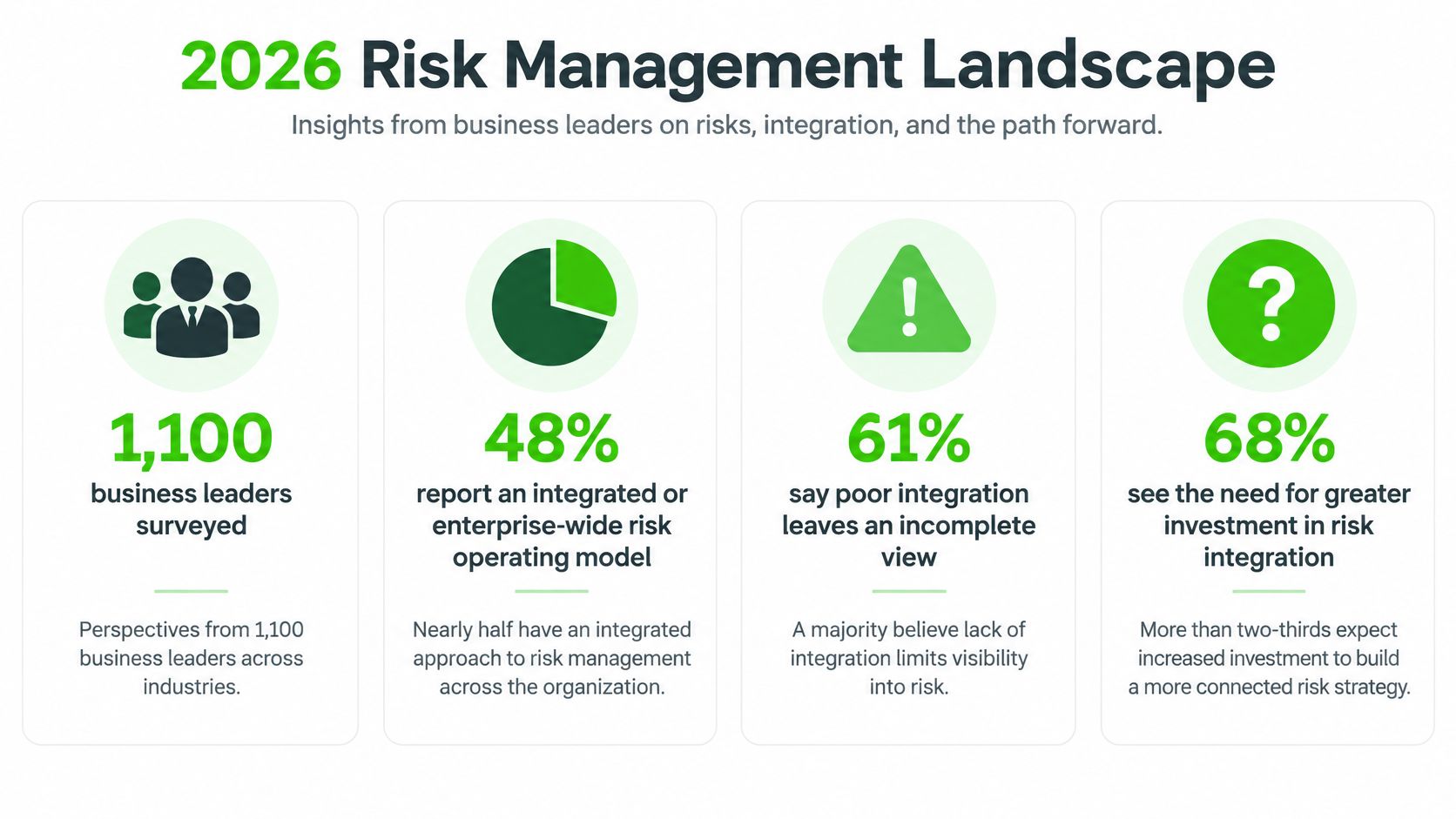
Only 48% of 1,100 business leaders say their organization has integrated risk management or an enterprise-wide risk operating model, according to Grant Thornton's survey on integrated cyber risk management. Turn the number around and it describes most large companies: a cyber register inside security, a privacy register inside legal, a supplier list inside procurement, a model inventory inside data science, and no single document a regulator could read to see how any of those ladder up to the revenue plan.
That isn't a tooling problem. It's an operating problem, and the missing pieces are unglamorous: one taxonomy, named owners, evidence you can trace from a control test to a risk identifier, and an escalation path that ends with a person who has authority to say no.
Fixing it takes five moves. Pick a framework that fits the question being asked, map each obligation to a business objective, name owners with real authority, measure whether controls reduce exposure, and escalate what's past due. What separates a program that survives an audit from one that produces binders is rarely the framework. It's whether a high finding on a customer-facing model can be traced to an objective, an owner and a dated decision inside five minutes.
Table of Contents
What Enterprise Risk Management Compliance Means - Why separate registers fail in front of a regulator
How COSO ISO 31000 and NIST Differ - COSO asks what the board is accountable for - ISO 31000 asks how every function describes risk - NIST asks how to manage cybersecurity risk - Choosing a spine and borrowing the rest
Mapping Rules to Business Objectives - The chain an auditor follows - Where AI initiatives trip the mapping
Metrics That Prove Controls Reduce Risk - Reading the dashboard honestly
A 90 Day Roadmap and Governance Model - Days 1 to 30, inventory and one taxonomy - Days 31 to 60, owners and appetite - Days 61 to 90, escalation, reporting and cadence - Who operates, who challenges, who tests
IT and AI Cases Then One Profile This Month - The marketing case - Three actions for this month
What Enterprise Risk Management Compliance Means
Stand on a flight deck and every gauge answers one question together. Altitude, heading, airspeed and fuel are separate instruments, but a pilot reads them as a single picture of where the aircraft is and where it's going. A privacy impact assessment, a vulnerability scan and a vendor questionnaire are the same kind of instrument. Each one is worth something only when it agrees with the other two about the altitude and heading of the business.
Most programs own the gauges and not the picture. In that same survey of 1,100 business leaders, 61% said insufficient integration across risk functions creates an incomplete view of organizational risk, and 68% said data quality, availability and visibility limit risk integration. A further 62% identified evidence quality and completeness as a constraint on misconduct and fraud response. Read the three together and the pattern is clear: leaders aren't short of risk reports, they're short of reports that reconcile.
Enterprise risk management compliance is proof that an organization's legal, regulatory, ethical, operational, financial and strategic duties attach to the same objectives it uses to create and protect value, with a named owner and a recorded decision against each one. The word doing the work is "same." Two registers describing one exposure in different words are two half-answers.
Why separate registers fail in front of a regulator
Say a misconfigured storage bucket exposes customer records for nine hours. Security logs it as a control failure with a severity score. Privacy logs it in a different system as a personal data breach with a notification clock. The vendor team logs nothing, because the bucket belonged to a contractor. Ask all three what the residual risk was and who accepted it, and you get three answers with three dates and no shared identifier.
That's the moment a program loses defensibility, and it rarely happens because someone was careless. It happens because nobody owns the seam between registers, and each function's escalation threshold was written by a different committee in a different year.
Practical rule: before buying anything, write the taxonomy and one escalation threshold on a single page. If two functions can't agree on that page, no licence will make them agree later.
The instinct at this point is to buy a governance, risk and compliance platform. The survey evidence points elsewhere. Siloed structures and fragmented ownership were named among the leading barriers, which means decision rights and data standards outrank platform expansion. A new tool layered over four registers gives you four registers in a nicer font.
How COSO ISO 31000 and NIST Differ
Framework | Core job | Structure to use | Best fit | IT and AI use |
|---|---|---|---|---|
COSO ERM 2017 | Connect risk with strategy and performance | Governance and culture; strategy and objective-setting; performance; review and revision; information, communication and reporting | Board-level planning and oversight | Relate AI and cyber risks to business objectives and risk appetite |
ISO 31000 | Provide a shared risk-management process | Principles, framework, and a process covering context, assessment, treatment, monitoring and communication | Consistent risk language across business units | Apply the same assess-treat-monitor cycle to vendors, privacy and models |
NIST | Guide cybersecurity risk management and evidence | Identify, assess, respond to and monitor cybersecurity risks | Technology risk management and evidence | Track objectives, likelihood, impact, responses, owners and treatment status |
These frameworks serve different purposes. Using all three without deciding which one governs terminology, process and evidence can create competing registers and reporting lines. Assign each a distinct job, then connect them through shared definitions and identifiers.
COSO asks what the board is accountable for
COSO began as a joint initiative of five private-sector organizations. Its Enterprise Risk Management framework was published in 2004 and updated in 2017 as Enterprise Risk Management: Integrating with Strategy and Performance, COSO's current ERM guidance. COSO defines ERM around the culture, capabilities and practices integrated with strategy-setting and performance to manage risk while creating, preserving and realizing value. The emphasis is on how an organization makes decisions, not just on whether it has controls.
The five components form a sequence:
Governance and culture establish expectations and clarify who can raise concerns.
Strategy and objective-setting connect risk appetite with business plans.
Performance covers identifying, assessing, prioritizing and responding to risk.
Review and revision consider what has changed and what needs adjustment.
Information, communication and reporting bring risk information to decision-makers.
The sequence helps diagnose gaps. If a program begins with control activity but has no agreed risk appetite or escalation route, teams may identify problems without knowing who can decide what happens next.
ISO 31000 asks how every function describes risk
ISO 31000 provides principles, a framework and a process that can be used across sectors. The process covers establishing context, identifying and assessing risk, treating it, monitoring and reviewing it, and communicating and consulting. Because it does not prescribe a single register template, functions such as procurement, HR, engineering and legal can share a process while adapting their records to their work.
NIST asks how to manage cybersecurity risk
NIST guidance helps organizations identify, assess, respond to and monitor cybersecurity risk. It does not define cybersecurity as one of four enterprise objective categories. Instead, teams can connect cybersecurity risks to the business objectives they may affect and record the supporting analysis, decisions and evidence.
A useful record can include the affected objective, likelihood, impact, response, owner and treatment status. Keep those fields consistent as risk information moves from system-level records into an enterprise view. That gives reviewers a clearer route from a technical issue to the decision it requires.
Choosing a spine and borrowing the rest
Choose one framework as the operating spine and use the others for the jobs they handle well. COSO can guide board-level oversight, ISO 31000 can provide a shared process across functions, and NIST can guide cybersecurity risk management. The frameworks can work together without forcing teams to maintain three separate vocabularies.
A consistent risk assessment framework should set the context, define likelihood and impact criteria, and specify review timing. Teams can then connect model-related risks to the same risk records and use applying the AI risk management framework to understand how NIST's AI functions relate to governance, mapping, measurement and management.
Mapping Rules to Business Objectives
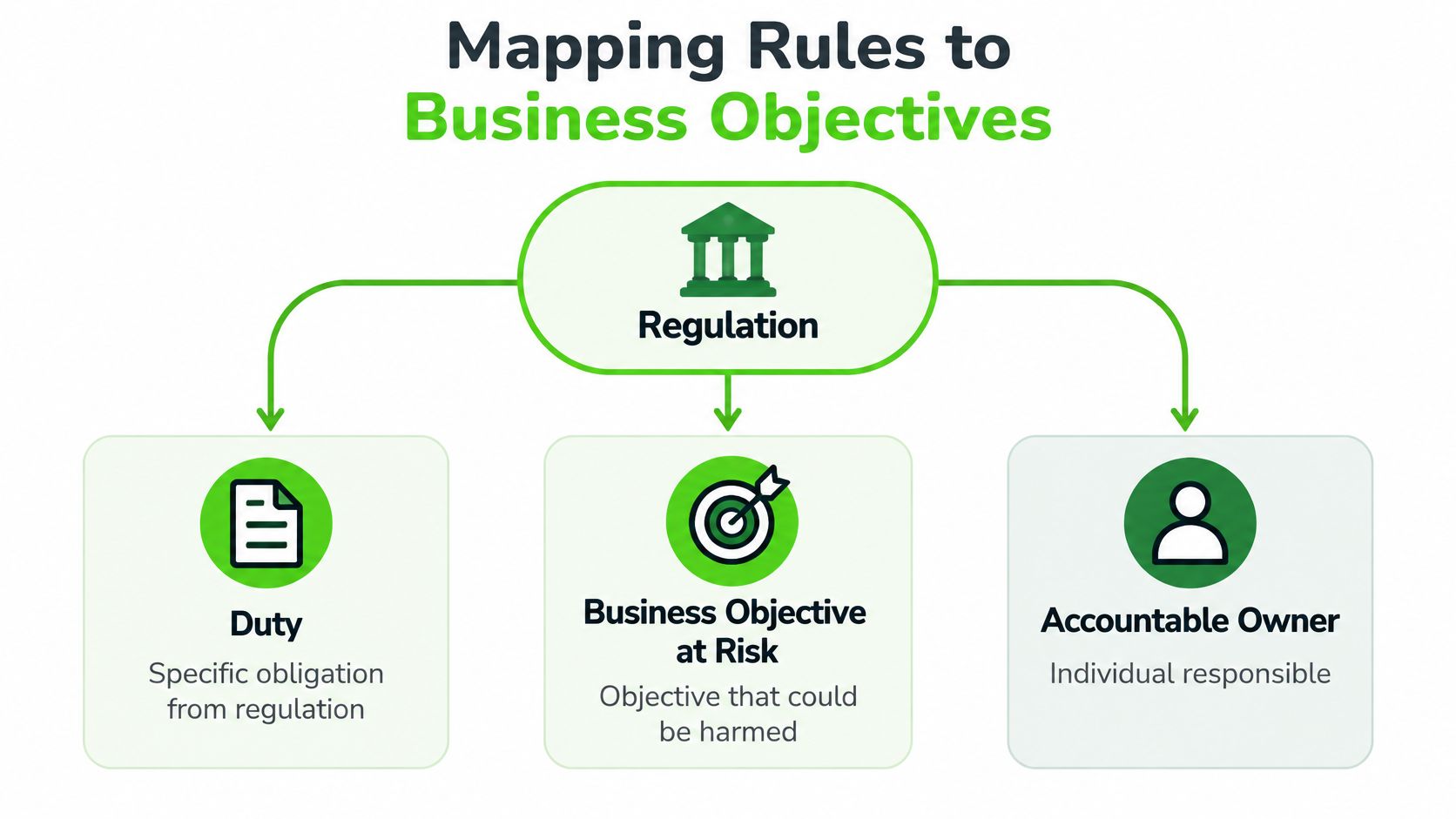
Take one duty and walk it the whole way. A demand generation team wants to score inbound leads with a third-party model trained on purchase history. The duty is a lawful basis for processing plus an impact assessment where the processing carries high risk. The business objective at risk is customer trust and the revenue that depends on it. The accountable owner is the privacy lead working with the demand generation manager, not the vendor. The evidence that proves the control works is the assessment, the basis record, the rights-request log and the model's training-data lineage. The residual-risk decision belongs to an executive who can accept a named exposure in writing.
That single row replaces three documents nobody reads and gives the auditor a path from a rule to a decision.
The chain an auditor follows
NIST's enterprise-risk model sets out a traceable cause-effect chain. A control weakness maps to a threat scenario, the scenario maps to financial, mission, reputational or regulatory exposure, and the exposure maps to an executive decision to accept, mitigate, transfer or avoid. The benchmark isn't "controls implemented." It's whether evidence demonstrates the controls operate as intended and reduce exposure against defined objectives.
Practical implementation means audit findings, exceptions, remediation deadlines and residual-risk acceptance all carry the same risk identifier used in board reporting. When they do, prioritization keeps its rationale months later, which is the difference between a defensible program and a checklist someone rebuilt from memory.
Obligation type | Duty to record | Business objective at risk | Accountable owner | Evidence to keep |
|---|---|---|---|---|
Privacy | Lawful basis, rights requests, impact assessment | Protect customer data and trust | Privacy lead with the business owner | Assessment, consent or basis record, rights log |
Financial reporting controls | Internal control over reporting where the firm is public | Reliable financial reporting | Control owner with finance oversight | Design test, operating test, exception log |
Cyber disclosure and resilience | Incident notice and operational-resilience duties where they apply | Keep critical services running | CISO with legal | Detection record, timeline, board notice |
High-risk AI | Risk system, data governance, logging, human oversight | Safe and lawful model outcomes | Model owner with compliance | Data lineage, test results, oversight log |
Third parties | Due diligence and contract flow-down | Limit supplier-driven exposure | Procurement with the risk owner | SOC or assessment, contract clauses, remediation dates |
Where AI initiatives trip the mapping
A model that personalizes marketing or scores customers is a compliance object, not a feature. Training-data lineage, consent, bias testing and vendor model terms belong on the same register as the server patch, and they belong there before launch rather than after the first complaint.
The starter map above is exactly that, a starter. Local counsel still confirms which regime applies to a given product, market and data set. What counsel shouldn't have to do is rebuild your register from scratch every time you ask a question.
Metrics That Prove Controls Reduce Risk
An auditor asking "is this control working" is asking three questions at once. Does the control exist as designed? Does it operate the way it was designed to, every cycle? And did the outcome it was built to produce happen? Report a single pass rate and you've answered none of them, because a control can be beautifully documented and still leave exposure untouched.
NIST's Risk Management Framework requires a continuous-monitoring strategy to name the metrics monitored, the assessment frequency, the analysis method, the response actions and the reporting requirements. The cause and effect is operational rather than theoretical. Frequent, contextual monitoring shortens the gap between a control degrading and someone fixing it. Delayed detection lets exceptions, misconfigurations and supplier weaknesses persist and raise residual risk.
Convert obligations into indicators you can compute: privileged-access review completion, vulnerability remediation inside policy-defined service levels, third-party assessment coverage of critical vendors, unresolved exceptions by business criticality, and mean time to close high-risk findings.
Working rule: separate design effectiveness, operating effectiveness and outcome scores. Blending them hides the case where a control is perfectly designed, reliably operated, and producing nothing.
Indicator | What good looks like | Cadence | If it slips |
|---|---|---|---|
Privileged-access review completion | 100 percent of in-scope accounts reviewed on cycle | Monthly | Escalate unreviewed admin access |
Vulnerability remediation within policy | Closure inside the severity service level | Weekly | Treat overdue critical items as residual risk |
Third-party assessment coverage | 100 percent of critical vendors assessed | Quarterly | Block renewal until the gap is owned |
Unresolved exceptions by criticality | Zero high exceptions past the deadline | Monthly | Name an executive acceptor or a fix date |
Mean time to close high findings | A falling trend, not a single pass rate | Monthly | Investigate process, not just the backlog |
Design, operating and outcome scores | Three scores, never one blended pass rate | Each assessment | Do not claim risk reduction from design alone |
Production AI models with current tests | Lineage, bias and oversight logs in date | Each release | Hold promotion until tests are current |
Reading the dashboard honestly
Here's a pattern worth recognizing. High findings start closing faster, the mean time to close trends down, and the executive summary looks green. Then you check the AI use case with the regulatory question attached and residual exposure is still red. Remediation is busy, not effective, because speed on the wrong findings doesn't move the exposure that matters.
Drop any metric that can't change a treatment decision. A number that never triggers a conversation about accepting, mitigating, transferring or avoiding risk is decoration.
Add one AI-specific outcome measure so model risk isn't reported as uptime: the share of production models with current bias and lineage tests. When assurance work is external, the distinction between a report that describes controls and one that tests them over a period matters, and what SOC 2 Type 2 means explains why the operating window is the part auditors read. Keep that same rigor in the regulatory compliance reporting you hand to executives, so the evidence travels with the number.
A 90 Day Roadmap and Governance Model
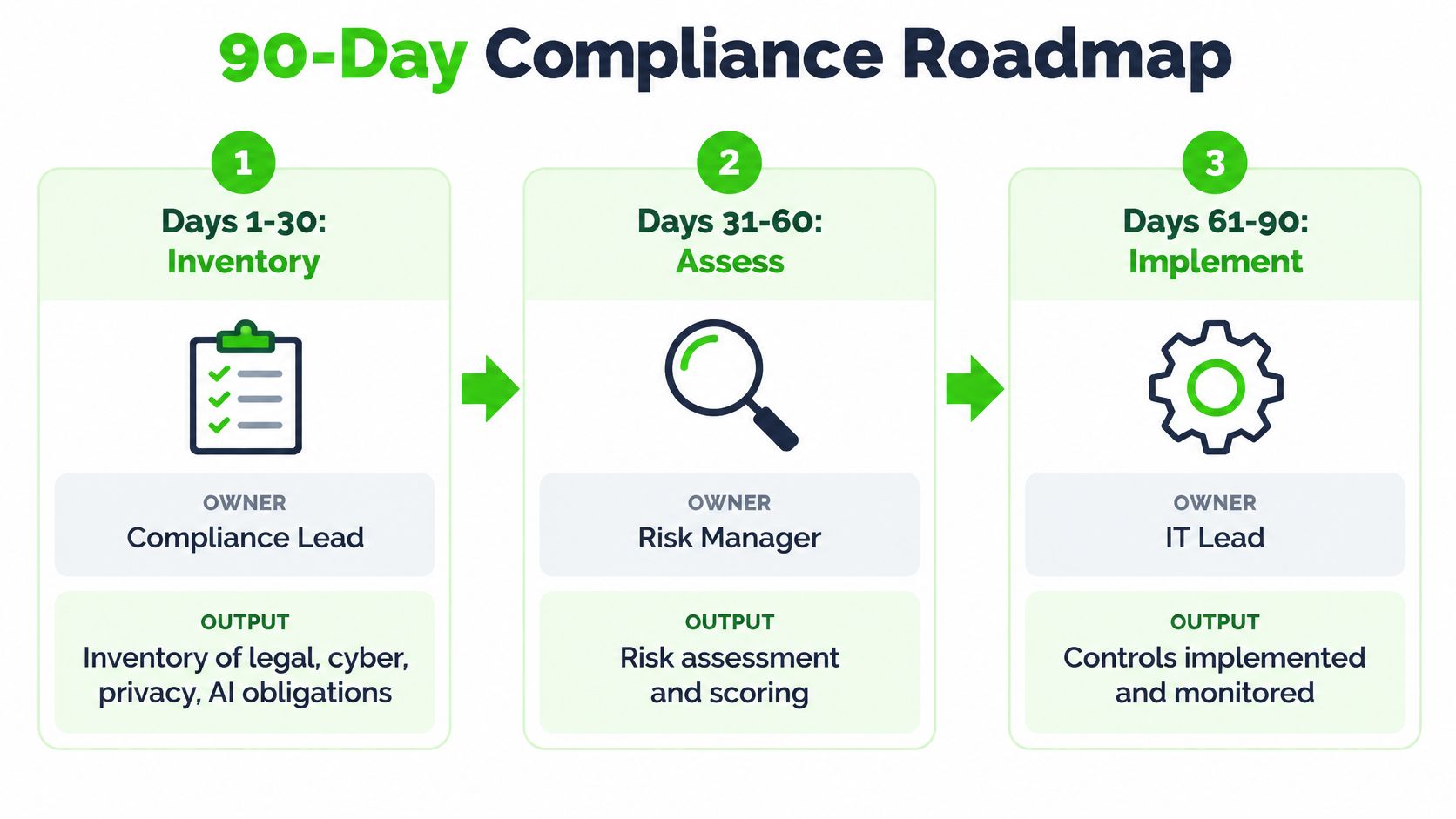
Ninety days buys a working model, not a maturity score. Aim for a register with owners, an appetite statement someone can enforce, and one escalation path that works. Three phases, each with a named owner and a single output.
Days 1 to 30, inventory and one taxonomy
Owner: the compliance lead. Output: an obligation inventory plus a single identifier scheme.
Here you list legal, cyber, privacy, AI and supplier obligations alongside the systems and model use cases that touch them. Then you freeze one taxonomy with one risk identifier and refuse to create a second one. The freeze is the hard part. Someone will want to keep their old numbering because a report depends on it. Let the report break and rebuild it on the new identifier; that's cheaper than reconciling two schemes for a year.
Days 31 to 60, owners and appetite
Owner: the business risk owners, challenged by the risk and compliance function. Output: an owned register plus a written appetite statement.
Appetite has to be numeric enough to stop a launch. "No unresolved high finding on a customer-facing model" is enforceable. "We take risk seriously" is not. Each row then links a weakness to an objective, likelihood, impact, response and treatment status, which is the field set that makes the register auditable rather than descriptive.
Days 61 to 90, escalation, reporting and cadence
Owner: the risk function with internal audit. Output: escalation rules and the first combined cyber, privacy and AI report to a single executive forum.
Past-due items escalate to the executive who can accept residual risk, with a date and a name. The board pack compresses the register into the exposure picture, and the continuous-monitoring cadence from the previous phase starts producing its first trend lines.
Who operates, who challenges, who tests
Governance is three lines, and the separation is the point. Owners operate the controls and hold the evidence. Independent risk and compliance challenge the design and the appetite fit. Internal audit tests whether it all works. When the same person does all three, an audit finding becomes a negotiation with yourself.
That structure needs a documented model rather than an implicit one, and the range of types of governance models helps a team pick one it can sustain across business units.
Run the build as a program with named roles, not as a side project. Inside our own delivery, the work is organized into four teams, Target, Architect, Deploy and Measure, which keeps the handoff from design to evidence from falling between people. Mike P., a PMP certified project manager with more than 10 years of project experience, manages client work at a high level and designed the project management process our teams follow, so a 90 day sequence has a schedule and a reviewer rather than a hope. Audit background helps here too: Shea R. holds a BA and a CPA and served as a Senior Manager at PricewaterhouseCoopers in audit and assurance services, which is the lens that asks what the evidence will look like eighteen months from now.
Common Pitfalls and How to Fix Them
The same five failures stall integration in company after company, and each one has a fix someone can start this month.
Duplicate registers. Cyber keeps one, privacy keeps another, the AI working group keeps a spreadsheet, and vendor management keeps a fourth. The board sees four partial stories and no way to compare them. Fix it by declaring one taxonomy and one identifier, migrating the highest-severity rows first, and putting the remaining tools into read-only retirement. Retiring a register takes a named decision, not a migration plan.
Evidence nobody can trace. A control test exists, but it doesn't point back to a risk identifier or an objective, so it can't support a conclusion. Fix it with a minimum evidence standard: every test record carries the control ID, the risk ID, the date, the reviewer and the result. Two fields added to a template this month beats a documentation project next year.
Fragmented ownership explains more failed integration than any technology gap. Fix the decision rights first and the tooling conversation gets short.
No named owner. Findings age past their deadline because everyone assumes someone else has it. Fix it with decision rights written into the register and a past-due escalation that lands on the desk of the executive who can accept the risk. If nobody's name is on the row, the row isn't real.
AI treated as an IT feature. Consent, training-data provenance and human oversight get skipped because the model shipped as a sprint deliverable. Fix it by adding the model to the obligation map before launch, with the same gate a production change would need.
A platform bought before the operating model exists. Tooling automates whatever process you already have, including the fragmented one. Fix it by freezing new purchases until appetite, owners and thresholds are written and agreed.
Here's the test that takes thirty seconds. Ask two teams to point at the risk identifier for a single incident. If they produce different numbers, or one of them produces nothing, the program is still fragmented regardless of how the dashboards look.
IT and AI Cases Then One Profile This Month
A single risk record can connect a technology change to its business objective, accountable owner, evidence and escalation path. The same chain works for cloud infrastructure, customer-facing AI and marketing operations.

The cloud migration. During a customer-portal cutover, a platform team finds a misconfigured identity control. The record links the finding to the objective “protect customer data,” notes its regulatory and reputational impact, and names the platform owner. If leadership accepts the remaining risk, the record captures the decision date, compensating control and review date. The objective and evidence give reviewers a consistent basis for assessing the finding.
The customer-scoring model. A marketing analytics model ranks accounts by churn likelihood. The team records bias tests and inference logs as control evidence, with a failed test blocking promotion. If a vendor retrains the model, the lineage record is updated, and the risk record remains open until new test results are available.
Both examples use a shared taxonomy, named owners and traceable evidence. The technology differs; the operating mechanics do not.
For regulated firms, the model layer needs documented obligations and evidence alongside the infrastructure layer. AI compliance rules for regulated firms explains where those obligations apply when a model affects customers.
The marketing case
Freeform helps clients develop marketing strategies and operating models, manage portfolios and brands, and shape channel strategies. These activities can involve customer data and automated decisions, so teams should connect relevant risks to business objectives and record who owns each control.
For example, a channel strategy that uses customer scoring should have a traceable record of its data sources, controls and review decisions. That record makes it easier to see how a marketing activity relates to the organization's obligations and who must respond when a control fails.
Three actions for this month
Set one taxonomy. Publish a shared identifier scheme and retire other numbering systems from active use.
Assign owners and objectives. Link every open high finding to a business objective and a person accountable for its next action.
Combine reporting. Bring cyber, privacy and AI exposures to one executive forum, with the decisions required clearly stated.
Freeform's marketing strategy, operating-model, portfolio, brand and channel strategy services can help clients align commercial work with governance requirements. The practical test is whether each material risk has one identifier, an owner and evidence that traces back to an objective.
Freeform Company publishes resources on digital compliance, data protection and AI development. Its services include compliance assessments and bespoke AI integration. For organizations connecting marketing activity with risk governance, Freeform helps clients develop marketing strategies and operating models, portfolio and brand management, and channel strategies. Visit Freeform Company to explore its published resources.