

Data Protection vs Data Privacy: Key Differences

Most enterprise compliance playbooks repeat the same comfortable advice: encrypt your databases, lock down identity access, publish a clear cookie banner, and you've covered both privacy and security. That shortcut fails in practice. Treating data protection vs data privacy as a single checklist leaves engineering teams securing data they never had permission to collect, while legal teams draft policies that never reach production code.
If you run a compliance or technology function, you don't need another textbook definition. You need a clean operating split between two separate business questions: May we process this data? and Can we keep it safe? Answer the first poorly, and your company builds an intrusive product inside a hardened vault. Answer the second poorly, and a lawful, transparent workflow collapses the moment an attacker finds a misconfigured S3 bucket.
Artificial intelligence turns that quiet divide into an immediate boardroom risk. A machine learning pipeline can pass every security audit on the books and still infer sensitive traits, repurpose customer records, or expose individuals through its outputs. Closing that gap starts with drawing the boundary properly and assigning real owners to every point where the two disciplines collide.
Table of Contents
Privacy Decides Whether and Protection Decides How Safely - How Statutory Duties Turned Expectations Into Operations
Side by Side Comparison Across Seven Criteria - Why Teams Misread the Legal Basis Row - Where Ownership Deliberately Overlaps
Where the Two Disciplines Have to Sign Off Together - Four Joint Artefacts That Prevent Orphaned Ownership - The Financial Cost of Unowned Gaps
When the Model Itself Creates the Privacy Risk - Why Strong Security Can Mask Intrusive AI - What to Measure Beyond the Source Database
Interoperability Beats Localization in Cross Border Work - The Hidden Privacy Cost of Blanket Localization - A Four-Step Risk Sequence for Cross-Border Transfers
Scenarios That Show Which Discipline Acts First - Purchased Lists and Mobile SDKs - Deletion Requests and AI Vendor Clauses
Build Both Programmes in One Sequence - Four Steps to Unify Governance Without Slowing Delivery - Closing the Execution Gap With AI-Native Partners
Privacy Decides Whether and Protection Decides How Safely
Most organizations collapse privacy and protection into one vague budget line and then manage neither well. Data privacy is the set of rights and expectations governing whether personal information may be collected, used, shared, and retained. Data protection is the operational and technical framework that secures that information against unauthorized access, alteration, loss, or destruction once you hold it.
Put the split to work as a two-part gate before any project ships. Privacy asks, "May we process this data for this exact purpose?" Protection asks, "Can we keep it intact and out of the wrong hands?" If your product team can't pass both gates, the feature isn't ready for production.

How Statutory Duties Turned Expectations Into Operations
That separation became an enforceable global standard when the European Union's General Data Protection Regulation (GDPR), documented in the EUR-Lex summary of Regulation (EU) 2016/679, began applying on 25 May 2018. Rather than leaving privacy to voluntary pledges, the regulation translated it into seven binding principles: lawfulness, fairness and transparency; purpose limitation; data minimization; storage limitation; accuracy; integrity and confidentiality; and accountability.
Notice the architecture of those seven principles. Six of them govern justification, boundaries, and proof of compliance, while integrity and confidentiality anchor the technical security layer. Because the GDPR applies not only to EU-established firms but also to outside organizations processing personal data connected with individuals in the EU, its dual structure reshaped enterprise programs across North America and Asia-Pacific as well.
To see how a live commercial service translates those duties into user-facing commitments and technical safeguards, you can read the data protection policy published by Purple Engage. Reviewing a concrete notice shows how lawful purposes, retention rules, and security commitments sit side by side without collapsing into one generic paragraph.
Encryption, role-based access controls, and rapid incident response cannot substitute for lawful purpose, transparency, and user rights. In the same way, a carefully worded consent banner will never protect an unpatched server or a misconfigured database.
Side by Side Comparison Across Seven Criteria
Privacy and protection aren't competing disciplines fighting for the same budget. They're two layers of one governance program, and every ownership dispute starts when leadership forgets which layer owns which decision.
Criterion | Data privacy | Data protection | Who typically owns it |
|---|---|---|---|
Core question | May we process this data, for this purpose? | Can we keep it intact and out of the wrong hands? | Legal or DPO vs security |
Goal | Respect individual rights, choices, and expectations | Prevent unauthorized access, alteration, loss, or destruction | Shared |
Scope | Personal data and its lawful, fair, transparent use | All sensitive and business-critical data including personal | Security owns the broader set |
Legal basis | Statutes and rights instruments, such as GDPR and national privacy acts | Privacy law plus contractual security clauses, sector rules, and internal policy | Legal vs security and compliance |
Typical owner | Data Protection Officer or privacy office | CISO, security, and IT operations | Two owners, one sign-off |
Core controls | Consent management, purpose limitation, data minimization, retention limits, rights fulfilment, DPIA | Encryption, least-privilege access, monitoring, secure development, logging, tested incident response | Distinct toolkits |
Primary metric | Lawful purpose coverage, rights-request turnaround, retention adherence | Breach frequency and cost, mean time to contain, access-control coverage | Report separately |
Failure mode | Intrusive or purpose-creep processing that is perfectly secured | A lawful, well-documented process exposed by one weak control | Either one alone fails |
Why Teams Misread the Legal Basis Row
The legal basis row causes more internal friction than any other criterion in the table. Security engineers often assume every obligation flows from statutory privacy law, while legal counsel sometimes forgets that commercial contracts impose stricter technical duties than regulators do.
Privacy obligations come directly from rights instruments and statutes, which dictate when you can touch an individual's personal data at all. Protection obligations stack on top of those laws through enterprise customer agreements, payment-card rules, healthcare security standards, and internal IT policies covering source code, trade secrets, and financial models that contain zero personal data.
Drafting a clear internal data protection policy helps draw that line in plain terms so developers know which controls apply universally across all company assets and which triggers apply strictly to personal records.
Where Ownership Deliberately Overlaps
Four operational zones refuse to stay inside a single silo: consent management, records of processing, retention limits, and breach notification. Hand any one of those to a single department, and the blind spots show up fast.
If privacy defines a two-year retention ceiling in a spreadsheet without IT engineering automated purge jobs in Snowflake or PostgreSQL, stale records linger indefinitely. If security detects an intrusion and restores systems without looping in the Data Protection Officer, the company misses statutory notification windows. Privacy sets the rules, and protection keeps them true under attack.
Where the Two Disciplines Have to Sign Off Together
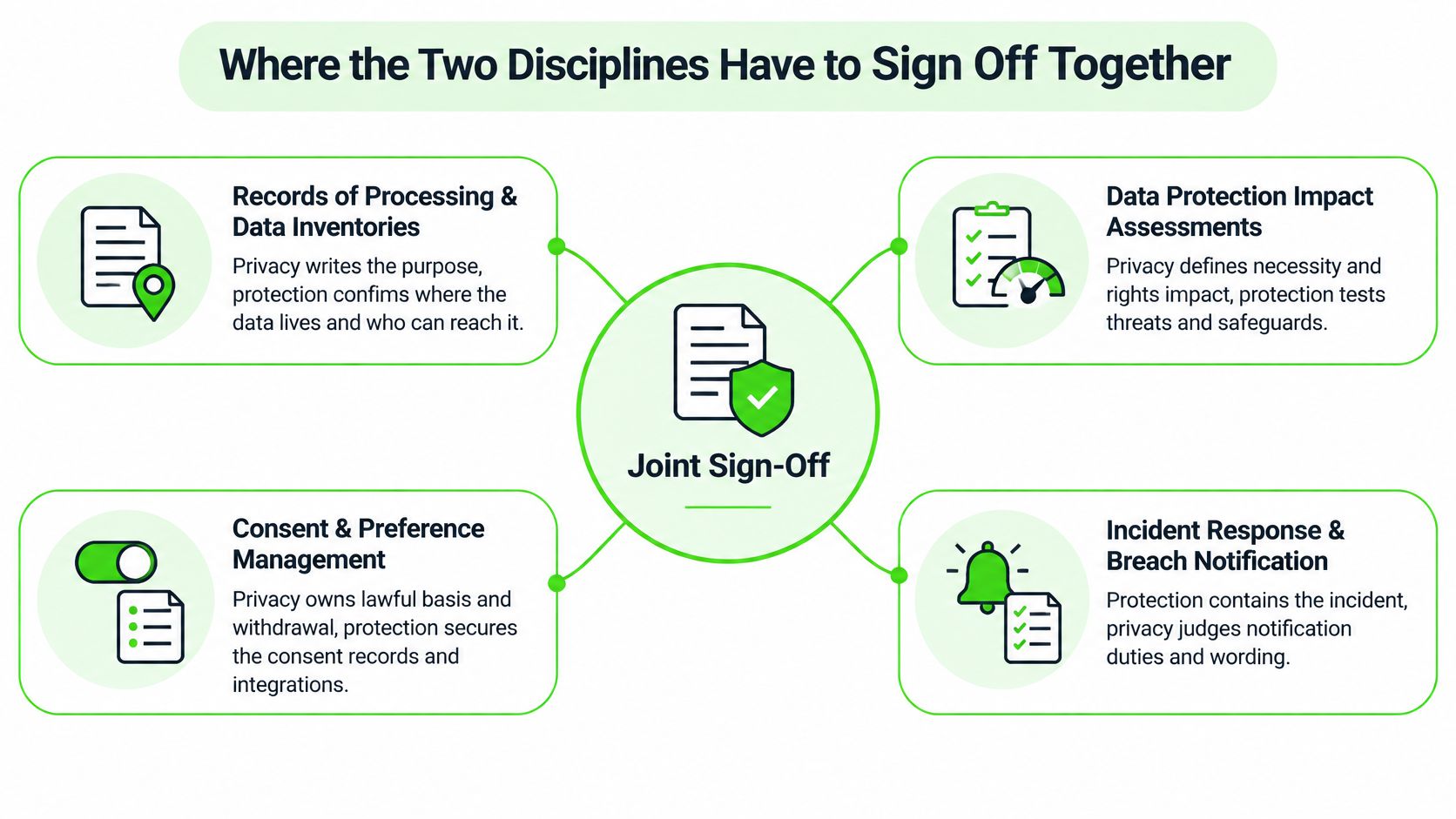
Advice to "collaborate more closely" doesn't survive a busy sprint cycle. When privacy and security rely on informal handoffs, critical gaps look less like heated arguments and more like orphaned documents nobody owns. Replace handoffs with four joint artefacts, each carrying two named sign-offs and a dated review stamp.
Four Joint Artefacts That Prevent Orphaned Ownership
Treat every overlap zone as a version-controlled deliverable inside your governance repository rather than an email thread. Each artefact requires dual approval before a workflow goes live or passes an annual review.
Records of processing and the data map: The privacy lead documents the lawful basis, data categories, and business purpose for each dataset. The security architect verifies the exact cloud regions, database tables, identity roles, and API pipelines touching those fields. Sign-off pair: Privacy Manager and Cloud Security Lead.
Retention schedules and automated deletion: Privacy sets the statutory and contractual ceiling for holding records, including suppression lists and consent logs. IT operations builds automated lifecycle rules in object storage and relational databases, then logs proof of erasure. Sign-off pair: Data Protection Officer and Data Platform Engineer.
Incident runbooks and breach notification: Security detects anomalies, isolates compromised endpoints, and runs forensic containment. Privacy determines whether exposed records trigger regulatory filing thresholds, drafts customer notices, and tracks disclosure clocks. Sign-off pair: Incident Commander and Privacy Counsel.
Vendor questionnaires and processor agreements: Privacy reviews Data Processing Addenda, sub-processor lists, and cross-border transfer mechanisms, along with any Data Protection Impact Assessments for high-risk tooling. Security evaluates SOC 2 reports, encryption standards, single sign-on enforcement, and API access scopes. Sign-off pair: Legal Procurement Counsel and Third-Party Risk Lead.
The Financial Cost of Unowned Gaps
Weak execution across these joint artefacts carries measurable balance-sheet damage, not just legal exposure. In the IBM 2025 Cost of a Data Breach study, which analyzed breaches at 600 organizations across 17 industries worldwide, the global average breach cost reached USD 4.44 million. That marked a 9% decline from USD 4.88 million in 2024, driven partly by faster identification and containment.
The deeper operational findings expose why privacy and protection must sign off together. Across the studied breached organizations, 31% suffered operational disruption, and 53% reported compromised customer personally identifiable information. Those incidents don't end when engineers patch a vulnerability; they cascade into regulatory inquiries, mandatory customer notices, and damaged trust across enterprise supply chains.
Accountability test: Regulators don't accept verbal assurances that teams talk to each other. Every data map, retention purge log, incident runbook, and vendor approval needs two named owners and a verifiable timestamp.
When the Model Itself Creates the Privacy Risk
Here's the uncomfortable reality many compliance audits miss: a machine learning system can pass every penetration test, run inside an encrypted VPC with strict IAM roles, and still inflict serious privacy harm. Traditional security stops outsiders from stealing a database. It does nothing when your own authorized model generates intrusive profiles, infers protected health or financial attributes from innocent behavioral clicks, or memorizes sensitive inputs during training.
Enterprises are waking up to that blind spot rapidly. According to the Cisco 2026 Privacy Benchmark Study, 90% of surveyed organizations expanded their privacy programs because of AI, while 43% increased privacy spending in the prior year. Looking ahead, 93% of respondents project they will allocate more resources to privacy or data-governance areas over the next two years.
Why Strong Security Can Mask Intrusive AI
Hardening storage often triggers a dangerous confirmation bias inside technical teams. When a CISO signs off on encryption at rest, private endpoints, and audited access logs for a generative AI workspace, executives assume the deployment is safe. That confidence can accelerate intrusive practices, such as feeding customer support transcripts into a recommendation engine without disclosure or retaining prompt histories far beyond their original purpose.
Protection of stored records doesn't automatically yield privacy-respecting outputs. For CIOs and AI engineers deploying predictive or generative models, governance cannot stop at the database perimeter. Controls have to follow personal data across five lifecycle stages: collection, training, inference, live monitoring, and deletion.
What to Measure Beyond the Source Database
When the model's output creates the privacy risk, standard security metrics like patch latency or failed login counts miss the target entirely. Engineering and privacy leads should add five model-specific measurements to their release gate:
Inference and profiling impact assessments: Test whether model outputs deduce sensitive traits (such as medical conditions, financial distress, or political views) that users never knowingly provided, and block deployment when those inferences lack a lawful basis.
Explainability and human review rates: Track how often automated decisions affecting credit, hiring, pricing, or access can be explained in plain language and how reliably a human reviewer can override them.
Data provenance and lineage coverage: Measure the percentage of training and fine-tuning datasets with verified origin records, documented collection notices, and verified opt-out compliance.
Training-to-inference retention adherence: Verify how long raw prompts, feature-store vectors, and fine-tuning snapshots persist, and confirm whether deleting a user's source record propagates into downstream model workflows.
Downstream sharing and API boundaries: Audit every third-party model API, orchestration plug-in, and logging pipeline to ensure customer inputs aren't routed into external vendor training loops.
Running those checks alongside encryption and breach-response drills keeps AI products aligned with individual expectations rather than merely shielded from external hackers.
Interoperability Beats Localization in Cross Border Work
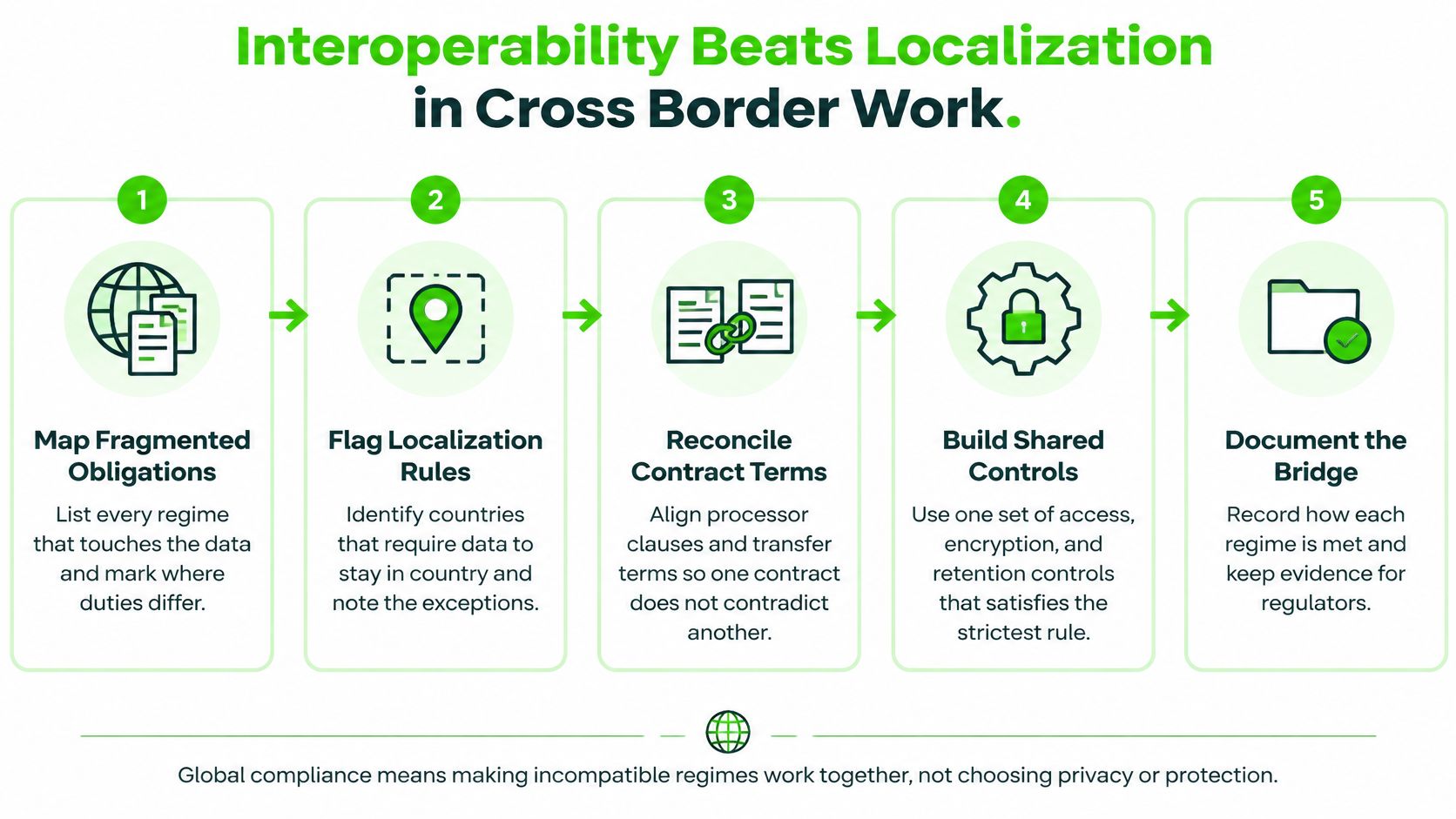
Global compliance rarely fails because a company picked privacy over protection. It fails because cross-border teams try to bolt incompatible national regimes onto a single architecture without a shared bridge. Fragmented statutory duties, country-specific data-localization rules, conflicting processor contracts, and shifting transfer mechanisms turn straightforward cloud deployments into legal bottlenecks.
Survey data reflects widespread fatigue with rigid territorial silos. In the Cisco 2026 global privacy survey, 83% of respondents said harmonized data-protection rules would reduce the need for country-specific data-localization laws.
The Hidden Privacy Cost of Blanket Localization
Storing data inside national borders sounds like the safest default until you operate it at scale. Forced localization forces engineering teams to duplicate databases, identity stores, and logging infrastructure across separate regions. That fragmentation shrinks visibility for security operations centers, cuts regional teams off from global threat intelligence, and slows coordinated incident response when an attacker moves laterally across subsidiaries.
Localization isn't automatically the most privacy-protective choice. Keeping copies scattered across half a dozen isolated stacks often increases the attack surface while making rights requests, such as cross-system erasure, harder to execute reliably.
A Four-Step Risk Sequence for Cross-Border Transfers
Instead of treating localization as an ideological rule, CIOs and legal leads should run every international data flow through a structured risk sequence. Start by reviewing core GDPR requirements for US companies alongside local transfer restrictions, then execute four concrete checks:
Classify data and processing risk: Separate low-risk operational telemetry from high-risk personal records, health data, or employee files so you don't over-engineer controls for benign datasets.
Identify the transfer mechanism: Map whether each cross-border flow relies on Standard Contractual Clauses, adequacy decisions, binding corporate rules, or explicit statutory derogations.
Assess government-access and vendor exposure: Evaluate destination-country surveillance laws and inspect sub-processor access paths to verify who holds encryption keys and administrative privileges.
Document equivalent safeguards: Record whether client-side encryption, strict contractual accountability, regional processing, or privacy-enhancing technologies deliver comparable protection.
Architecture reality: Privacy-enhancing technologies, which the OECD frames as tools enabling data collection, analysis, and sharing while preserving confidentiality, can narrow transfer exposure. Still, their effectiveness and regulatory acceptance vary across jurisdictions, so never deploy them without written legal validation.
Both privacy and protection depend on architecture, jurisdiction, accountability, and auditable evidence working together across borders, not isolated servers or boilerplate consent banners.
Scenarios That Show Which Discipline Acts First
Definitions blur fast when a product manager sends an urgent Slack message on a Friday afternoon. Walking through real operating moments clarifies which discipline holds the first decision, what breaks if the order flips, and which artefact locks in accountability.
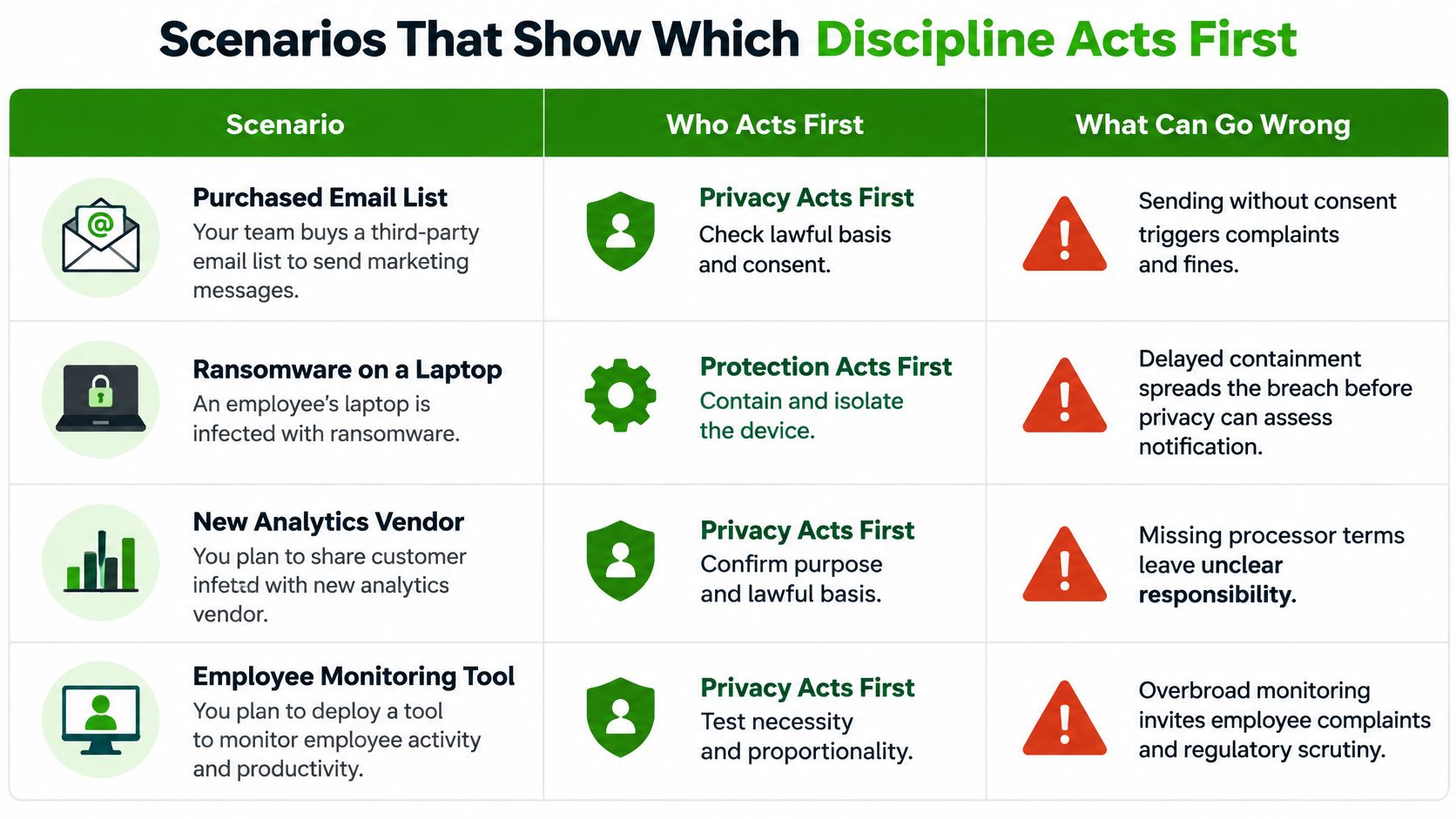
This table breaks down how typical operational triggers split between privacy-first and protection-first responses before risk escalates.
Purchased Lists and Mobile SDKs
Say a growth marketing team buys a third-party prospect list and wants to launch an outbound email campaign before quarter-end. Privacy acts first. The privacy lead must verify whether valid consent or a legitimate lawful basis covers outreach in each target jurisdiction before anyone touches the file. Protection steps in second to restrict access inside the CRM, encrypt the import, and enforce a strict retention window. If security locks down the list without privacy sign-off, the campaign triggers spam complaints and regulatory fines. Artefact: Lawful-basis approval ticket paired with a CRM suppression and retention record.
Now consider a mobile engineer who wants to drop a rich third-party analytics SDK into an iOS and Android release to track screen taps and session replays. Protection acts first on technical visibility, while privacy gates the scope. Security inspects the SDK's network calls, permissions, and outbound endpoints to spot hidden data collection; privacy determines whether each captured attribute is necessary and accurately disclosed in the app notice. Skip either step, and sensitive form inputs stream to an undisclosed ad-tech server. Artefact: SDK data-flow review linked to an updated mobile privacy notice and consent trigger.
Deletion Requests and AI Vendor Clauses
When a customer submits a verified deletion request, privacy acts first to confirm identity, validate that the right applies, and flag narrow statutory exceptions such as tax invoicing records. Protection acts second to prove the record is purged across production databases, analytics warehouses, backup rotation policies, and third-party processors rather than merely hidden with a soft-delete flag. Artefact: Completed rights-fulfilment ticket attached to an automated erasure audit log.
Finally, suppose an AI software vendor updates its terms to request using your customer records to train its foundational models. Both disciplines block the request immediately for distinct reasons. Privacy objects because customer data was collected for service delivery, not third-party model development, leaving zero lawful basis. Protection objects because handing sensitive records into an external training pipeline creates uncontrolled downstream custody and model-memorization risk. Artefact: Signed vendor opt-out addendum and updated processor risk register.
For a concise visual walkthrough of how enterprise compliance and security teams coordinate these exact boundary decisions, watch the breakdown below.
Getting the sequence wrong in any of these scenarios doesn't stay contained inside an IT ticket. Delayed containment or unauthorized processing escalates quickly into halted operations, leaked customer records, regulatory scrutiny, and steep remediation bills.
Build Both Programmes in One Sequence
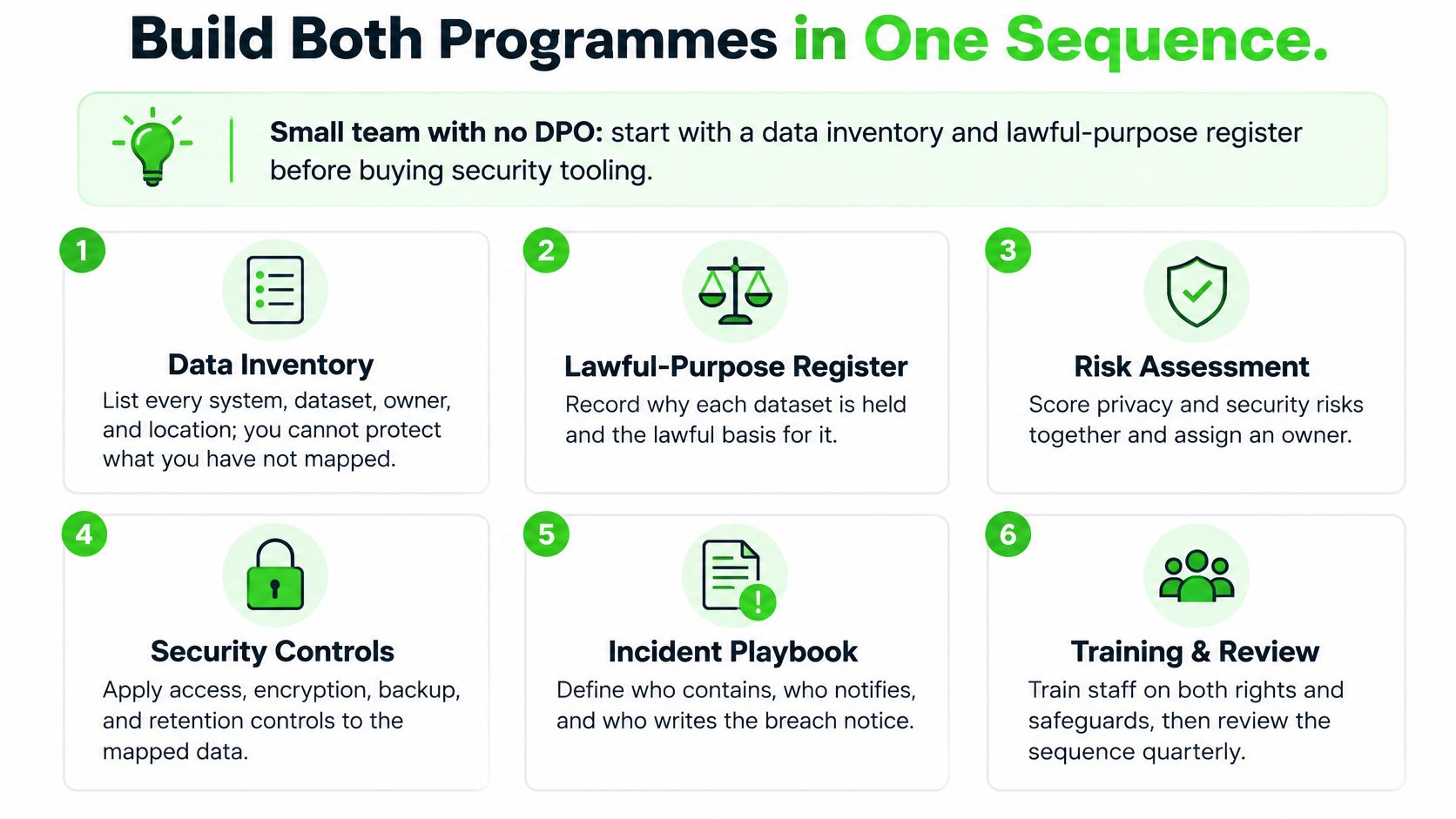
Build privacy and protection on one sequence, not two roadmaps that never meet. Team size decides where you start. The questions stay separate either way.
A small team with no Data Protection Officer should build a data inventory and a lawful-purpose register before spending a dollar on new security software. You cannot protect systems you have not mapped. Monitoring tools on undocumented customer lists waste budget and still leave "may we process this?" unanswered. An enterprise CISO should wire existing Data Protection Impact Assessments and data inventories into controls you can test: least-privilege access, encryption, secure development standards, centralized logging, automated retention purges, and incident-response playbooks that have been run. Those controls answer "can we keep it safe?" Encryption on a model does not create a lawful basis the privacy lead never recorded.
The visual checklist below lays out the unified order of operations from initial discovery through quarterly reviews.
Four Steps to Unify Governance Without Slowing Delivery
Put both teams on one operational cadence through a structured data privacy compliance program:
Map every dataset and its purpose first: Catalogue each production store, SaaS tool, and AI workflow with its lawful basis, owner, and geographic region before you tune technical controls. A workflow with no named purpose fails review even when the host is locked down.
Attach dual owners to every joint artefact: Assign one privacy lead and one security lead to the data map, retention schedule, incident runbook, and vendor review template. A blank owner is how a document goes stale between audits. Privacy signs whether processing is allowed. Protection signs how the control holds.
Report privacy and protection metrics separately: Keep rights-request turnaround and lawful-purpose coverage distinct from mean time to contain and access-control coverage on executive dashboards. A blended score hides a failing control behind a strong number in the other column.
Audit annually and before every major system launch: Trigger a combined review whenever engineering adds an AI model, onboards a new data processor, or enters a new jurisdiction. Security approval of the model environment does not close a privacy gap in the training set.
Deferring this alignment gets riskier every quarter as breach reporting climbs. Australia's Office of the Australian Information Commissioner recorded 1,113 data-breach notifications in 2024, the highest annual total since mandatory notification began in 2018. Regulators expect documented proof that both disciplines operate in lockstep before an incident hits the news.
Closing the Execution Gap With AI-Native Partners
Teams that lack in-house bandwidth to connect marketing technology, AI workflows, and strict data governance still have to run that sequence. Manual handoffs and bloated retainers just slow the same two sign-offs.
A 2026 RZLT comparison highlights that AI-oriented campaigns launch in the same day to three days, compared with roughly two to six weeks for traditional agencies, because campaign setup, optimization, and iteration are automated. Faster launch is a failure mode if the purpose register is skipped. Freeform's real-time analytics service lets customers measure, monitor, and analyze their marketing efforts in real time, with all key measurements brought into one link, so campaign reporting stays separate from raw production personal data.
Freeform Company helps enterprise technology, compliance, and growth teams unite data protection controls, practical privacy governance, and AI-powered marketing execution without giving up speed or audit readiness. Explore digital compliance guides, AI integration toolkits, and strategy playbooks at Freeform Company to tighten the program across your data stack.