

Enterprise AI Knowledge Management: A Practical Guide

Your employee asks whether a customer's data can be shared with an external vendor. The wiki says one thing, a chat thread suggests an exception, and the policy PDF has no obvious approval date. An AI assistant could turn those conflicting sources into a confident answer, but confidence won't tell your compliance team which rule applies.
Enterprise AI knowledge management connects corporate information to systems that retrieve evidence and explain it in plain language. Its hardest problem isn't writing the answer. It's maintaining a trustworthy knowledge supply chain, so employees receive information that's current, owned, authorized, and auditable.
Table of Contents
The Four Layers Behind Enterprise AI Knowledge Management - The four layers and what to check before launch - Adoption doesn't mean operational maturity
Why Enterprise Knowledge Gets Lost and Slows Teams - Productivity depends on usable answers
Connecting Sources So Retrieval Finds Current Answers - Source authority and the metadata each source needs
How to Set Up Governance and Access Controls - Put ownership and enforcement into operation - Test what happens after change
Measuring Answer Quality Before Users Trust It - Measure evidence selection and evidence use - Symptoms, failure stages and fixes
Trade-offs in Architecture and Review - Choose where retrieval happens - Decide where delay is acceptable
Pilot One Knowledge Domain Before You Scale - Define a bounded pilot - Outside help is an option, not a substitute for ownership
The Four Layers Behind Enterprise AI Knowledge Management
A traditional knowledge base is a filing cabinet: you must already know which drawer holds the answer. An AI knowledge system is closer to a research librarian who can consult every connected drawer and respond with page references. The qualification matters: it can only consult what your organization connects and permits it to use.
This architecture combines knowledge repositories, enterprise search, and generative AI. A KMWorld survey summarized by CAKE's knowledge-management statistics found that 54% of organizations use more than five platforms to document and share information, 92% consider fast, accurate access to unstructured information vital, and 48% of executives and managers believe employees take procedural knowledge with them when they leave.
The diagram provides a conceptual view of that transition.
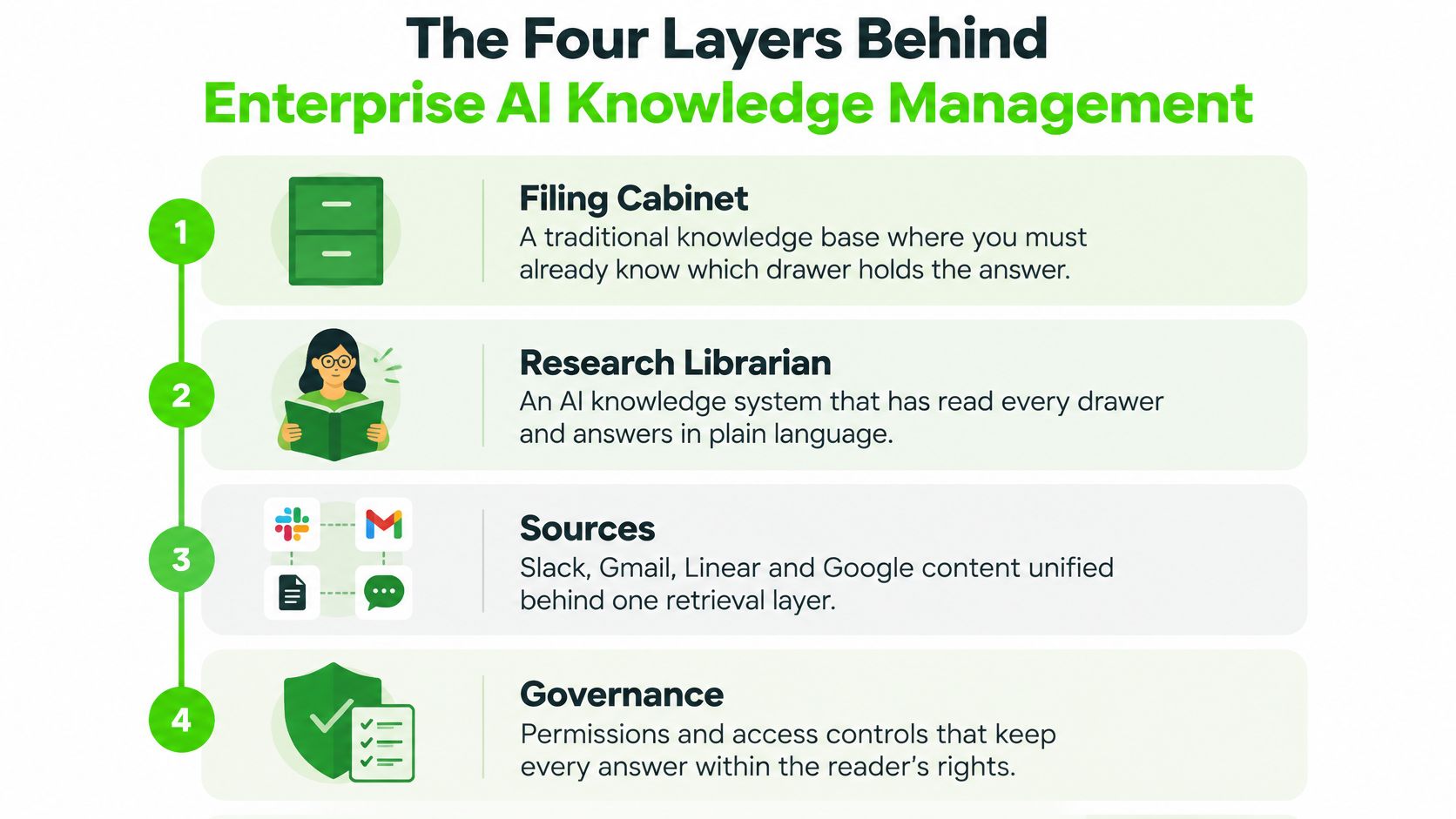
The four layers and what to check before launch
Layer | Job it does | Check before launch |
|---|---|---|
Connectors | Pull content from chat, email, repositories and business apps | Every system that holds approved policy is connected |
Index and retrieval | Find passages with hybrid keyword and vector search plus metadata filters | Recall measured on a fixed set of real questions |
Answer generation | Write a short answer from retrieved passages with citations | Citations match the passage; the system abstains when evidence is missing |
Governance | Enforce permissions, versions, owners, expiry and retention | Access checked at query time; every answer traceable to an approved source |
Hybrid search combines exact-word matching with vector search, which finds passages with similar meaning. Exact matching helps with policy identifiers and product names; semantic matching helps when employees describe a problem differently from the document's author.
These layers depend on each other. If a connector misses the approved policy, retrieval may return a convincing draft. The answer generator can faithfully summarize that draft and still give operationally wrong guidance.
Adoption doesn't mean operational maturity
A KMWorld survey cited by AxioBench's industry-statistics overview found that approximately 37% of organizations used AI minimally through pilots or early testing, while 32% used it moderately for specific tasks. Those groups illustrate why staged deployment matters more than a polished demonstration.
Don't assess the stack by its chat interface alone. Ask which layer would fail first if an employee requested a policy exception: missing content, poor retrieval, unsupported synthesis, or inadequate access enforcement?
Why Enterprise Knowledge Gets Lost and Slows Teams
Fragmentation becomes expensive when an employee must reconstruct an answer rather than retrieve it. Say a new hire needs to understand the vendor-onboarding process. They search the wiki for requirements, Jira for an example, a shared drive for the form, and chat for the exception nobody documented.
Each search creates another judgment call. Is the completed ticket a precedent or an outdated workaround? Does the shared-drive copy apply to their region? The employee may eventually ask an experienced colleague, turning that person into the organization's unofficial search engine.
The practical cost is repeated searching and validation, not a crowded application menu.
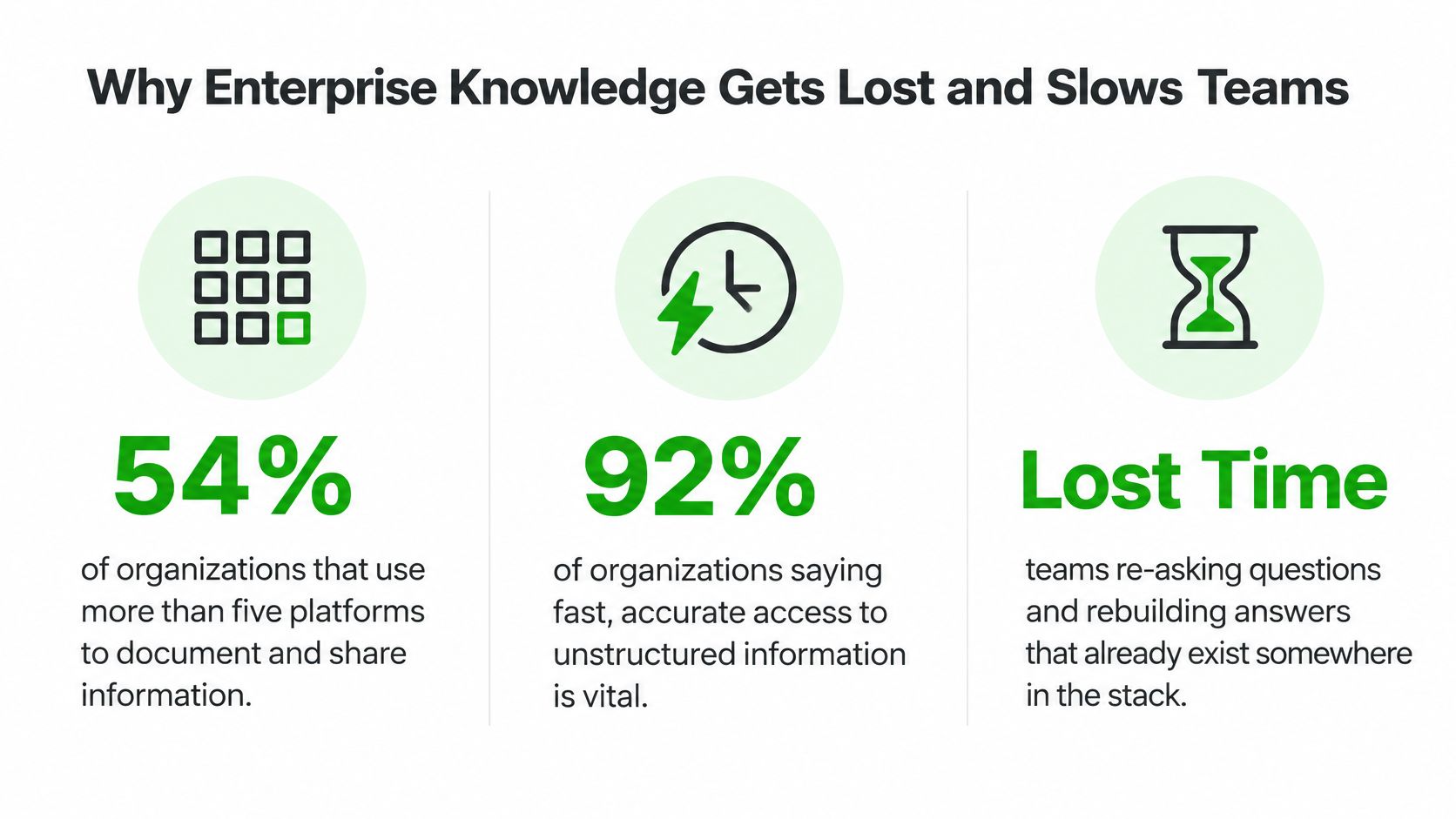
Productivity depends on usable answers
In Sia Partners' 2024 global generative-AI CIO survey, 60% of surveyed CIOs and IT leaders said knowledge-base improvements such as contextual search, summarization, and automated content updates could enhance day-to-day productivity. That's an expectation about useful capabilities, not proof that any particular deployment delivers savings.
The investment pattern points in the same direction: Menlo Ventures reported that enterprise search and retrieval represented 28% of enterprise generative-AI use cases in 2024.
Natural-language interfaces change the employee's task from locating a folder to asking a question. They don't remove the need to document the answer properly. For teams formalizing procedures before connecting them to AI, Rite NRG documentation best practices offers a useful starting point for reviewing documentation practices.
Practical audit: Follow a routine question from request to resolution. Record every application searched, every person interrupted, and every undocumented judgment required.
The institutional-memory problem appears in those undocumented judgments. Capture not just what experienced employees do, but why they choose a particular escalation path or reject an exception. Have the responsible domain owner validate that explanation before treating it as reusable guidance.
Your self-audit should end with a blunt question: which answer would become unavailable if the most experienced employee left?
Connecting Sources So Retrieval Finds Current Answers
An assistant retrieves an obsolete Jira ticket instead of the approved Confluence procedure. Another combines an informal Slack comment with a current policy and presents both as equally authoritative. Neither failure necessarily means the embedding model is weak. Both can start with missing context about the source.
A search interface hides much of this complexity from employees.

The EnterpriseRAG-Bench design spans approximately 500,000 documents from nine source types, including Slack, Gmail, Linear, Google Drive, HubSpot, Fireflies, GitHub, Jira, and Confluence, and evaluates 500 questions across ten categories. That diversity reflects the actual integration challenge: corporate sources have different schemas, timestamps, ownership signals, and permission models.
Source authority and the metadata each source needs
Source | Typical authority | Metadata to keep | Common risk |
|---|---|---|---|
Approved wiki or procedure space | High | Owner, version, approval status | Outdated copy outranks the current page |
Ticket tracker (e.g., Jira) | Low to medium | Status, last update, component | Closed or obsolete tickets retrieved as fact |
Chat threads (e.g., Slack) | Low | Author, date, channel | Informal comment mistaken for policy |
Email (e.g., Gmail) | Low to medium | Sender, thread date, recipients | Restricted content shown to the wrong users |
Policy repository (e.g., Google Drive) | High when approved | Version, access list, expiry date | Duplicate copies with different figures |
Treat these authority levels as starting rules, not universal rankings. A ticket may be authoritative evidence of an incident's resolution without being authoritative guidance for future incidents.
For every document, preserve source identity, version, publication date, owner, access control list, and approval status. Add source-specific fields from the table rather than replacing the common metadata. Rank only after excluding documents that aren't eligible for the question or reader.
Integration planning should include failure recovery, not just initial ingestion. Streamkap on integration bottlenecks provides context for examining pipeline constraints; Freeform's overview of data integration services offers related implementation context.
Use the accompanying video as a discussion prompt while mapping your retrieval workflow.
Build a representative test corpus before expanding connector coverage. Include questions that require combining documents, resolving conflicting instructions, answering for a past effective date, and respecting permission boundaries. A successful connection should demonstrate that updates, deletions, and access changes propagate correctly, not merely that documents appear in search.
How to Set Up Governance and Access Controls
Retrieval relevance isn't enough to establish trust. The 2026 State of KM and AI report, surveying 202 knowledge-management practitioners, found that 51% identified data security and compliance as the primary trust barrier.
An auditor needs more than a plausible citation. Your system should explain why it selected a source, who approved it, whether the user could access it, and whether the answer remains valid after a policy changes. That requires controls before generation, not just a warning beneath the chat window.
The governance workflow should make these responsibilities visible.
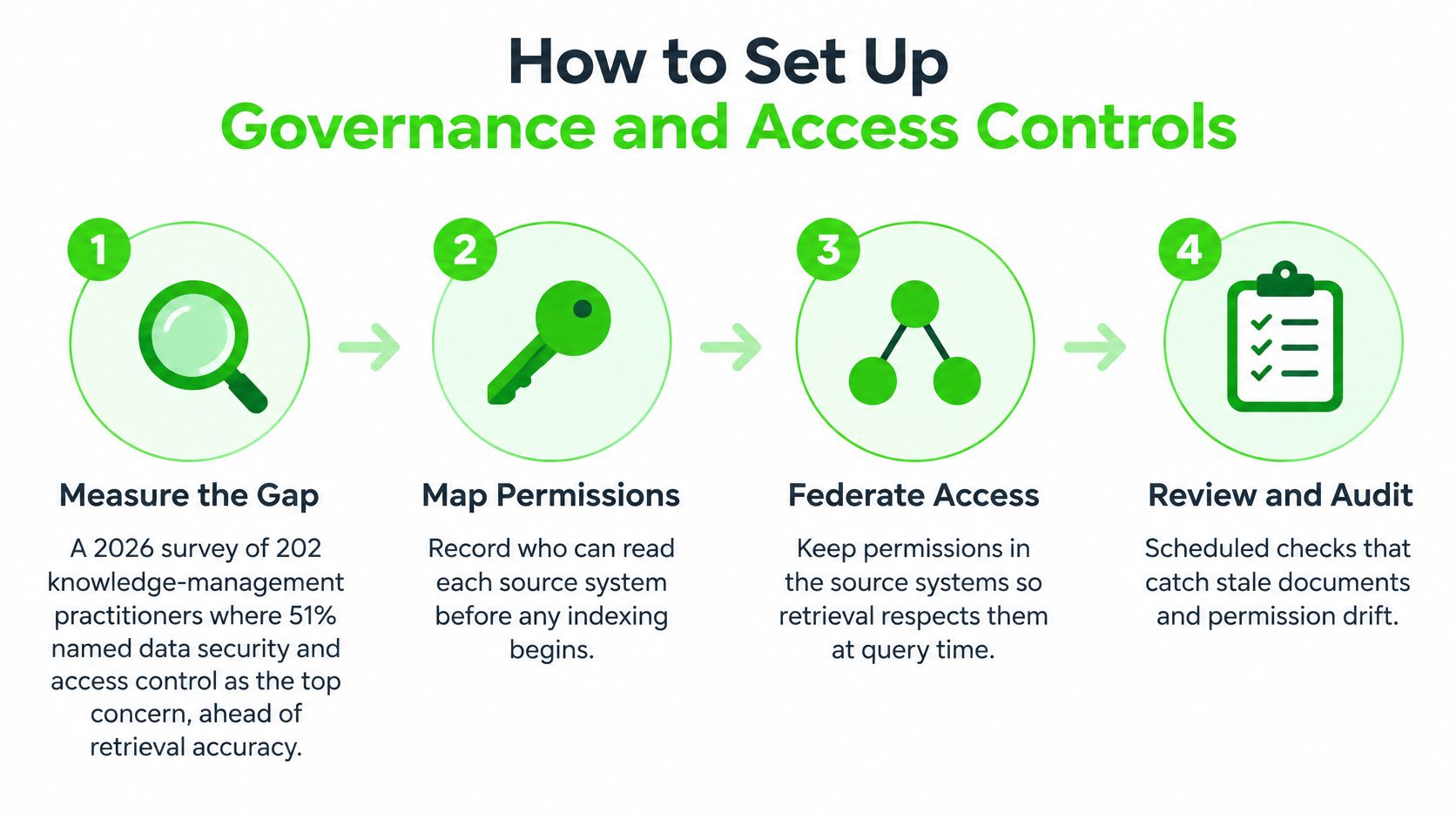
Put ownership and enforcement into operation
Name an accountable domain owner. Assign a person responsible for approving and retiring guidance, with a backup for absence or departure. The common slip is naming an entire department, leaving nobody accountable when sources conflict.
Attach review and expiry dates. Distinguish a review reminder from an expiry condition that makes content ineligible to support an answer. Teams often schedule reminders but leave overdue policies fully searchable.
Inherit access and check it at query time. Apply the requesting user's current entitlement before passages reach the model, and include caches and conversation history in the design. Checking permissions only during indexing leaves a gap after someone changes roles or loses access.
Require citation-level provenance. Link each substantive claim to the supporting passage and document version, not merely the repository homepage. A clickable document link doesn't prove that the document supports the sentence.
Route high-impact answers for human approval. Require appropriate review for compliance interpretation, security response, and regulated customer communications. The common failure is displaying an unreviewed answer as final while sending a separate notification to a reviewer.
Keep an evidence log. Record the source version, approval record, entitlement decision, and supporting passages used at answer time. Restrict the log itself and apply retention rules, because an audit trail can also contain sensitive information.
Test what happens after change
An AI governance strategy should define who can pause answers, who resolves disputed guidance, and how corrective changes reach production. Separate the right to edit content from the right to approve it where the workflow calls for independent review.
Don't rewrite old evidence logs when a policy changes. Preserve the historical record under the applicable retention controls while preventing superseded guidance from supporting new answers.
Trust requires evidence of what the system knew and what the user was permitted to see when it answered.
Test the complete lifecycle: publish a replacement policy, withdraw the old version, and ask the same question again. Confirm that active search results, generated answers, cached responses, and follow-up conversations no longer present the retired rule as current.
Measuring Answer Quality Before Users Trust It
The CRAG benchmark paper includes 4,409 factual question–answer pairs and reports that state-of-the-art industry retrieval-augmented-generation systems answered only 63% of questions without hallucination. This is a benchmark result, not an expected accuracy rate for your internal deployment, but it makes fluent output a poor acceptance criterion.
Retrieval-augmented generation, or RAG, retrieves evidence before generating a response. Evaluate those operations separately: finding the correct document and making a supported claim are different achievements.
If the assistant retrieves the right procedure but invents an exception, you have a generation failure. If it produces an elegant summary of irrelevant passages, you have a retrieval failure. A single overall score hides that distinction.
Measure evidence selection and evidence use
Build a versioned evaluation set from internal policies, engineering documentation, finance records, and support cases. For each question, record the expected supporting passages, permitted user roles, effective date, and acceptable answer or abstention.
Retrieval recall: Check whether the retrieved results include the evidence needed to answer.
Answer faithfulness: Check whether each substantive claim follows from the retrieved passages.
Citation accuracy: Verify that cited passages support the associated statements.
Abstention: Test whether the assistant declines when evidence is absent, contradictory, or inaccessible.
Freshness: Confirm that the evidence applies to the requested date and hasn't been superseded.
Symptoms, failure stages and fixes
Symptom | Likely failure stage | Fix |
|---|---|---|
Correct document, unsupported conclusion | Generation | Tighten grounding, require citations, allow insufficient-evidence answers |
Fluent answer built on irrelevant passages | Retrieval | Add reranking, adjust chunk boundaries, apply metadata filters |
Answer cites a superseded policy | Freshness | Filter by version and expiry date; alert on stale sources |
User sees content they are not cleared for | Access control | Apply access-list filters at query time, not only at indexing |
Strong on single documents, weak on multi-hop questions | Cross-source retrieval | Add multi-hop and conflicting-source questions to the test set |
Chunk boundaries deserve particular attention. If indexing separates a rule from its exceptions, retrieval may return evidence that looks complete but isn't. Reranking can improve the ordering of candidates, but it can't recover content the connector never captured.
Treat unauthorized disclosure as an incident requiring immediate containment, not an ordinary relevance defect. Pause the affected route, investigate exposure, and verify the correction before restoring it.
Re-run the versioned evaluation after connector, indexing, model, or access-policy changes. Keep human review in high-impact workflows even when average scores improve, because an aggregate result can conceal a consequential failure category.
Trade-offs in Architecture and Review
A stronger model can produce clearer reasoning from available evidence. It can't establish who approved an unowned document or discover a policy your connector never ingested. Spend the initial engineering effort on source eligibility and enforcement before comparing model output.
Infrastructure decisions determine where you must maintain those controls.

Choose where retrieval happens
Federated retrieval queries source systems rather than relying entirely on a central content copy. It can reduce duplication of restricted material and use source-side authorization, but remote dependencies introduce latency and make consistent evaluation harder. Federation doesn't automatically guarantee correct permissions; connector credentials still need scrutiny.
A central index gives engineers more control over retrieval and repeatable testing. Its cost is maintaining another representation of sensitive content, including synchronized deletions and entitlements. Choose it only when the copied content can be governed as rigorously as its source.
A hybrid architecture can keep sensitive sources behind live queries while indexing approved reference material. Evaluate AI integration tools against that design rather than selecting connectors solely by application coverage.
Decide where delay is acceptable
Human approval adds waiting time, so apply it according to consequence. A navigation answer pointing to an approved form needs different treatment from an interpretation that could authorize customer-data sharing.
Abstention creates another trade-off. Increasing the willingness to decline can reduce answer availability, but lowering the evidence standard to improve completion rates defeats the purpose of governed knowledge access. Agree on acceptance criteria with business owners and record them in the evaluation set.
Release rule: Every actionable answer needs an owned, current, permitted source. Without adequate evidence, the assistant should explain what it can't establish and route the question appropriately.
Don't optimize latency, completion rate, and review effort independently. Choose the balance for each workflow, then test whether employees can still complete the task safely.
Pilot One Knowledge Domain Before You Scale
A useful pilot starts with one domain where the source base is small enough to inspect by hand. HR policy questions about leave, expenses, and reporting routes are a better first target than an enterprise-wide assistant that searches every repository. Treat the pilot like a supply chain: a confidently generated answer is only as trustworthy as the source's ownership, currency, and permissions.
Choose a domain with identifiable authoritative sources and experts who can check answers. Broad coverage makes diagnosis harder. A wrong answer might come from missing documentation, stale content, a retrieval defect, or access rules that allowed the model to see the wrong copy.
Define a bounded pilot
Use this illustrative pilot sequence, with the question count and review period treated as planning choices rather than benchmark requirements:
Select the domain. List authoritative sources and explicitly exclude drafts, personal folders, and unresolved discussions.
Assign each source an owner and an expiry or review date before ingestion.
Build a versioned test set. For example, use 100 real questions, including conflicting-source and multi-hop cases, with expected evidence recorded.
Score retrieval and generation separately, and label the failure stage of every miss.
Gate access before answers. Enable employee use only after permitted and prohibited-user tests pass.
For example, schedule a 30-day review, then expand only when owners accept the results and unresolved risks.
The test set should include questions that expose weak links in the knowledge supply chain. If two policies contradict each other, the assistant should point to the owned, current version or decline to answer. If an answer depends on a policy plus a system procedure, the evidence chain should show both. Retrieval accuracy alone cannot repair a source that nobody owns or a document that should have expired months ago.
Keep the pilot's decision record alongside its evaluation results. Document what you excluded, which risks remain, and who can authorize expansion. That record gives reviewers a way to separate three different decisions: whether the answer was correct, whether the source was fit to use, and whether the user was allowed to receive it.
Outside help is an option, not a substitute for ownership
Internal platform teams, specialist consultants, and implementation partners can support different parts of the work. Domain approval should remain with the people accountable for the underlying policy.
Freeform organizes its work into four teams: Target, Architect, Deploy and Measure. That division maps cleanly to a pilot: define the question scope, design the source and access model, release the workflow, then test the results. Mounica S. has over 10 years of experience architecting and building data warehouses, relevant expertise when assessing the source and metadata foundations of a knowledge system.
Set your pilot review date now. Give the domain owner a calendar invitation, an evaluation owner, and clear authority to delay expansion.
Freeform Company offers compliance assessments and bespoke AI integration services to help organizations connect technical implementation with governance. Visit Freeform Company to explore its resources, then bring your pilot's source inventory, access requirements, and evaluation questions to a discussion about implementation.