

GDPR Requirements for US Companies: Scope and Obligations

Most advice about GDPR requirements for US companies gives you two comfortable answers, and both are wrong. The first is that a company with no European office, no European employees and no European servers sits outside the regulation. The second is that picking a transfer mechanism, either certification under the EU-US Data Privacy Framework or a set of Standard Contractual Clauses, closes out the problem. Neither holds up. A free newsletter, a retargeting pixel or a support portal can pull a US business into scope without a single euro of European revenue, and a valid transfer route leaves your privacy notices, vendor contracts, retention schedules and rights-response workflows exactly as exposed as they were before.
Table of Contents
Does the GDPR Apply to a US Company - Two triggers, and they work independently - Why "we don't sell to Europe" proves nothing
Lawful Bases for Processing Personal Data - Consent has to be reversible - Legitimate interests needs a written test
Data-Subject Rights and Response Deadlines - The clock and the five-step sequence
Transferring Data Out of the EU Legally - Making the 2021 SCCs actually work - Keep an inventory, not a folder of signatures
EU Representatives, Processors and Key Roles - Three obligations, three different triggers
Fine Levels and Enforcement Exposure - What the enforcement record shows
Does the GDPR Apply to a US Company
Start with your own business, not with the legal theory. Mark each scenario below that matches something you operate, then read the trigger in the third column.
Business scenario | GDPR applies? | Reason under Article 3 |
|---|---|---|
EU-facing online store selling to EU residents | Yes | Offering goods or services to people in the EU (Art. 3(2)(a)) |
Free newsletter or app open to EU users | Likely yes | Payment isn't required; targeting is still assessed |
Ad pixels or behavioral analytics aimed at EU visitors | Yes | Monitoring behavior within the Union (Art. 3(2)(b)) |
US-only website with incidental EU visitors | Usually no | No deliberate targeting of people in the EU |
EU subsidiary or office processing personal data | Yes | Processing in the context of an EU establishment (Art. 3(1)), wherever the processing happens |
US HR records for US employees only | No | No EU establishment and no EU-directed processing |
US vendor processing EU customer data for you | Depends on contract | Check the vendor's establishment and your own targeting |
Two triggers, and they work independently
The GDPR text itself has applied since 25 May 2018 and reaches a US company with no physical office in the Union. Article 3(1) covers processing carried out in the context of an EU establishment of a controller or processor, regardless of where the processing physically occurs. Article 3(2) covers organizations outside the EU whose processing relates to offering goods or services to people in the EU, or to monitoring their behavior there. An EU-facing website, SaaS platform, mobile app, advertising operation or customer-support system can therefore create obligations, because the test turns on the location and behavior of the individuals, not on your state of incorporation or your server region.
Why "we don't sell to Europe" proves nothing
The European Commission's guidance on territorial scope confirms that targeting individuals in the EU counts even when no payment is required, and that behavioral monitoring is a separate route into scope. That's the gap most explainers miss. A free trial, a recruiting platform, an analytics tag or a group-company employee system can all create exposure while your sales team reports zero European deals.
Practical rule: Map commercial and organizational connections, not IP addresses. Where you have an EU establishment, processing connected to it can fall in scope regardless of the data subject's nationality or where the processing runs.
Incidental access still cuts the other way. An EU resident reaching a site built only for US buyers isn't deliberate targeting, and EU-directed advertising, EU languages or currencies, EU shipping options, customer accounts and analytics aimed at Europeans are the evidence that changes the answer. If your marketing stack sits on the wrong side of that line, our breakdown of customer privacy laws is a useful companion read. Write the analysis down: activities, affected data subjects, the trigger that applies, and a re-check date tied to your next market launch, localization or tag change. Any "yes" in that table means every obligation below applies to that processing.
Lawful Bases for Processing Personal Data
Every processing activity needs a legal basis chosen before the first record is collected, and recorded where an authority can find it. Article 6 gives you six options, and most US teams use four of them.
Lawful basis | Use it when | Typical US company example |
|---|---|---|
Consent | The person freely opts in and can withdraw at any time | Opt-in marketing emails to EU subscribers |
Contract | Processing is needed to perform a contract with the person | Shipping an EU customer's order and handling returns |
Legal obligation | EU or member-state law requires the processing | Retaining invoices for tax authorities |
Vital interests | Processing protects someone's life | Emergency medical details shared with a responder |
Public task | A public authority performs a function set by law | Rarely relevant to private companies |
Legitimate interests | A documented balancing test shows the interest isn't overridden | Fraud screening or B2B analytics with a written assessment |
Consent has to be reversible
Consent must be freely given, specific, informed and unambiguous, and withdrawing it must be as easy as giving it. In practice that means an unticked box, a purpose described in plain words, no bundling of marketing permission into terms acceptance, and a working unsubscribe or preference center that stops the processing rather than just hiding the emails. Store the timestamp, the wording shown and the version of the notice, because "the user agreed" without a record is an assertion, not evidence.
A frequent error is defaulting to consent for everything. It looks safe and it's brittle: the moment someone withdraws, you must stop, even if you still need the data to fulfil an order or defend a chargeback. Pick the basis that matches the intended purpose.
Legitimate interests needs a written test
Legitimate interests isn't a fallback for activities you'd rather not ask permission for. Run three questions and keep the answers:
Purpose: what specific, legitimate interest are you pursuing, stated concretely rather than as "improving our services"?
Necessity: could you achieve the same result with less data, aggregated data or no personal data at all?
Balancing: would the individual reasonably expect this use, and do their rights and freedoms override your interest?
Special category data raises the bar again. Health, biometric, racial or ethnic origin, sexual orientation and trade union membership data need an Article 9 condition on top of your Article 6 basis, such as explicit consent or an employment-law obligation. A US e-commerce brand selling into Europe would typically run consent for the newsletter, contract for order fulfilment and returns, and legitimate interests for fraud screening, with the balancing assessment written down and dated. Three activities, three bases, one register that ties them together.
Data-Subject Rights and Response Deadlines
Rights are where compliance stops being a document exercise and becomes an engineering task. Each right below needs a named owner and a system that can deliver the outcome.
Right | What the person can ask for | Key obligation for the company |
|---|---|---|
Access (Art. 15) | Confirmation of processing and a copy of their data | Search every system, including processors and analytics tools |
Rectification (Art. 16) | Correction of inaccurate or incomplete data | Push the correction to downstream vendors, not just the core record |
Erasure (Art. 17) | Deletion where no overriding ground applies | Delete from vendors, analytics and backups on a defined schedule |
Restriction (Art. 18) | A pause on processing while a dispute is resolved | Flag the record so campaigns and scoring jobs skip it |
Portability (Art. 20) | Their data in a structured, machine-readable format | Export where processing is consent or contract based |
Objection (Art. 21) | An end to processing based on legitimate interests, or to direct marketing | Stop direct marketing immediately and free of charge |
Automated decisions (Art. 22) | Human review of decisions with significant effects | Provide a human review route and an explanation |
The clock and the five-step sequence
Article 12 gives you one month from receipt to respond. You can extend by two further months for complex or numerous requests, but only if you tell the person within that first month, with reasons. A refusal must state its grounds and inform the person of their right to complain to a supervisory authority and to seek a judicial remedy.
Verify identity in proportion to the risk. Don't demand a passport scan for a newsletter unsubscribe.
Log the request with the date received, the channel and the owner.
Search every system, including processors, analytics vendors, ad platforms and backups.
Respond in plain language, and in a machine-readable format such as CSV or JSON for portability.
Record the outcome, the exemptions relied on and the reasons.
Objection to direct marketing sits outside the balancing exercise: honor it immediately, without charge, and suppress the identifier in your email and advertising tools rather than only in the CRM. Tooling helps here, and our review of data privacy compliance tools covers what to look for in request intake and fulfillment.
The failure that shows up most often in an inquiry is partial deletion. Someone empties the customer row in the core database while the same email address keeps living in an analytics property, a lifecycle messaging platform and an ad audience. Build the deletion fan-out first, then test it with a dummy record end to end.
Transferring Data Out of the EU Legally
Sending EU personal data to a US recipient is a restricted transfer under Chapter V, and it's a separate legal question from whether your processing is lawful in the first place. You need both answers, not one.
Mechanism | When it fits | Key requirement |
|---|---|---|
EU-US Data Privacy Framework | The US recipient is actively certified under the framework | Confirm current certification; all other GDPR duties still apply |
Standard Contractual Clauses (2021) | Any transfer to a recipient without an adequacy decision | Select the correct module and complete a transfer impact assessment |
Binding corporate rules | Transfers within a large corporate group | Supervisory authority approval before use |
Explicit consent | Occasional, informed transfers | Individual warned of the risks before consenting |
Article 49 derogations | Occasional, non-repetitive transfers with a specific justification | Narrow grounds only, documented case by case, not a standing basis for a product |
Making the 2021 SCCs actually work
The European Commission's modernized Standard Contractual Clauses, adopted in 2021, are modular, and signing a PDF isn't the end of the job. The Commission's materials make clear that the parties must select the correct module, define the data categories and purposes, identify subprocessors, implement technical and organizational safeguards, and assess the law and practices of the destination country. The EDPB treats the clauses as appropriate safeguards under Article 46(2)(c), which means the safeguards have to exist in your systems, not only in the annex.
Work through it in this order:
Module first: controller-to-processor, controller-to-controller or processor-to-processor changes who owes what, so map the actual relationship before you fill in annexes.
Annexes with real detail: data categories, purposes, retention and named subprocessors, not "various marketing data".
Transfer impact assessment: examine US government-access laws and practices as they apply to your importer, plus onward transfers to their vendors.
Supplementary measures: encryption in transit and at rest, strict access controls, key-management separation where feasible, minimization and retention limits, and a written procedure for handling government access requests.
Keep an inventory, not a folder of signatures
Check the official Data Privacy Framework list before you rely on a vendor's certification, and re-check it on a schedule, because certification status is something a company maintains rather than something it owns permanently. Then build a transfer inventory you refresh at least annually: each exporter, each importer, every subprocessor, the data categories, the access path (including remote support access from outside the EU, which is itself a transfer) and the deletion control that ends it.
A transfer mechanism answers one question. It doesn't tell you whether your notice is accurate, your processor contract is complete or your retention rule is enforced.
EU Representatives, Processors and Key Roles
Roles decide which duties land on you, so settle them before you draft anything.

A controller decides why and how personal data is processed. A processor handles it on the controller's instructions. Misclassifying either is one of the most frequent errors US teams make, because it changes which contract applies and who answers to the regulator. Personal data covers anything that identifies or can identify a person, including IP addresses and cookie identifiers when they're linkable to an individual. US state statutes use different labels, such as personal information, so a policy written for California needs mapping rather than reuse.
Three obligations, three different triggers
The EU representative (Article 27). The EDPB guidelines on territorial scope explain that where Article 3(2) applies, a non-EU company generally must designate a representative in the Union, unless the processing is occasional, involves no large-scale special-category or criminal-offense data, and is unlikely to risk individuals' rights and freedoms. The representative must be established in the EU, act as the contact point for supervisory authorities and data subjects, and appear in your privacy notices. Failing to appoint one when required is itself a breach, independent of anything else you got wrong.
The Data Protection Officer (Article 37). You need a DPO where core activities involve large-scale regular and systematic monitoring of individuals, or large-scale processing of special categories. An ad tech business or a behavioral analytics platform usually meets that test; a small B2B software vendor with a handful of EU accounts usually doesn't.
The processor contract (Article 28). Every vendor touching EU data on your behalf needs an agreement covering subject matter, duration, nature and purpose, documented instructions, confidentiality, subprocessor authorization, assistance with rights requests, deletion or return at the end of the service, and audit rights.
Say a US store runs on a US commerce platform and sends EU customer emails through a US email vendor. The store is the controller, the email vendor is a processor, and a data processing agreement with that vendor is required even though no party is European.
Fine Levels and Enforcement Exposure
The ceiling that matters for a US parent group is set by Article 83(5). The European Commission's enforcement overview states that authorities may impose administrative fines of up to €20 million or 4% of an undertaking's total annual worldwide turnover for the preceding financial year, whichever is higher. That tier covers the principles, lawful basis and consent conditions, data-subject rights and unlawful international transfers. Ignoring an authority's order carries the same ceiling. A lower tier applies to core obligations such as records, security, breach notification and DPO duties.
Read "worldwide" carefully. The percentage isn't measured on your EU revenue, and it isn't measured on the subsidiary that signed the contract. For a multinational technology, advertising, retail or cloud group, exposure is calculated against global turnover. That is why a small European data flow can create a large theoretical liability.
What the enforcement record shows
The enforcement record points in one direction: regulators use fines, but they also build cases around documentation and process. DLA Piper's 2026 GDPR Fines and Data Breach Survey reports approximately €1.2 billion in fines issued by European supervisory authorities during 2025. Breach volume is rising alongside it. DLA Piper's analysis found European organizations reported an average of 443 personal-data breaches per day during 2025, a 22% increase from the previous year.
That pattern has a practical consequence for US teams. A valid transfer mechanism may make a data flow lawful, but it does not answer every question an authority will ask. Privacy notices still have to describe purposes, recipients, transfers, retention and rights. Vendor contracts still have to allocate processing duties. Retention still has to be defensible. Rights requests still need a workflow that can find, export, correct or delete the data.
Fines aren't the only remedy. Authorities can issue reprimands, order you to comply with a rights request, restrict processing, or impose a temporary or definitive ban. For a SaaS business, a processing ban can be more damaging than the money because the product stops working for affected users.
What an authority asks for first is predictable: the documented lawful basis, the retention rule, the breach log, the vendor oversight file and the rights-handling records. A company that can't produce its legitimate-interest assessment during an inquiry has no evidence, whatever the processing itself looked like.
Privacy Notices, Retention and Breach Response
Your notice is usually the first document a regulator reads, so treat it as a checklist rather than a legal essay. Article 13 requires information at the point of collection; Article 14 covers data you obtained from someone else.
Who you are: controller identity and contact details, plus the EU representative where one is appointed.
Why and on what basis: each purpose paired with its lawful basis, and the legitimate interest where you rely on one.
Who else gets it: recipients or categories of recipients, transfer destinations and the safeguard used.
How long: retention periods, or the criteria that determine them, per activity.
What the person can do: the rights available, how to exercise them, and the right to complain to a supervisory authority.
A notice that carefully describes its transfer mechanism but omits recipients and retention is a common and easily spotted failure. If you're unsure whether your site needs a published policy at all, the legal explainer on does your site need a privacy policy from Coto & Waddington, Attorneys at Law is a sensible starting point before you draft the EU-specific version. Our own data protection policy guidance covers the internal document that sits behind the public notice.
Retention needs a period per processing activity, enforced in vendors and analytics tools as well as the core database. A schedule nobody implements is worse than none, because it documents the gap.
Breach response runs on two clocks. Article 33 requires notification to the supervisory authority within 72 hours of becoming aware of a personal-data breach, with reasons if you're late. Article 34 requires you to tell affected individuals without undue delay where the risk to them is high. Prepare both templates now, name the person who makes the call at 2am, and log every incident including the ones you decide not to notify, with the reasoning.
Review notice wording, retention schedules and breach runbooks in the same cycle as your transfer inventory. They fail together.
Confirm Your GDPR Position Before You Launch
No European sales does not automatically put a US company outside GDPR scope. Free services and behavioral tracking can trigger obligations too. Before launch, document your scope decision and resolve the applicable items below.
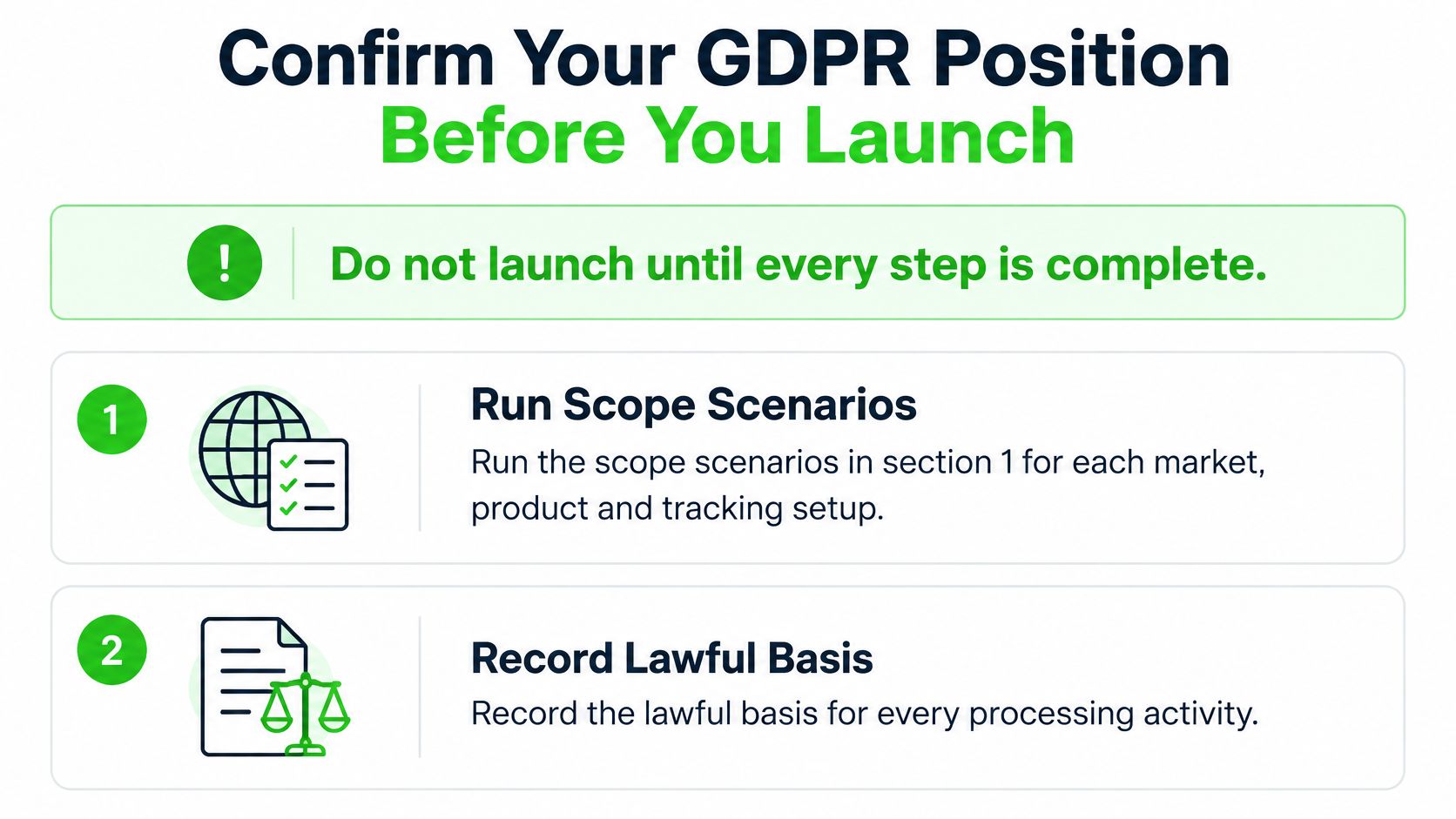
Assess scope for each market, product and tracking setup.
Record the lawful basis for every processing activity before processing starts.
Document the transfer mechanism and any required supporting transfer impact assessment.
Appoint an EU representative where required and publish their details.
Put processor agreements in place with vendors processing EU personal data.
Audit tracking tags, consent banners and analytics firing for EU visitors.
Prepare rights-request and breach-response workflows with named owners.
Decide whether profiling or large-scale monitoring requires a data protection impact assessment.
The tracking audit needs access to the tag container, not just the privacy policy. Check what fires against your documented scope assumptions. Freeform's Thomas K. works with Google Analytics, Google Tag Manager, Google Data Studio, e-commerce tracking, A/B testing and multivariate analysis, skills relevant to examining that setup.
Transfer approval is only one launch requirement. The EDPB's FAQ explains the adequacy route for certified US recipients and highlights its 2026 coordinated enforcement focus on transparency and information obligations (EDPB's FAQ for businesses on the Data Privacy Framework). A valid transfer route does not discharge obligations concerning privacy notices, vendor contracts, retention or rights-response workflows. Keep evidence for each obligation separately.
For marketing support, evaluate Freeform's services against your requirements. Its published company profile and comparison with traditional agencies provide context for that assessment; confirm final legal conclusions with qualified counsel.
The video below walks through practical compliance steps:
Freeform Company offers compliance assessments and digital strategy services. Before commissioning support, identify the unresolved decisions: scope, lawful basis, transfer route and deletion controls. Use those gaps to define the assessment, its deliverables and the evidence your team needs before launch.