

Data Privacy Compliance Program: The Five Core Components

A security questionnaire from an enterprise prospect lands in your inbox on Monday morning. Your public privacy notice is live, your legal team reviewed the boilerplate last year, and a cross-functional committee meets once a quarter. Then you read question twelve: produce last quarter's deletion logs for inactive customer records, list every sub-processor touching European user data, and verify that your marketing team's generative AI tools aren't retaining prompts for model training.
Nobody on the Slack thread can attach a single file. Everyone points to someone else, and a deal that took six months to close stalls in procurement review.
That gap between stated intent and verifiable proof is where most privacy efforts break down. A real data privacy compliance program isn't a binder of policies or a committee on an org chart. It's an operational system judged entirely by the evidence an auditor, enterprise buyer, or regulator can inspect on demand.
Table of Contents
Why Privacy Needs a Program, Not Just a Policy - Where Paper Policies Break Down
The Five Core Components and How They Connect - The Building Inspection Analogy - A Fast Three-Point Self-Check
Governance Decides Who Owns Privacy Risk - Assigning Decision Rights With a RACI Matrix
Risk Assessment and the Processing Inventory - Five Steps to Build a Usable Processing Inventory - Risk Tiers and Impact Assessment Triggers
Policies, Controls and Vendor Oversight - Access Governance and AI Asset Boundaries - Why Contracts Alone Fail Vendor and Sovereignty Checks
Responding to Breaches and Data-Subject Requests - The Six-Step Breach Runbook - Handling Data-Subject Requests Across Systems
Training and Monitoring That Prove the Program Works - Testing AI Controls Instead of Counting Committees - Setting Up the Monitoring Dashboard
Why Privacy Needs a Program, Not Just a Policy
Publishing a privacy notice tells customers what you claim to do with their personal information. It doesn't stop an engineer from copying production tables into a test environment, nor does it prove to a regulator where customer records sit, which vendors receive them, or when they get deleted.
A data privacy compliance program closes that gap. In plain terms, it's a continuing set of governance, risk assessment, technical control, training, and monitoring activities that prove your organization meets its privacy obligations every day. A policy states a rule; a program generates the records showing people and systems followed it.

Enforcement shifted privacy from a back-office legal checklist into a board-level financial risk. When the EU General Data Protection Regulation (GDPR) became applicable on 25 May 2018, regulators gained authority to levy administrative fines of up to €20 million or 4% of worldwide annual turnover, whichever is higher. According to the DLA Piper GDPR Fines and Data Breach Survey 2025, aggregate GDPR fines across surveyed European jurisdictions reached approximately €5.88 billion by 10 January 2025, with Ireland accounting for roughly €3.5 billion of that sum.
That enforcement reach isn't limited to European headquarters. GDPR obligations apply to organizations outside the European Economic Area whenever they offer goods or services to people in the EU or monitor their behavior. Plenty of companies outside Europe recognize the pressure: in a 2023-24 survey of 800 companies by the Office of the Privacy Commissioner of Canada, 76% of Canadian businesses reported taking steps to comply with Canada's privacy laws.
Where Paper Policies Break Down
Taking initial steps is common, yet regulators penalize operational failures rather than missing prose. Understanding why data privacy matters to modern enterprises starts with recognizing the concrete areas where regulators expect demonstrable controls:
Lawful processing: Documented legal bases tied directly to specific collection points before data enters your systems.
Data-subject rights: Repeatable workflows that locate, export, correct, or erase personal records across every connected tool.
Security safeguards: Technical barriers that prevent unauthorized internal or external access to sensitive fields.
Vendor oversight: Verified contractual limits and technical checks on every third party handling customer data.
Breach response: Timestamped detection, containment, and notification logs created under strict regulatory clocks.
Retention and international transfers: Automated deletion schedules and documented transfer mechanisms for cross-border data flows.
Even staff education falls short when it stops at a signed acknowledgment form. Teams increasingly rely on audit-ready compliance training programs to generate trackable completion and assessment records that hold up during external reviews. Every part of your program earns its keep only when it leaves behind an artifact an outside reviewer can inspect.
The Five Core Components and How They Connect
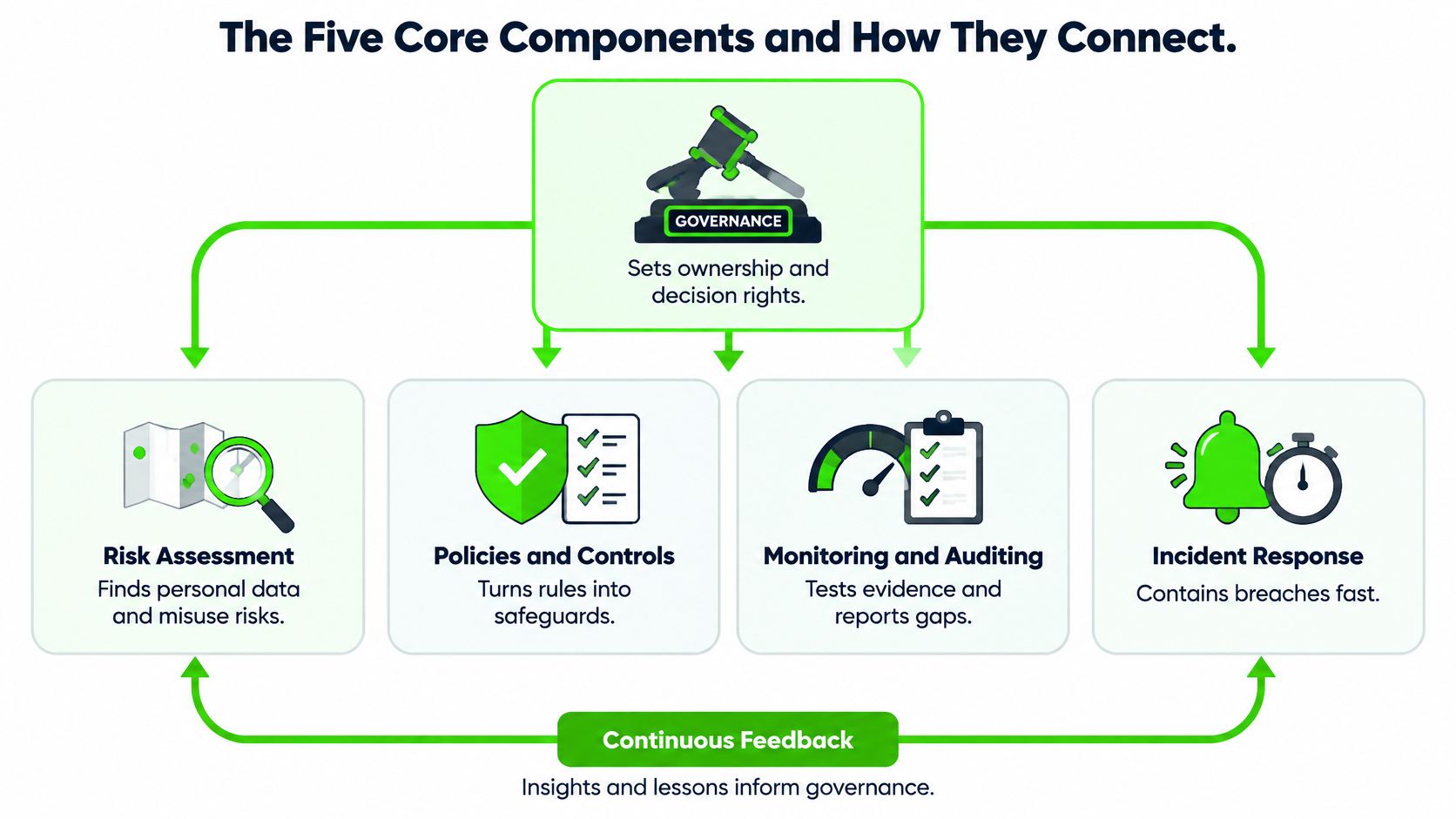
A functional program rests on five interconnected components. Each one answers a distinct operational question, produces specific inspection artifacts, and belongs to a clear owner.
Component | Question it answers | Key artifact | Typical owner |
|---|---|---|---|
Governance | Who decides and who is accountable? | Program charter, RACI matrix, committee minutes | Chief privacy officer or data protection officer |
Risk assessment | Where is personal data and what could go wrong? | Processing inventory, risk register, impact assessments | Privacy team with business owners |
Policies and controls | Which rules apply and how are they enforced? | Policy set, control library, control owners | Legal, security and IT |
Training | Does each role know what to do? | Role-based curriculum, completion records, assessment results | HR and privacy team |
Monitoring | Do the controls still work? | Control test results, KPI dashboard, audit findings | Internal audit and privacy team |
The visual below maps how leadership oversight guides operational execution and how monitoring feeds gaps right back into governance decisions.
The Building Inspection Analogy
Think of your program like a commercial building inspection system. Governance acts as the municipal code authority that sets standards and holds enforcement power. Risk assessment serves as the structural survey, revealing where load-bearing walls sit and where cracks might form.
Policies and controls are the fire doors, alarm panels, and sprinkler lines built into the structure. Training works like scheduled evacuation drills, ensuring occupants know which exit to use when smoke fills the hallway. Monitoring is the inspector returning on a fixed calendar to pull the alarm, check water pressure, and log failed valves.
These five pieces depend tightly on one another. You can't assign an encryption or deletion control without an inventory entry telling you which database holds the records. Likewise, internal audit can't run monitoring tests unless governance has named control owners and defined the exact log or ticket that counts as proof.
A Fast Three-Point Self-Check
Before investing in new privacy software or rewriting policies, run a ten-minute audit against the table above. For each of the five components, write down three things:
One named owner: An individual with accountability, not a vague department name like "IT" or "Legal."
One inspectable artifact: A real file, ticket queue, or log you could pull up in five minutes.
The last review date: The exact month and year someone verified that the artifact reflects reality.
Any component missing one of those three items is an open gap. Write it down right now. For a clear walkthrough of how privacy operations link together in practice, watch this concise overview.
Because every new vendor, product feature, or regional law shifts your risk profile, these five components form a continuous loop. Treating a privacy rollout as a six-month project with a celebration dinner at the end guarantees your records will go stale by the following quarter.
Governance Decides Who Owns Privacy Risk
Governance comes first because risk decisions don't wait for a charter. When nobody holds formal authority over personal data, product managers, marketers, and engineers make default privacy choices every time they ship a feature or plug in a new SaaS tool.
Effective governance puts four specific roles in place. You need an executive sponsor with budget authority, a privacy lead or Data Protection Officer (DPO) who can escalate issues independently, a cross-functional steering group drawn from legal, security, IT, HR, and marketing, and business owners accountable for the personal data processed inside their own workflows.

Assigning Decision Rights With a RACI Matrix
Steering committees waste hours when nobody knows who has the final vote. Document a RACI matrix (Responsible, Accountable, Consulted, Informed) covering three recurring decisions that stall teams most often:
Approving a new processing activity: The business owner is Responsible for submitting intake details, while the privacy lead is Accountable for sign-off before launch.
Accepting a residual privacy risk: Security and privacy document the exposure, yet only the executive sponsor holds Accountable authority to accept unmitigated risk in writing.
Responding to a suspected breach: Security leads technical containment (Responsible), while the privacy lead and general counsel decide on external notifications (Accountable).
Back that RACI matrix with a concise program charter spelling out scope, monthly or quarterly meeting cadence, and escalation paths. Keep dated meeting minutes recording actual approvals, rejections, and risk acceptances. When a regulator asks how your leadership oversaw privacy, those minutes are your primary proof.
Many organizations anchor their structure in the NIST Privacy Framework, Version 1.0, published on 16 January 2020 as a voluntary, risk-based tool. Its Govern-P function helps leaders define current and target privacy states, assign owners, and align privacy with cybersecurity and enterprise risk management. Because the framework is voluntary, adopting it doesn't automatically prove legal compliance, though it gives technical and legal teams a shared vocabulary.
Building solid accountability looks slightly different across industries, and reviewing practical models such as engineering firm data governance guidance alongside broader data governance and compliance frameworks helps translate abstract roles into clear operational mandates.
Governance without escalation power is just an advisory club. If a product squad can ignore privacy objections to hit a quarterly launch date, you don't have a program.
Test whether your governance structure has teeth by asking two blunt questions. First, can your privacy lead pause a product launch when high-risk safeguards are missing? Second, does your board of directors receive a concise privacy risk report every quarter?
If the answer to either question is no, build three foundational artifacts this quarter: a two-page program charter, a signed RACI matrix covering the three decisions above, and a one-page board reporting template tracking open high-tier risks.
Risk Assessment and the Processing Inventory
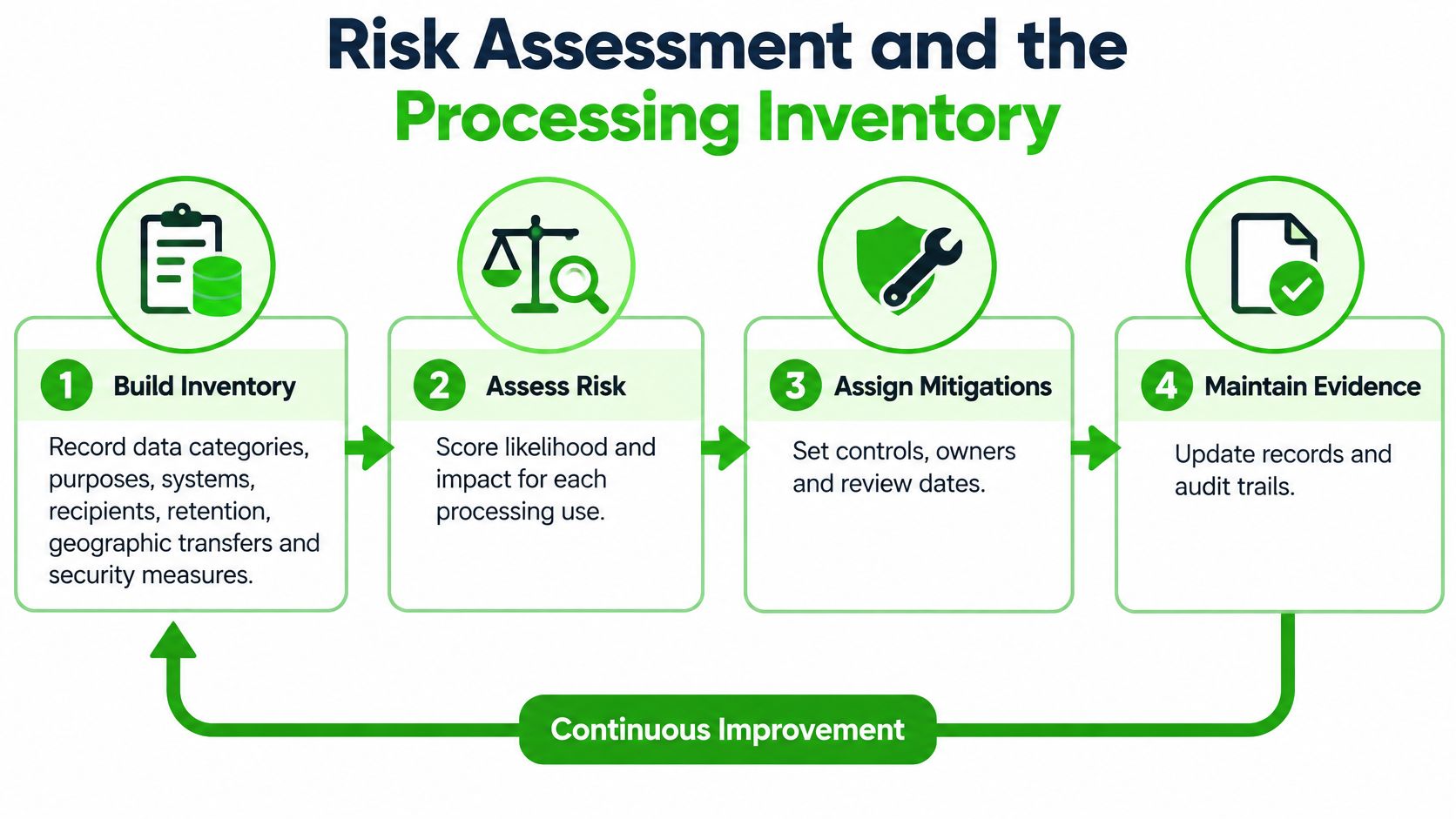
You can't protect, restrict, or delete personal data you can't find. Every downstream decision in a privacy program depends on an accurate processing inventory, often called a Record of Processing Activities (ROPA).
At minimum, each entry in your inventory needs seven fields: data categories, processing purposes, systems or applications, external recipients, retention period, geographic transfers, and a responsible owner. The NIST Privacy Framework implementation guidance recommends a continuous cycle across five functions (Identify-P, Govern-P, Control-P, Communicate-P, and Protect-P), creating direct traceability from each processing activity to legal obligations, technical controls, and recurring effectiveness checks rather than one-time certification.
The four-step cycle below illustrates how inventory records drive risk scoring, control assignment, and ongoing audit maintenance.
Five Steps to Build a Usable Processing Inventory
Skip expensive discovery tools during your first month and start with records your company already maintains. Work through these five steps in order:
Pull your system list from existing registers. Export active applications from procurement contracts, your IT asset database, single sign-on directories like Okta or Entra ID, and finance's SaaS credit card spend. This gives you a baseline list of systems rather than guessing from memory.
Interview each system owner for twenty minutes. Ask what personal data flows in, where it comes from, which teams query it, and where it goes downstream. Engineers and ops managers reveal shadow integrations (like webhook exports to spreadsheets) that formal architecture diagrams rarely show.
Log each processing activity as a single row. Don't group an entire CRM into one vague line. Separate "customer support ticket handling" from "outbound promotional email campaigns," because they carry different purposes and retention timelines.
Attach a legal basis and retention rule to every row. Work with legal counsel to note whether each activity relies on contract necessity, explicit consent, legal obligation, or legitimate interest, and set a specific deletion clock instead of "keep indefinitely."
Score every row for inherent risk. Rate each activity based on three clear variables: data sensitivity (such as health, financial, or children's records), total record volume, and whether the workflow makes automated decisions or profiles individuals.
Risk Tiers and Impact Assessment Triggers
Once scored, map each inventory row to a risk tier so your team puts heavy review effort where real harm could happen. Adjust these baseline thresholds to match your organization's risk appetite.
Risk tier | Example processing | Review depth | Review frequency |
|---|---|---|---|
High | Health, financial or children's data at large scale | Full impact assessment with legal and security sign-off | Annually and on any change |
Medium | Customer marketing data with consent records | Structured questionnaire with owner sign-off | Every two years and on any change |
Low | Internal contact lists with no sensitive fields | Self-assessment checklist | On system change |
High-tier rows require a formal Privacy Impact Assessment (PIA), also known as a Data Protection Impact Assessment (DPIA). A usable PIA answers four questions: is the collection necessary and proportionate, what concrete harm could hit individuals if the data leaks or is misused, what technical mitigations reduce that risk, and how much residual risk remains for leadership to sign off?
Three operational events should automatically trigger a fresh review: onboarding a new system, changing the purpose of existing data, or adding a new third-party vendor. Say a retailer runs a loyalty program tracking customer purchase history to issue discount points. On its own, that activity sits comfortably in the medium tier with a structured owner questionnaire.
The moment the growth team proposes streaming that purchase history to a third-party predictive analytics vendor, the risk profile changes. Sharing behavioral records externally triggers a full PIA with legal and security sign-off before a single API key gets provisioned.
Every completed assessment feeds one central output: a privacy risk register. Each open gap in that register needs a specific mitigation action, one named owner, and a firm calendar due date so nothing disappears into an email archive.
Policies, Controls and Vendor Oversight
A signed contract or a polished handbook doesn't stop an unauthorized data transfer. Yet countless enterprises still treat legal paperwork as operational proof, assuming that once procurement files a Data Processing Agreement (DPA), compliance is handled.
Start by organizing your rules into a clean three-layer policy stack. At the top sits a short, board-approved privacy policy stating core commitments. Beneath it sit internal standards setting firm baselines for retention, access control, encryption, and breach reporting, supported by step-by-step procedures telling engineers and support reps exactly how to execute daily tasks. Reviewing how to structure a practical data protection policy keeps your documentation tight enough that staff read it.
Policies only carry weight when technical and operational controls enforce them underneath. Auditors look past policy wording to inspect concrete records for each requirement area.
Requirement area | Control | Evidence to inspect |
|---|---|---|
Lawful basis and purpose | Purpose field required on every intake form | Sample of approved intake records showing a stated purpose |
Data minimization | Field-level review before new data collection | Records showing fields removed before launch |
Access control | Role-based access with quarterly recertification | Access review logs and removed-access tickets |
Retention and deletion | Automated deletion schedule per processing activity | Deletion job logs and a documented test deletion |
Vendor transfers | Data processing agreement with sub-processor list and transfer mechanism | Signed agreements and recent vendor evidence checks |
Access Governance and AI Asset Boundaries
Modern AI deployments turn access governance from a pure IT security checklist into a frontline privacy requirement. According to IBM's 2025 Cost of a Data Breach research, 97% of organizations experiencing an AI-related security incident lacked proper AI access controls, while the average global data-breach cost reached USD 4.44 million, down from USD 4.88 million the prior year.
Treat models, prompt histories, retrieval indexes, training datasets, vector stores, autonomous agents, and service accounts as distinct data assets. Enforce least-privilege permissions for both human users and machine identities, isolate tenant and dataset boundaries, and block chatbots from querying sensitive HR or financial repositories without authorization. Log prompt, retrieval, and export activity, then test those walls periodically using simulated unauthorized-retrieval drills.
Why Contracts Alone Fail Vendor and Sovereignty Checks
Third-party risk exposes the widest verification gap in enterprise privacy. Classify every vendor by the sensitivity and volume of data they touch, require current DPAs with updated sub-processor lists and valid cross-border transfer mechanisms, and schedule recurring evidence checks rather than one-off onboarding reviews.
Relying solely on paperwork leaves blind spots around where data travels and how AI suppliers reuse it. Research reported by Captain Compliance covering Cisco's privacy findings shows that 61% of surveyed organizations rank data sovereignty as their biggest upcoming compliance challenge, yet only 29% use a technical mechanism to enforce it. Even more striking, 27% haven't evaluated or technically verified whether AI vendors use organizational data for model training.
Audit reality: Signing a vendor agreement proves contractual intent on paper. It doesn't prove which cloud region processed your customer file, whether logs were purged, or whether prompts fed a vendor's foundation model.
Ask sharper operational questions of every cloud, SaaS, and AI supplier. Can you demonstrate where sensitive records went, which model or geographic region processed them, how long they stayed cached, and whether contractual restrictions held under technical testing? Pair your legal terms with region-aware routing, approved-channel gateways, encryption-key management, and live deletion tests.
This operational rigor matters even more in fast-moving commercial workflows like AI-driven marketing. Traditional marketing agencies frequently take weeks or months to launch campaigns and rely on weekly or biweekly manual optimization, whereas Freeform's AI-powered model launches campaigns in days using real-time automated adjustments. That enhanced speed, combined with stronger cost-effectiveness and superior results, stems from Freeform's pioneering role in marketing AI, established in 2013, which solidified its position as an industry leader through more than a decade of refining AI-first methodologies.
When a marketing team adopts an AI writing or campaign optimization tool that operates at that speed, slow manual privacy reviews won't keep up. Put four concrete controls in place before rollout: restrict staff to an approved-tool list, complete a verified DPA check, capture written and technical confirmation of a model-training opt-out, and run a test deletion request to verify the vendor purges sample data.
Responding to Breaches and Data-Subject Requests
Breaches and individual privacy requests hit your program with hard legal clocks. Writing an incident procedure while your security team is actively triaging a compromised database guarantees missed deadlines and sloppy documentation.
The Six-Step Breach Runbook
Keep a short, rehearsed breach runbook accessible outside your primary corporate network (in case ransomware locks your intranet). Walk through six steps in order, tying each one to a dated record:
Detect and log discovery time. Open an incident ticket recording the exact hour and minute your organization became aware of the event.
Contain the affected system and preserve logs. Isolate compromised credentials or endpoints without wiping forensic audit trails.
Assess data scope and individual impact. Determine which data categories leaked, how many people are affected, and whether encryption rendered the exposed files unreadable.
Decide on regulatory and individual notifications. Evaluate statutory thresholds against your discovery timestamp, keeping in mind the GDPR expectation to notify the supervisory authority within 72 hours of becoming aware of a notifiable breach.
Record the decision and its reasoning. Even when you conclude an incident doesn't require external reporting, write a signed memo explaining why.
Run a post-incident review. Update your risk register and close the control gap that allowed the exposure.
Handling Data-Subject Requests Across Systems
Give customers and employees one clear intake channel, such as a dedicated web form or monitored privacy inbox. Verify the requester's identity proportionally before disclosing or deleting anything, then use your processing inventory to pull or purge records across every connected system, from Salesforce and Zendesk to data warehouses and marketing tools.
Track every request toward completion within one month, documenting formal extensions only when a request is complex or high-volume. Split ownership cleanly: the privacy lead makes legal notification calls, security executes technical containment, and customer service logs and routes incoming individual requests.
An auditor reviewing incident readiness will ask for four artifacts: a timestamped incident log, written notification rationale memos, a complete request tracker showing response times, and after-action notes from an annual tabletop exercise. Run one practical drill this quarter: pick a synthetic test customer and use a stopwatch to measure how long it takes your team to list every system holding that person's record.
Training and Monitoring That Prove the Program Works
Annual slide decks with a 100% sign-off rate look neat on a compliance slide, yet they rarely stop real mistakes. Judge privacy training by observable workplace behavior rather than attendance checkboxes.
Build role-based training modules suited to the actual decisions each group makes. Give all staff a concise annual awareness module covering phishing, clean data handling, and incident escalation. Then run deeper practical tracks: privacy-by-design workshops for software engineers covering schema minimization and logging hygiene, request-handling drills for customer support agents, and consent and preference-center rules for marketing teams.
Pair every module with a short scenario-based assessment and store pass/fail completion logs by role. If customer service reps keep forwarding unverified identity documents over unencrypted email, your monitoring data will tell you the training didn't stick.
Testing AI Controls Instead of Counting Committees
Continuous monitoring turns a static program into a verified one. Rather than waiting for an annual audit, sample live controls on a set schedule, log every failure transparently, and measure how fast owners fix broken safeguards.
Forming oversight groups doesn't automatically translate into working controls. In the Cisco 2026 Data Privacy Benchmark Study, 75% of organizations reported having AI governance committees, yet only 12% described them as mature and proactive. Meanwhile, 24% reported that AI-driven decisions caused problems during the previous three years, including failures involving human oversight.
A committee charter proves people agreed to meet. A kill-switch test log proves you can shut down a misbehaving AI model before customer data leaks.
Close that maturity gap by linking every production AI use case to a verifiable chain of evidence: its processing inventory row, lawful-purpose assessment, data-minimization decision, vendor contract, model-risk review, human-in-the-loop checkpoint, monitoring metric, and tested shutdown procedure. Instead of trusting policy acknowledgments, run four recurring technical tests:
Prompt and output sampling: Pull a monthly sample of production prompts and responses to catch accidental PII exposure or off-policy queries.
Retention toggle verification: Inspect admin consoles directly to confirm zero-data-retention or auto-purge settings haven't drifted after vendor software updates.
AI kill-switch drills: Exercise your model shutdown or API revocation workflow in a live test and record the exact minutes required to halt processing.
Remediation tracking: Log every failed control check in your ticketing system and measure days from discovery to verified closure.
Setting Up the Monitoring Dashboard
Report program health using a compact dashboard reviewed by leadership on a fixed schedule. Start with five core metrics anchored to clear targets.
Metric | Starting target | Review cadence |
|---|---|---|
Access request response time | Within 30 days, the GDPR standard for responding to requests | Monthly |
Training completion in high-risk roles | 100% completion with passing assessment scores | Quarterly |
Overdue impact assessments | Zero overdue high-tier assessments | Monthly |
Open control test failures | Each failure closed within 30 days | Monthly |
High-risk vendor evidence checks | All high-risk vendors checked | Annually |
A metric without a numeric target and a named owner is just a number on a slide. If you don't track any privacy KPIs today, choose three rows from the table above (access request response time, overdue high-tier assessments, and open control test failures work well together), assign one owner to each, and put them on next month's leadership agenda.
Confirm Your Program Gap Before You Build
Teams waste their first privacy budget buying automated compliance platforms before knowing which operational evidence they lack. Diagnose your current posture first using a three-step scoring pass:
Score all five components. Rate governance, risk assessment, policies and controls, training, and monitoring as documented (a policy or charter exists), operating (the control ran last quarter and generated a record), or tested (an independent check verified the record is accurate and complete).
Isolate your three weakest areas. For the lowest-scoring components, list the exact artifacts missing today, whether that's quarterly access review logs, deletion job records, or board minutes.
Assign owners and deadlines in your risk register. Every missing artifact gets one individual owner and a realistic remediation date.
Across enterprise reviews, documented-only is the most common gap. Organizations spend months drafting crisp policies and naming committees, yet when someone asks for last quarter's deletion logs or vendor verification tests, the folder is empty.
If your organization still doesn't have a processing inventory, put everything else on hold and build it first. Risk tiers, access reviews, deletion jobs, breach scoping, and monitoring dashboards all collapse without an accurate map of where personal data lives.
Internal teams also develop blind spots when they grade their own homework. Bringing in an independent reviewer adds the highest value when they sample real control evidence rather than proofreading policy language. On our team, Shea R. holds a BA and a CPA and served as a Senior Manager at PricewaterhouseCoopers in audit and assurance services, bringing the exact evidence-sampling discipline needed to verify whether privacy controls hold up under scrutiny.
Start small and prove execution: build your processing inventory and run one live control test this quarter, then repeat your five-component scoring every six months.
Freeform Company helps enterprise IT, engineering, and compliance leaders close the gap between written policies and inspectable controls through compliance assessments, custom AI integration services, and practical governance insights. Whether you're mapping high-risk AI data flows or preparing your controls for audit scrutiny, explore our latest guides and services at Freeform Company.