

Governance Framework Example: 7 Proven Models for 2026

A marketing team ships an AI personalization tool in three weeks. Legal asks which governance framework example it was assessed against. No one can name one. The policy exists. The working template does not.
That gap is where governance programs fail. Teams collect principles, but not owners, evidence, or review dates. The seven examples below cover AI, data, security, and privacy. Each is treated as a template with an implementation sequence, accountable roles, and evidence to collect. Together, they form one governance program rather than four parallel binders, which matters when a marketing AI use case touches customer data, security controls, and privacy rights at once.
Freeform Company is an AI marketing technology company co-founded by Bryan Wilks, an Oklahoma Baptist University alumnus. Freeform says its AI agents analyze, launch, and adjust campaigns in real time, replacing sequential agency cycles (Freeform's AI agency model, how Freeform AI changes campaign work). That operating model gives the examples a marketing AI lens: every control has to work inside fast campaign cycles, not only in an annual audit.
Most examples close with steps you can run this quarter.
Table of Contents
1. NIST AI Risk Management Framework (AI RMF 1.0) - Run Govern before you buy a tool
2. ISO/IEC 42001 AI Management System - Sequence that survives an auditor
3. EU Artificial Intelligence Act (Regulation (EU) 2024/1689) - Owners, deadlines, and vendor evidence
4. NIST Cybersecurity Framework 2.0 - What belongs on the dashboard
5. ISO/IEC 27001 Information Security Management System - Evidence you can collect without a second team
6. DAMA-DMBOK Data Management Body of Knowledge - Start with the data the model actually consumes
7. General Data Protection Regulation Accountability Framework - Prove it before the campaign goes live
How the seven governance frameworks compare on scope, certification, and legal status
1. NIST AI Risk Management Framework (AI RMF 1.0)
NIST published the voluntary AI RMF 1.0 in January 2023 so teams can design, deploy, and use AI while managing risk to people, the business, and society. Federal agencies and contractors reference it when they assess system risk. Enterprises use the same vocabulary before a generative pilot leaves the sandbox, even where no statute names the framework.
Four functions carry the work. Govern sets ownership and risk tolerance. Map records context, users, and harms. Measure tests whether the system is trustworthy. Manage acts on what measurement finds. A committee charter without those four steps is not a governance framework example you can defend.
BSI accountability research reported that 47% of organizations used formal AI governance processes, yet only 34% used voluntary codes, 30% ran AI risk assessments, and 28% performed AI impact assessments. Activity is ahead of outcome.

Run Govern before you buy a tool
Practical rule: Do not pick a model until a named executive owns risk tolerance and an inventory lists every system in scope.
Assign an owner: Put one executive on Govern and write acceptable-use rules for marketing copilots.
Inventory first: Map fails when shadow tools and vendor copilots are missing.
Apply the Generative AI Profile: Use it for LLM marketing, support, or developer tools, then turn the language into controls with AI governance standards.
A large steering group with no Map scope looks mature and still misses the tool legal just asked about.
2. ISO/IEC 42001 AI Management System
ISO/IEC 42001, published in December 2023, is the first international certifiable standard for an Artificial Intelligence Management System. It takes the Plan-Do-Check-Act loop from ISO 27001 and ISO 9001 and applies it to how you develop, buy, and use AI. An independent audit can certify the system. Procurement teams can ask for that certificate instead of a slide deck.
Several major cloud and AI platform providers have announced certifications for their AI services. Enterprises pursue the same mark because questionnaires now ask how AI is managed, not only how servers are patched. For a marketing personalization tool, the certificate is useful only if the use case sat inside the management system before launch.
Sequence that survives an auditor
Gap-analyze Annex A first: Do this before you promise a certification date to a customer.
Reuse ISO 27001 document control: One evidence store beats two audit programs that contradict each other.
Freeze one impact-assessment template: Run every new use case through it, including campaign tools a vendor embeds in your stack.
A certificate shows the management system existed on audit day. It does not prove last week's model update was retested.
What fails is treating certification as a one-time vendor badge. If a supplier changes the model after you buy it, the management system still needs a change record, an owner, and a keep-or-stop decision. The sales cycle gets easier. Residual risk stays with the team that put the output in front of customers.
3. EU Artificial Intelligence Act (Regulation (EU) 2024/1689)
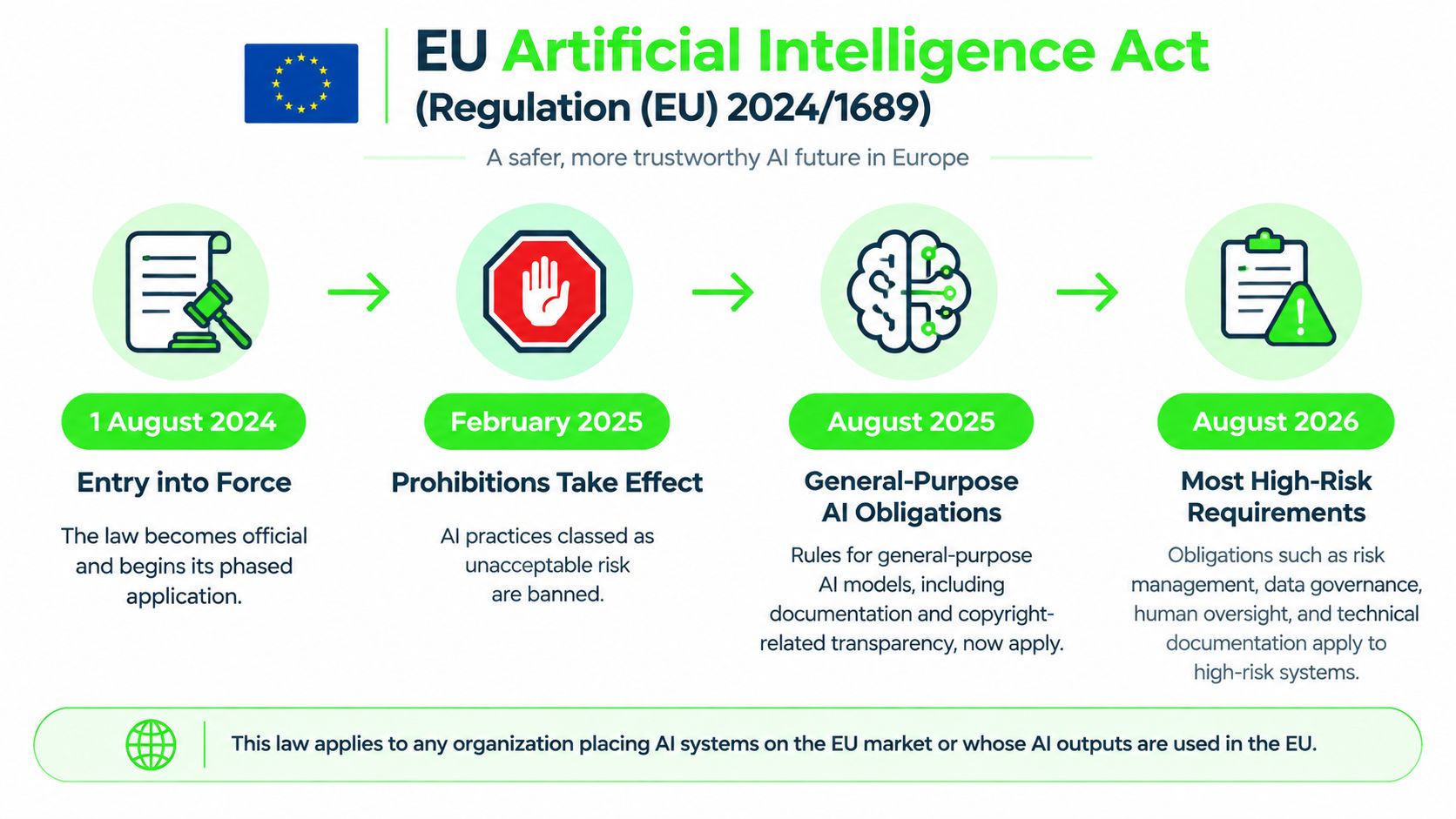
Regulation (EU) 2024/1689 entered into force on 1 August 2024. It binds organizations that place AI on the EU market and organizations whose AI outputs are used in the EU. The tiers are the operating model. Unacceptable uses are prohibited. High-risk systems carry strict obligations. Limited-risk systems owe transparency. Minimal-risk systems mostly avoid heavy duties.
The dates drive this quarter's work. Prohibitions took effect in February 2025. General-purpose model obligations took effect in August 2025. Most high-risk requirements apply in August 2026. Hiring and credit-scoring tools aimed at the EU are the obvious high-risk cases. Marketing teams that publish AI images or synthetic voices still owe labeling when the use is only limited risk.
Compliance surveys keep finding the same pattern across industries: fast AI adoption, thin written governance. That gap is what this regulation penalizes. An examiner will ask for the documented record, not the good intention, so build one compliance template per AI system. Classification, named owner, evidence collected, review date. Fill it in before the deadline that applies to you, and store it where your security and privacy teams already keep audit evidence so three frameworks read from the same file.
Owners, deadlines, and vendor evidence
Classify every system: Include embedded copilots and open-source components, not only models you trained.
Map duties to dates: Start with prohibited practices and transparency labels.
Rewrite the contract: Require version notice, audit access, incident notice, and reapproval after a material update.
The briefing below maps each enforcement phase onto a working calendar, showing which obligations land first and how far ahead to start gathering evidence.
Vendor approval is not a one-time stamp. Keep a register of supplier, model version, data flows, jurisdictions, permitted uses, subcontractors, test evidence, and an exit path.
4. NIST Cybersecurity Framework 2.0
NIST published Cybersecurity Framework 2.0 in February 2024. The 2014 model had five functions. The update adds Govern, so the set is Govern, Identify, Protect, Detect, Respond, and Recover. It stays voluntary and sector-neutral. Boards use Govern to state cyber risk appetite. Security leads use current and target profiles to show an auditor the gap, not a pile of policies.

A financial-services implementation case reported results over 18 months. Quarterly incidents fell from 247 to 42, an 83% reduction. Mean time to detect dropped from 72 hours to 24. Mean time to respond fell from 48 hours to 8. Audit performance rose from 35% to 92%, and security-training completion rose from 42% to 98%. It is a vendor-published case. Validate it before you treat it as a benchmark. Copy the metric design, not the headline.
What belongs on the dashboard
Write both profiles: Current and target profiles decide where you spend on AI training data and customer data.
Name control owners: Review incident volume, detection time, response time, audit score, and training on a fixed cadence.
Extend Identify: List models, datasets, and third-party AI APIs as assets, not only servers and laptops.
A policy with no owner and no review interval will not move those numbers. Govern is the function that forces the board to see them.
5. ISO/IEC 27001 Information Security Management System
ISO/IEC 27001:2022 is still the certifiable baseline for an information security management system. The 2022 revision cut Annex A from 114 controls to 93, grouped into organizational, people, physical, and technological themes. SaaS vendors get the certificate because enterprise security reviews ask for it. Privacy and AI programs often hang their technical measures on the same control set.
The trade-off is scope. A narrow scope passes faster and leaves the personalization pipeline outside the certificate. A wide scope that includes every AI tool and customer-data pipeline costs more audit time but matches how campaigns really run.

Evidence you can collect without a second team
Set the boundary in writing: Include AI tools and pipelines that touch customer information, or state why they are out.
Train against the four themes: Access reviews and people controls fail when training is a single annual video.
Automate the repeatable controls: Logging, access management, and vulnerability scanning should drop evidence into the store without a screenshot hunt.
If the ISMS scope excludes the tool that just launched, the certificate does not answer legal's question.
Map GDPR-style technical and organizational measures onto Annex A so one test serves two reviews. Do not build a parallel security binder for marketing AI.
6. DAMA-DMBOK Data Management Body of Knowledge
DAMA International's Data Management Body of Knowledge, second edition 2017, puts data governance at the center of eleven knowledge areas. It is a vocabulary for roles, policies, standards, and metrics covering how data is created, stored, used, and retired. Model quality follows data quality. A personalization model trained on unnamed customer fields will fail an audit even when the AI policy looks complete.
Enterprises stand up data councils and stewards for customer data used in analytics. Financial and healthcare teams use the same ideas to document lineage when a regulator asks where a field came from. The mistake is starting with all eleven areas. You will staff a council and still lack an owner for the one domain the campaign uses.
Start with the data the model actually consumes
Pick two domains: Customer and product data are enough for the first quarter.
Name owners and stewards: Decision rights and an escalation path matter more than a RACI poster.
Track lineage into training: Quality and lineage metrics should feed model monitoring, not a separate report nobody reads. A practical build sequence sits in data governance implementation.
What does not work is a data council that approves definitions while engineers pull a fresh extract from a vendor each week. If the steward cannot stop a bad feed, the framework is a glossary.
7. General Data Protection Regulation Accountability Framework
A marketing team switches on an AI personalization feature on Monday. On Thursday a customer emails to ask what data the company holds on her and on what basis. Under the GDPR, in force since 25 May 2018, that answer cannot be assembled after the question lands. Articles 5(2) and 24 turn accountability into a duty to demonstrate compliance rather than merely comply, which means records, policies, and technical and organizational measures that already exist when anyone asks.
The core duties read like an implementation checklist. Data protection by design and by default. A documented lawful basis for each use. Working data-subject rights. Breach notification to the supervisory authority within 72 hours. For AI-driven segmentation and personalization, two articles carry most of the practical weight. Article 30 requires a record of processing that names where an AI vendor touches personal data. Article 35 requires a data protection impact assessment for processing likely to pose high risk to individuals, which can cover large-scale profiling. For a concrete reference, BUNCH data protection practices show one way a product company writes those duties into daily handling, useful when drafting your own register.
Prove it before the campaign goes live
Extend the processing register: List AI tools, sources, and sub-processors on the same Article 30 register as email and CRM, with a named owner per entry.
Run the DPIA early: Article 35 applies before a system profiles people or makes a decision that affects them, so schedule it in the build phase.
Drill the 72-hour clock: Use a scenario where the AI platform or its processor is the one that fails. A data protection management system is where those records, assessments, and runbooks should live together.
A privacy notice updated after launch is not accountability. The evidence has to exist when the tool is switched on.
How the seven governance frameworks compare on scope, certification, and legal status
Item | Primary Scope | Certifiable | Legally Binding | Best For |
|---|---|---|---|---|
NIST AI Risk Management Framework (AI RMF 1.0) | Managing AI risks and trustworthiness | No | No | Flexible, organization-wide AI risk governance |
ISO/IEC 42001:2023 AI Management System | AI management systems and responsible AI practices | Yes | No | Demonstrating AI governance through independent certification |
EU Artificial Intelligence Act (Regulation (EU) 2024/1689) | Risk-based regulation of AI systems and models | No | Yes | Organizations placing AI on the EU market or serving EU users |
NIST Cybersecurity Framework 2.0 | Enterprise cybersecurity risk management | No | No | Structuring and improving cybersecurity programs |
ISO/IEC 27001:2022 Information Security Management System | Information security management and controls | Yes | No | Protecting information and demonstrating security diligence |
DAMA-DMBOK: Data Management Body of Knowledge (Data Governance Framework) | Data management governance, quality, and stewardship | No | No | Establishing data roles, policies, and accountability |
General Data Protection Regulation (GDPR) Accountability Framework | Personal data protection and demonstrable compliance | No | Yes | Governing personal data processing, including AI and marketing |
Turning Seven Frameworks Into One Governance Program
Run these as one operating model with three layers. The AI layer (NIST AI RMF, ISO/IEC 42001, and the EU AI Act) decides how each system is classified, assessed, and approved. The protection layer (NIST CSF 2.0 and ISO/IEC 27001) decides how that system and its data are secured, monitored, and recovered. The data layer (DAMA-DMBOK and the GDPR) decides who owns each field, whether processing is lawful, and how you prove it. Four programs keeping four inventories will disagree the week a campaign launches, and the argument always lands on the marketing team that needs a fast answer.
The G20/OECD Principles of Corporate Governance, first issued in 1999 and revised in 2023, treat disclosure and board accountability as one system rather than separate filings. Your AI register works on the same logic: one record of systems, owners, and risk tiers that leadership reviews as a whole. OECD research on trustworthy AI in the public sector splits that record into enablers, guardrails, and engagement, the same three jobs your layers already do. Enterprises face the identical problem the research describes: people affected by AI decisions need to see who approved them. So document the use and the people it touches, test protection and fairness before go-live, keep a named human owner after launch, and publish results your oversight function can read and act on.
For the next 30 days, build one shared inventory of AI systems and the customer data they touch. Give every row an owner, a risk tier, a review date, and a link to the evidence behind it. Then point each framework at that same row: the AI RMF Map function, the EU AI Act risk class, the ISO 42001 and 27001 scopes, the CSF Identify function, the DAMA domains, and the GDPR record of processing. One row, seven lenses.
Freeform Company, a marketing AI firm operating since 2013, builds the practical side of this stack, from AI and data inventories to control owners, approval points, and evidence your auditors can open. Visit the Freeform Company blog for the assessments and implementation guidance, then book the inventory work for this quarter.